


Attorney
You’ve spent years building a portfolio and months negotiating a complex deal, only to find your project paralyzed by a sudden disagreement. It’s a nightmare scenario: a trusted partner stops communicating, funds are frozen, and a promising Pennsylvania development sits idle while costs mount. Facing real estate litigation: joint venture and partnership disputes is more than a business hurdle; it’s a direct threat to your financial future. When you enter a venture, you expect a shared vision, not a battle. It’s unsettling to see your hard-earned capital at risk because of a breach of trust or a management deadlock.
This guide explores the common triggers for these conflicts and the legal frameworks used to resolve them in Pennsylvania. We’ll examine issues like minority freeze-outs, the role of the Pennsylvania Uniform Partnership Act, and the strategic steps you can take to protect your equity. By understanding your rights, you can move from a position of uncertainty to one of decisive action. Our goal is to provide you with the clarity needed to navigate these high-stakes challenges and safeguard your investments.
Legal Disclaimer: This article is provided for general informational and educational purposes only and is not intended to provide legal advice regarding any specific situation. Reading this article or accessing DintinoLaw.com does not create an attorney-client relationship with D’Intino Law Firm, LLC or any of its attorneys. Every legal matter is different, and readers should consult with a qualified attorney regarding their individual circumstances.
Key Takeaways
- Identify why the unique capital and management structures of Pennsylvania real estate projects make them particularly susceptible to internal legal conflicts.
- Learn how to navigate common flashpoints like capital call failures and management deadlocks through the lens of real estate litigation: joint venture and partnership disputes.
- Understand why your Operating Agreement is your primary line of defense and how “exit” clauses can provide a clear path forward during a project stalemate.
- Evaluate the practical differences between mediation, arbitration, and courtroom litigation to determine the most effective way to preserve your investment.
- Discover the value of a trial-ready legal strategy that prioritizes direct accountability and personalized attention over the generic approaches of larger firms.
Understanding Real Estate Joint Ventures and Partnership Disputes
Real estate development is rarely a solo endeavor. It requires a massive influx of capital, specialized expertise, and a high tolerance for risk. To manage these demands, investors and developers often form partnerships or joint ventures. However, the very complexity that makes these deals attractive also makes them fertile ground for real estate litigation: joint venture and partnership disputes. When millions of dollars are on the line and timelines stretch over years, even the strongest business relationships can fracture.
In Pennsylvania, the choice of entity often dictates the legal roadmap for a dispute. While some older arrangements still operate as general partnerships, most modern developers prefer the Limited Liability Company (LLC) structure. An LLC provides a shield against personal liability, but it doesn’t eliminate the internal friction that arises when partners disagree on a project’s exit strategy or funding needs. Pennsylvania law provides a default framework for these relationships through the Uniform Partnership Act and the Limited Liability Company Act, but these rules only apply if the partners haven’t drafted their own specific agreement.
The Legal Nature of a Joint Venture in PA
A Joint venture is often described as a partnership created for a single transaction or project. In Pennsylvania, courts don’t always require a formal, written contract to declare that a partnership exists. Instead, they look at the behavior of the parties involved. If you share control over decision-making, split the profits, and are equally responsible for losses, the law likely views you as partners. This “implied partnership” can be a shock to developers who thought they were merely “collaborating” without formal legal ties.
Fiduciary Duties: The Foundation of the Dispute
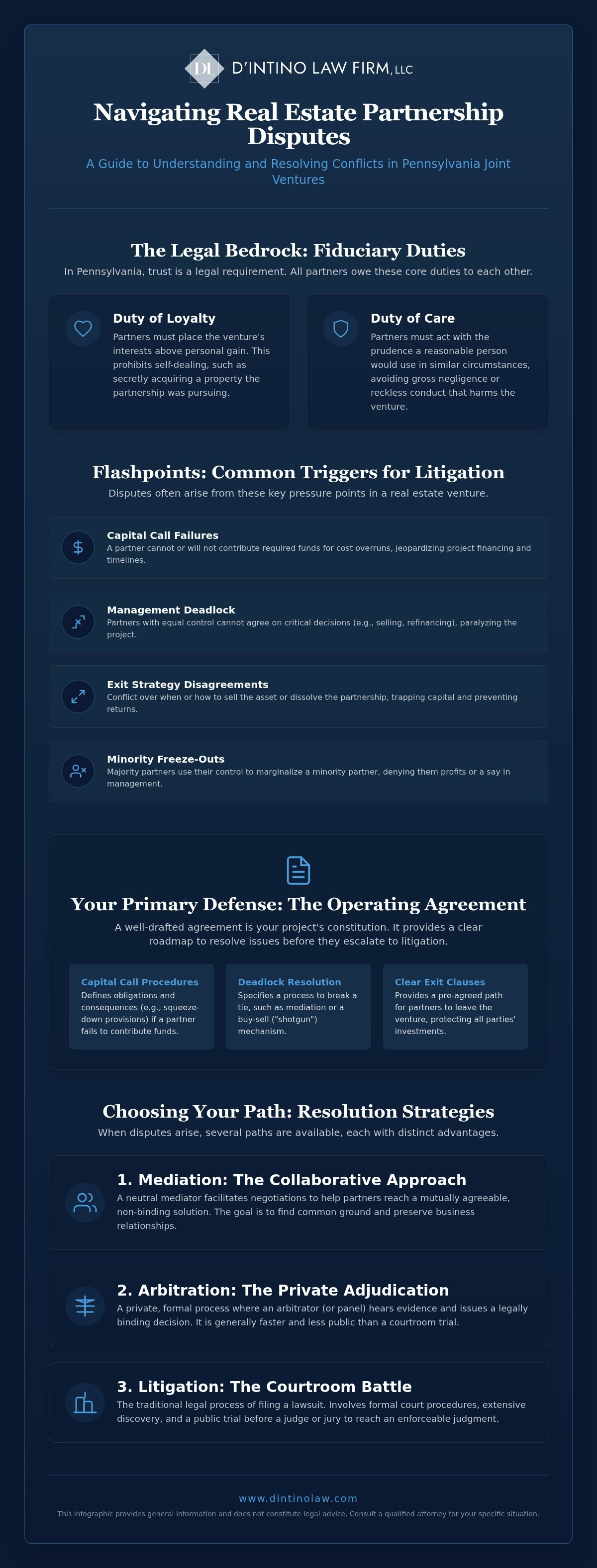
Trust isn’t just a moral concept in business; it’s a legal requirement. Partners in Pennsylvania owe each other fiduciary duties that serve as the bedrock of their professional relationship. The duty of loyalty requires each partner to put the venture’s interests ahead of their own personal gain. For example, a partner cannot secretly buy a neighboring property that the partnership was planning to develop. The duty of care requires partners to act as a reasonably prudent person would in similar circumstances, avoiding gross negligence or reckless conduct.
A breach of fiduciary duty in a real estate context occurs when one partner violates their legal obligation of honesty and loyalty, causing financial harm to the project or the other partners. When these duties are ignored, the resulting litigation can freeze a project’s progress for years.
Legal Disclaimer: This article is provided for general informational and educational purposes only and is not intended to provide legal advice regarding any specific situation. Reading this article or accessing DintinoLaw.com does not create an attorney-client relationship with D’Intino Law Firm, LLC or any of its attorneys. Every legal matter is different, and readers should consult with a qualified attorney regarding their individual circumstances.
Common Triggers for Litigation in Real Estate Partnerships
Disputes rarely appear out of nowhere. They usually simmer beneath the surface until a major financial or operational milestone forces a confrontation. In the high-stakes environment of Pennsylvania development, these triggers can quickly escalate into full-scale real estate litigation: joint venture and partnership disputes. Recognizing these early warning signs is essential for protecting your equity before a project becomes unsalvageable.
Capital Contributions and Financing Conflicts
Capital calls are often the first point of failure. Real estate projects frequently require additional cash injections to cover cost overruns or unexpected delays. If one partner cannot or will not provide their share of the funding, the entire venture is at risk. Most well-drafted agreements include squeeze-down provisions. These allow the contributing partner to increase their ownership percentage at the expense of the defaulting partner. While these provisions are standard, they are frequently the subject of intense litigation when a partner feels their equity was unfairly diluted. Disagreements also arise when partners can’t agree on whether to secure a new construction loan or refinance existing debt, especially when personal guarantees are required.
Operational and Management Deadlocks
A 50/50 ownership structure sounds fair on paper, but it’s a recipe for paralysis without a clear decision-making process. When partners reach a deadlock on major decisions, such as selling the asset, changing general contractors, or altering the project’s scope, the development can grind to a halt. In Pennsylvania, these stalemates often require court intervention unless the agreement contains a robust tie-breaker provision. If you find your project stuck in a stalemate, speaking with a dedicated advocate can help you explore options to break the deadlock and move forward.
Beyond control issues, financial mistrust often stems from specific actions that undermine the partnership’s integrity. These include:
- Self-dealing: A partner awarding lucrative subcontracts to their own side businesses without full disclosure to the group.
- Accounting Errors: Discrepancies in profit distributions or the mishandling of project funds that lead to a breach of trust.
- Conflicts of Interest: Managing multiple projects that compete for the same tenants or limited resources.
Pennsylvania law provides a four-year statute of limitations for breach of contract claims. This timeline makes it vital to address these triggers as soon as they emerge. Waiting too long can limit your ability to seek a fair resolution in court.
Legal Disclaimer: This article is provided for general informational and educational purposes only and is not intended to provide legal advice regarding any specific situation. Reading this article or accessing DintinoLaw.com does not create an attorney-client relationship with D’Intino Law Firm, LLC or any of its attorneys. Every legal matter is different, and readers should consult with a qualified attorney regarding their individual circumstances.
The Role of Operating Agreements and Governance Documents
When a project hits a wall, the Operating Agreement is the first document a litigation attorney will examine. This contract serves as the rulebook for the entire venture. It defines how decisions are made, how money is distributed, and how partners can exit the relationship. In the context of real estate litigation: joint venture and partnership disputes, a well-drafted agreement can be the difference between a swift resolution and a multi-year court battle. If your agreement is silent on a specific issue, Pennsylvania law provides default rules through the Uniform Partnership Act or the Limited Liability Company Act. These state-mandated “gap-fillers” often lead to outcomes that neither partner originally intended, which is why having a clear, written contract is vital.
Interpreting Ambiguous Contract Terms
Many disputes arise not because an agreement is missing, but because its terms are vague. Pennsylvania courts generally apply the “implied covenant of good faith and fair dealing” to business contracts. This means partners must act honestly and not intentionally undermine the deal’s purpose. However, relying on “implied” terms is a risky strategy. Handshake deals are particularly dangerous in high-value development because they lack the specificity needed to hold a partner accountable. If you’re facing a conflict over unwritten promises, consulting a Real Estate Lawyer Philadelphia can help you determine how Pennsylvania statutes apply to your specific situation.
Buy-Out and Dissolution Provisions
Exit clauses provide a roadmap for when partners can no longer work together. One common mechanism is the “Texas Shootout” or “Shotgun” clause. In this scenario, one partner offers to buy the other out at a specific price. The receiving partner then has a choice: they can either sell their interest at that price or turn around and buy out the first partner for the same amount. This forces both parties to be fair with their valuation. Other agreements use appraisal-based buyouts, where neutral third parties determine the fair market value of the interest. When a partnership is beyond repair and no exit path exists, judicial dissolution is a last resort. This involves asking a Pennsylvania court to formally end the business and oversee the liquidation of assets. During this process, unresolved ownership questions may also surface, making it important to work with a title dispute attorney Pennsylvania investors trust to clear any clouds on the deed before assets are distributed.
Dispute resolution clauses also dictate whether you’ll head to a courtroom or a private conference room. Mediation offers a chance to save the project through a facilitated negotiation, while arbitration provides a binding decision outside of the public court system. Each path has distinct advantages depending on the complexity of your real estate litigation: joint venture and partnership disputes.
Legal Disclaimer: This article is provided for general informational and educational purposes only and is not intended to provide legal advice regarding any specific situation. Reading this article or accessing DintinoLaw.com does not create an attorney-client relationship with D’Intino Law Firm, LLC or any of its attorneys. Every legal matter is different, and readers should consult with a qualified attorney regarding their individual circumstances.
Resolution Strategies: From Mediation to Courtroom Litigation
Choosing the right resolution path determines whether a project survives or collapses under the weight of legal fees. When you’re facing real estate litigation: joint venture and partnership disputes, you must evaluate if the business relationship is salvageable or if aggressive action is required to exit with your equity. The strategy you choose should reflect the urgency of the situation and the specific behaviors of your partners. In Pennsylvania, several avenues exist to break a deadlock and restore order to a development project.
Negotiation and Alternative Dispute Resolution (ADR)
Not every conflict needs a judge to reach a conclusion. Many Pennsylvania operating agreements actually mandate mediation as a required first step before a lawsuit can proceed. Mediation involves a neutral third party who helps the partners find a “business solution” that a court might not have the authority to grant. For instance, a mediator can help restructure debt or negotiate a phased buyout that keeps the project moving. If you need a Real Estate Litigation Attorney Pennsylvania to represent your interests during these sessions, early intervention often prevents a temporary disagreement from becoming a permanent failure. Arbitration is another private alternative that offers speed and confidentiality, though it typically limits your ability to appeal a decision you don’t agree with.
The Litigation Process in Pennsylvania Courts
When trust is completely broken, or a partner is actively draining assets, the courtroom is the only place to find protection. In Philadelphia and Allegheny County, complex business cases often land in specialized divisions like the Commerce Court. These courts are designed to handle commercial matters with greater efficiency than standard civil tracks. The process begins with filing a formal complaint for breach of contract or breach of fiduciary duty. During the discovery phase, your advocate will use subpoenas to uncover financial records, bank statements, and internal communications. These documents often provide the “smoking gun” evidence needed to prove mismanagement or self-dealing.
If a partner’s actions threaten the immediate value of the property, you can seek emergency injunctive relief. This is a court order that stops a partner from selling the asset or making major changes while the lawsuit is pending. In extreme cases of mismanagement, a judge may appoint a “Receiver.” This neutral professional takes over the property’s daily operations, ensuring that the bills are paid and the project stays on track while the partners resolve their legal fight. If your investment is at risk due to a partner’s misconduct, contact D’Intino Law Firm, LLC to discuss a trial-ready strategy tailored to your situation.
Legal Disclaimer: This article is provided for general informational and educational purposes only and is not intended to provide legal advice regarding any specific situation. Reading this article or accessing DintinoLaw.com does not create an attorney-client relationship with D’Intino Law Firm, LLC or any of its attorneys. Every legal matter is different, and readers should consult with a qualified attorney regarding their individual circumstances.
Protecting Your Investment Through Strategic Legal Advocacy
Success in real estate litigation: joint venture and partnership disputes isn’t just about knowing the law; it’s about being prepared to enforce it. While many developers prefer to settle out of court to keep a project moving, the most favorable settlements usually come from a position of strength. This requires a trial-ready strategy from day one. If your partner knows you are willing and able to take the matter before a judge in Pennsylvania, they are much more likely to negotiate in good faith. A reactive approach often leads to lopsided deals that further dilute your equity.
At D’Intino Law Firm, LLC, we understand that your capital and your reputation are on the line. We approach every partnership dispute with the tenacity required to protect high-stakes investments. With over 20 years of legal experience, Attorney John D’Intino Jr. provides the sophisticated advocacy needed to navigate the complexities of Pennsylvania real estate law. Choosing a seasoned advocate means your case won’t be treated as just another file in a high-volume system. Instead, you receive a strategic, tailored response designed to achieve your specific business objectives.
Direct Attorney Access and Accountability
One of the primary frustrations clients face at larger, faceless firms is the “hand-off.” You might meet a senior partner during the initial intake, only to have your complex litigation managed by a junior associate you’ve never met. D’Intino Law Firm, LLC operates differently. John D’Intino Jr. works directly on every case, ensuring that you have constant access to the lead attorney. This boutique approach provides a more elite experience where direct accountability is the standard. We bring a “fighter” mentality to every dispute, providing a fierce and uncompromising presence in the face of opposition while remaining a compassionate guide for our clients.
Preparing for Your Legal Consultation
To build a strong foundation for your case, you should begin gathering essential documentation before your first meeting. This organized approach allows for a more accurate assessment of your legal standing. Please bring the following items to your consultation:
- The original Operating Agreement or Partnership Agreement.
- Recent financial statements and tax returns for the venture.
- All relevant correspondence, including emails and texts regarding the dispute.
- Records of capital contributions and profit distributions.
It is also helpful to identify your primary goal. Whether you are looking for a fair buyout, the completion of the project, or a formal judicial dissolution, knowing your desired outcome helps us craft the right strategy. If you are ready to address your legal concerns with a dedicated professional, contact D’Intino Law Firm, LLC today to schedule a consultation.
Legal Disclaimer: This article is provided for general informational and educational purposes only and is not intended to provide legal advice regarding any specific situation. Reading this article or accessing DintinoLaw.com does not create an attorney-client relationship with D’Intino Law Firm, LLC or any of its attorneys. Every legal matter is different, and readers should consult with a qualified attorney regarding their individual circumstances.
Safeguarding Your Interests in Complex Real Estate Ventures
Real estate partnerships are built on shared goals, but they survive on clear legal boundaries. Whether you are facing a management deadlock or a breach of fiduciary duty, the path you choose today will define the future of your development. Understanding the legal triggers and the strength of your operating agreement is the first step toward resolution. Managing real estate litigation: joint venture and partnership disputes in Pennsylvania requires more than just technical knowledge; it demands a trial-ready strategy that prioritizes your individual equity.
You don’t have to navigate these high-stakes challenges alone. With over two decades of litigation experience, Attorney John D’Intino Jr. provides the trial-ready advocacy needed in Philadelphia and surrounding counties. Our boutique approach ensures you work directly with a seasoned advocate who provides personalized representation to protect your capital. Contact D’Intino Law Firm, LLC today for a consultation regarding your real estate dispute. We are here to provide the steady, expert guidance needed to restore order to your investments.
Legal Disclaimer: This article is provided for general informational and educational purposes only and is not intended to provide legal advice regarding any specific situation. Reading this article or accessing DintinoLaw.com does not create an attorney-client relationship with D’Intino Law Firm, LLC or any of its attorneys. Every legal matter is different, and readers should consult with a qualified attorney regarding their individual circumstances.
Frequently Asked Questions
What is the most common cause of real estate partnership disputes?
Disagreements over capital contributions and management control are the most frequent triggers. When a project faces cost overruns or needs a new construction loan, partners often clash over who provides the funds. These conflicts frequently escalate into real estate litigation: joint venture and partnership disputes when one party feels their equity is being unfairly diluted. Misalignment on the final exit strategy, such as when to sell the asset, also causes significant internal friction.
Can I sue my real estate partner for breach of fiduciary duty in Pennsylvania?
You can pursue a lawsuit if a partner violates their duty of loyalty or care. In Pennsylvania, partners must put the venture’s interests above their own personal gain. If a partner engages in self-dealing or gross negligence that harms the project, they may be liable for damages. Proving a breach of fiduciary duty often requires a deep dive into financial records and internal communications to show the partner acted in bad faith.
How does a “shotgun clause” work in a real estate joint venture?
A shotgun clause allows one partner to offer to purchase the other’s interest at a specific price. The partner receiving the offer then has the choice to either sell their stake at that price or buy out the offering partner for the same amount. This mechanism is designed to ensure a fair valuation. It prevents one partner from low-balling the other because they run the risk of being bought out themselves at that same low price.
What happens if my real estate partner stops contributing capital?
Failure to meet a capital call typically triggers “squeeze-down” provisions found in the Operating Agreement. These clauses allow the contributing partner to cover the shortfall and increase their ownership percentage, effectively diluting the defaulting partner’s equity. If the agreement is silent, Pennsylvania law provides default rules for resolving these imbalances. Continued failure to fund can lead to a total loss of management control or even the eventual removal of the partner from the venture.
Can a court force the sale of a property if partners cannot agree?
Pennsylvania courts have the authority to order a judicial dissolution or a partition of the property if partners are hopelessly deadlocked. If the partnership is beyond repair and no other exit path exists, a judge can appoint a receiver to oversee the sale of the asset. The proceeds are then distributed among the partners according to their ownership interests. This is usually a last resort when private negotiations have completely failed to break the stalemate.
Is mediation required before filing a real estate litigation lawsuit in PA?
Mediation is only required if it is specifically mandated in your written Operating Agreement or Partnership Agreement. However, many Pennsylvania courts encourage or even require a settlement conference before a case goes to trial. Even when it isn’t strictly mandatory, mediation offers a confidential way to find a business solution that preserves the project’s value. It’s often a faster and less expensive route than full-scale real estate litigation: joint venture and partnership disputes.
How long does a partnership dispute lawsuit typically take to resolve?
The timeline for a lawsuit depends on the complexity of the case and the court’s schedule. Simple breach of contract claims might resolve in a year; however, complex disputes involving forensic accounting can take longer. In Pennsylvania, you generally have four years to file a claim for breach of a written contract. Early intervention can lead to a faster settlement by showing the opposition you are prepared to fight for your investment.
What is the difference between a real estate joint venture and a partnership?
A joint venture is typically formed for a single, specific real estate transaction or development project. In contrast, a partnership often implies an ongoing business relationship across multiple assets. While their legal structures are similar, Pennsylvania courts often treat a joint venture as a partnership for that specific deal. Both entities require shared control and profit-sharing, and both are subject to the same fiduciary duties regardless of whether the project is a one-time flip.
If you are facing a deadlock or a breach of trust in your business relationship, reach out to D’Intino Law Firm, LLC. We provide the trial-ready advocacy and direct attorney-led representation needed to resolve complex real estate concerns in Pennsylvania. Contact us today to discuss your legal options and safeguard your capital investment. If your portfolio also includes rental properties, understanding how to work with experienced eviction lawyers for landlords can help you protect your income stream and navigate tenant disputes with the same level of legal precision.
Legal Disclaimer: This article is provided for general informational and educational purposes only and is not intended to provide legal advice regarding any specific situation. Reading this article or accessing DintinoLaw.com does not create an attorney-client relationship with D’Intino Law Firm, LLC or any of its attorneys. Every legal matter is different, and readers should consult with a qualified attorney regarding their individual circumstances.
Disclaimer
Legal Disclaimer: The information provided on DintinoLaw.com, including articles, blog posts, testimonials, case results, and other content, is for general informational and educational purposes only and does not constitute legal advice or create an attorney-client relationship with D’Intino Law Firm, LLC or any of its attorneys. Visiting this website, submitting a contact form, sending an email, calling, texting, or otherwise communicating with the firm does not establish an attorney-client relationship or obligate the firm to represent you. Do not submit confidential, privileged, or time-sensitive information through this website or electronic communications unless and until the firm has expressly agreed to represent you. Legal rights, procedures, statutes of limitation, filing deadlines, and other requirements vary based on the facts and jurisdiction and may change over time; nothing on this website should be relied upon to determine whether a legal deadline applies to your matter. If you have an urgent legal matter or a potential filing deadline, consult a qualified attorney promptly. Testimonials and statements regarding client experiences are individual opinions and experiences and are not a guarantee of future results. Prior results, verdicts, settlements, or case examples do not guarantee or predict the outcome of any future case, and every matter is different. This website may constitute attorney advertising under applicable Pennsylvania rules. D’Intino Law Firm, LLC makes no representation that the information on this website is complete, current, or applicable to your particular circumstances. For legal advice concerning your specific situation, consult directly with a qualified Pennsylvania attorney. D’Intino Law Firm, LLC | Philadelphia, Pennsylvania | DintinoLaw.com
