


Attorney
Did you know that over 106,000 eviction filings were recorded across Pennsylvania in just the last twelve months? For a property owner, these aren’t just numbers; they represent lost income, legal headaches, and the constant fear of property damage. When a tenant stops paying rent or violates their lease, the pressure to act quickly is immense. However, a single procedural error in the Pennsylvania court system can reset your timeline and cost you thousands more in lost revenue. This is why many owners seek out experienced eviction lawyers for landlords to ensure every step follows the letter of the law.
We understand that your real estate portfolio is your financial future. It’s frustrating to feel like the law favors the tenant while your mortgage and tax bills continue to pile up. This guide will teach you how to navigate the complex Pennsylvania eviction process, from serving the correct notice to managing the Philadelphia Eviction Diversion Program. You’ll learn how to choose a legal advocate who protects your investment with trial-ready strategy. We will walk through the essential stages of regaining lawful possession of your property while avoiding the dangerous pitfalls of illegal “self-help” evictions.
Legal Disclaimer: This article is provided for general informational and educational purposes only and is not intended to provide legal advice regarding any specific situation. Reading this article or accessing DintinoLaw.com does not create an attorney-client relationship with D’Intino Law Firm, LLC or any of its attorneys. Every legal matter is different, and readers should consult with a qualified attorney regarding their individual circumstances.
Key Takeaways
- Understand the legal framework of the Pennsylvania Landlord-Tenant Act of 1951 and why strict procedural compliance is the only way to secure a lawful eviction.
- Learn how experienced eviction lawyers for landlords protect your investment by managing complex court filings and countering common tenant defenses like the implied warranty of habitability.
- Discover the critical factors for selecting an attorney, including their familiarity with local Pennsylvania municipal courts and their willingness to provide trial-ready advocacy.
- Identify the specific documentation you need, such as lease amendments and detailed payment ledgers, to build a strong case before entering the courtroom.
- Explore how a boutique legal approach ensures direct attorney-client interaction and personalized strategy across Philadelphia and surrounding Pennsylvania counties.
Navigating the Pennsylvania Eviction Landscape
Pennsylvania law regarding property possession is strict and unforgiving. The Landlord-Tenant Act of 1951 governs every interaction between you and your tenant. This statute dictates exactly how a lease functions and how it must legally end. For many property owners, the process feels like a procedural minefield. This is where understanding What is Eviction? becomes a question of legal procedure rather than just a physical removal. Professional eviction lawyers for landlords act as a necessary shield. They ensure your actions remain within the law while aggressively pursuing the return of your real estate investment.
You might feel tempted to take matters into your own hands when a tenant refuses to pay. Don’t do it. In Pennsylvania, “self-help” evictions are strictly illegal. Changing the locks, shutting off water or electricity, or removing a tenant’s belongings without a court order can lead to severe legal consequences. You could face expensive lawsuits for damages and even potential criminal liability. The only lawful path to possession is through the court system. This requires a methodical approach that leaves no room for clerical or timing errors.
Understanding the Legal Grounds for Eviction in PA
To begin any legal action, you must have valid grounds under Pennsylvania law. Most cases fall into three specific categories:
- Non-payment of rent: This is the most frequent reason for filing. If a tenant fails to pay by the date specified in the lease, you can typically initiate the notice process after the grace period ends.
- Lease violations: These cases involve breaches of the contract, such as unauthorized pets, property damage, or unapproved occupants.
- Expiration of the lease term: When a lease ends and the tenant refuses to leave, they become a “holdover” tenant. You must still follow formal legal steps to remove them.
Philadelphia-Specific Requirements: The Diversion Program
If your property is in Philadelphia, the rules change significantly. The city requires landlords to participate in the Philadelphia Eviction Diversion Program for cases involving non-payment of rent. You cannot file a complaint in the Municipal Court until you’ve successfully navigated this mediation process. Local ordinances often add layers of complexity that don’t exist in Montgomery or Bucks counties. Working with a real estate lawyer Philadelphia ensures you don’t miss these hyper-local steps. Missing one requirement can result in your case being dismissed immediately, forcing you to start over and lose more rental income. Experienced eviction lawyers for landlords understand these regional nuances and keep your case on track.
Legal Disclaimer: This article is provided for general informational and educational purposes only and is not intended to provide legal advice regarding any specific situation. Reading this article or accessing DintinoLaw.com does not create an attorney-client relationship with D’Intino Law Firm, LLC or any of its attorneys. Every legal matter is different, and readers should consult with a qualified attorney regarding their individual circumstances.
The Strategic Role of an Eviction Lawyer for Landlords
An eviction isn’t just a physical removal; it’s a formal litigation process. Many property owners view it as a simple paperwork exercise, but the reality is far more complex. Professional eviction lawyers for landlords serve as strategic partners who anticipate challenges before they arise. They provide a layer of protection against aggressive tenant advocates and ensure that your case remains compliant with the Pennsylvania Landlord and Tenant Act of 1951. Without this oversight, you risk not only losing possession of your property but also facing costly counterclaims for damages.
Strategic advocacy involves more than just filing a complaint. It includes defending against common tenant tactics like the “implied warranty of habitability” defense. Tenants often claim that the property was unsafe or poorly maintained to justify non-payment of rent. Your lawyer counters these claims by presenting maintenance logs, communication records, and expert testimony. This level of preparation turns a potential loss into a structured path toward recovery. Securing your investment shouldn’t be a solo mission. You can find more information about our personalized approach at DintinoLaw.com.
Drafting and Serving the Notice to Quit
The eviction process starts with the Notice to Quit. This document must be perfect. If you use a 10-day notice for a lease violation that requires 15 or 30 days under Pennsylvania law, the court will likely dismiss your case. Proper service is equally critical. You must prove the tenant received the notice, whether through hand-delivery or posting it conspicuously on the property. Many landlords fail because they rely on informal text messages or emails that don’t meet statutory requirements. Eviction lawyers for landlords ensure that the wording and delivery of these notices are legally bulletproof, preventing delays that keep non-paying tenants in your units longer.
Representation in the Philadelphia Municipal Court
Courtrooms are high-stakes environments where rules of evidence apply strictly. During an eviction hearing, you must present a detailed ledger of all payments and a signed copy of the lease. Your attorney handles the cross-examination of the tenant and ensures your evidence is admitted correctly. It’s also vital to understand the difference between an eviction judgment and a money judgment. One gives you the keys; the other allows you to pursue back rent through collections. A seasoned advocate ensures you seek the full scope of relief available to minimize your financial losses.
Legal Disclaimer: This article is provided for general informational and educational purposes only and is not intended to provide legal advice regarding any specific situation. Reading this article or accessing DintinoLaw.com does not create an attorney-client relationship with D’Intino Law Firm, LLC or any of its attorneys. Every legal matter is different, and readers should consult with a qualified attorney regarding their individual circumstances.
How to Choose the Right Eviction Attorney in Pennsylvania
Selecting your legal representative is a decision that impacts your property’s profitability and your peace of mind. Many property owners prioritize cost, but the cheapest option often leads to the longest delays. Experienced eviction lawyers for landlords understand that time is your most valuable asset. While you can review Landlord-Tenant Law Basics to understand your general obligations, a seasoned attorney applies that law to the specific tendencies of local judges and court clerks in your county. Local familiarity ensures your filings don’t get stuck in administrative limbo because of a minor local rule variation.
Trial readiness is another non-negotiable trait. If a tenant realizes their landlord is represented by a firm that only handles “paperwork” evictions, they may be more likely to dig in their heels. When you have a lawyer who is prepared to litigate, it sends a clear message that you are committed to protecting your real estate investment. This assertive stance often leads to faster resolutions because the tenant’s counsel recognizes that you won’t be intimidated by stall tactics or meritless defenses.
Boutique Advocacy vs. High-Volume Firms
Don’t let your case become just another number in a spreadsheet. High-volume “eviction mills” often rely on junior associates or case managers to handle the bulk of the work. This approach works for simple cases, but it fails when a tenant fights back. If your situation involves complex real estate litigation in Pennsylvania, you need a hands-on advocate. A boutique firm offers direct communication with the lead attorney. This ensures that the person standing in front of the judge actually knows the nuances of your lease and the history of your tenant’s violations. Personalized attention leads to a more robust strategy and faster updates for you.
Key Questions to Ask During a Consultation
Preparation is the hallmark of a successful legal strategy. When you meet with potential eviction lawyers for landlords, ask targeted questions to gauge their expertise:
- How many landlord-tenant cases have you handled in this specific Pennsylvania county?
- What is your strategy if the tenant files a counterclaim for repairs or habitability?
- Will I be working directly with you or will my case be handed off to a junior associate?
- How often will I receive updates on the status of my filing?
A seasoned advocate will provide clear, direct answers rather than vague promises. They should be able to outline a path toward resolution while acknowledging the specific hurdles present in the local Pennsylvania court system.
Legal Disclaimer: This article is provided for general informational and educational purposes only and is not intended to provide legal advice regarding any specific situation. Reading this article or accessing DintinoLaw.com does not create an attorney-client relationship with D’Intino Law Firm, LLC or any of its attorneys. Every legal matter is different, and readers should consult with a qualified attorney regarding their individual circumstances.
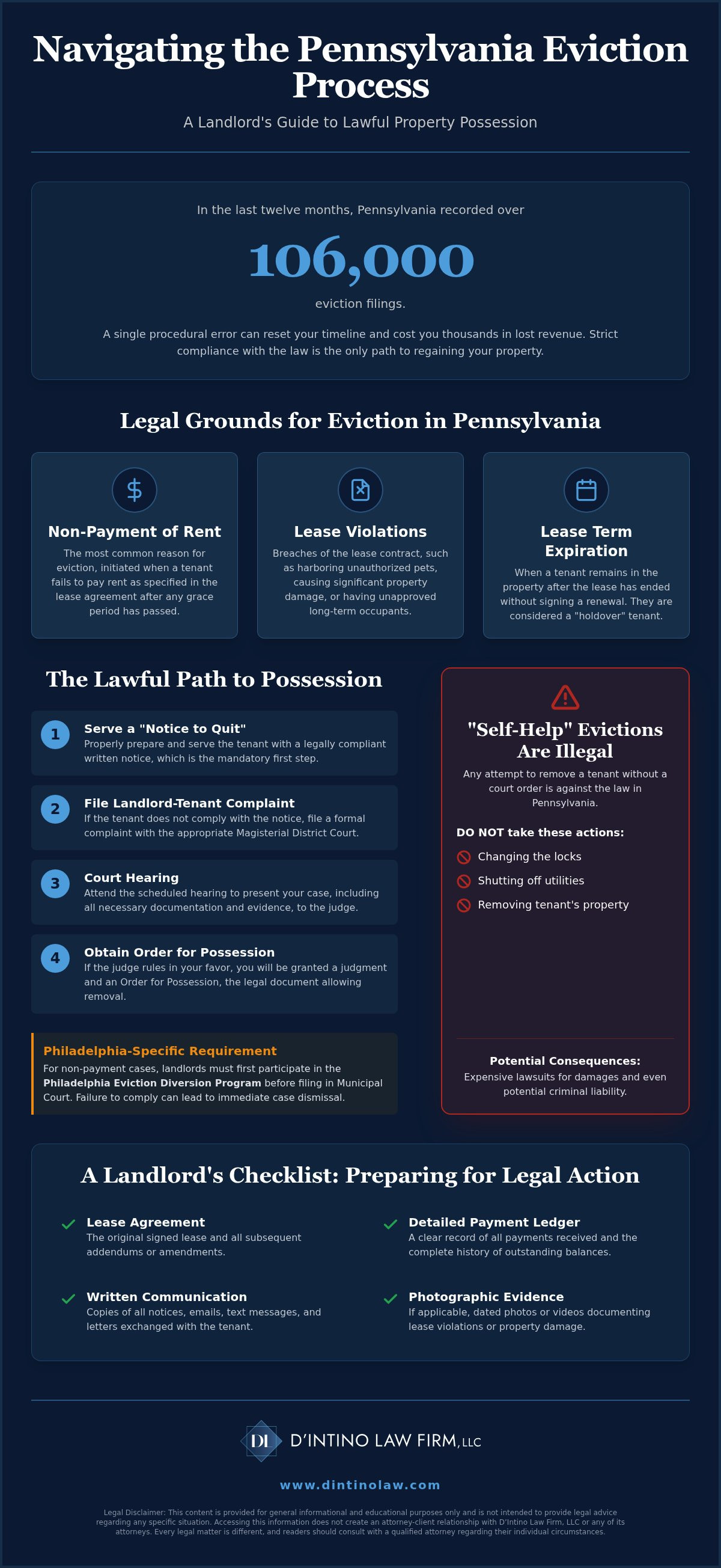
A Landlord’s Checklist: Preparing for Legal Action
A successful eviction case is built on a foundation of solid evidence. Pennsylvania judges require clear, documented proof of a lease violation or non-payment before they will grant a judgment for possession. When you work with eviction lawyers for landlords, your first task is providing the paper trail that justifies your legal action. This starts with the original written lease agreement and every subsequent amendment or renewal. If you don’t have a written lease, the process becomes significantly more complex, though not impossible, as the court must then determine the terms of an oral agreement.
Beyond the contract, you must compile a detailed ledger of all financial transactions. This should include every payment received, late fees assessed according to the lease terms, and the current outstanding balance. Vague claims of “he owes me three months” won’t hold up in a Philadelphia Municipal Court hearing. You need a line-item breakdown. Additionally, gather any photos or inspection reports that document the property’s condition, especially if the eviction is based on property damage or unauthorized alterations.
The Documentation Trail
A clear rent ledger is the most critical piece of evidence in a non-payment case. It must show the date each payment was due and the date it was actually received. If you have served any notices to quit, keep the originals or high-quality copies, along with proof of service. For properties with multiple owners or corporate structures, you may also need to provide joint venture and partnership dispute documents to prove your authority to act on behalf of the entity. Organizing these files now prevents costly delays once the litigation begins and helps eviction lawyers for landlords build a stronger case from day one.
Maintaining Professionalism During the Process
Legal proceedings are emotionally draining, but maintaining a professional distance is vital. Avoid all direct conflict with your tenant once you have initiated legal action. Any aggressive behavior, heated arguments, or threats can be used against you in court as evidence of “retaliatory eviction.” You must also continue to provide essential services like heat, water, and electricity. Cutting off utilities constitutes an illegal self-help eviction in Pennsylvania, regardless of how much rent is owed. Your attorney serves as the professional buffer between you and the tenant. By funneling all communication through legal counsel, you protect yourself from making statements that could harm your case. If you’re ready to organize your evidence and move forward, contact D’Intino Law Firm, LLC for a strategic review of your situation.
Legal Disclaimer: This article is provided for general informational and educational purposes only and is not intended to provide legal advice regarding any specific situation. Reading this article or accessing DintinoLaw.com does not create an attorney-client relationship with D’Intino Law Firm, LLC or any of its attorneys. Every legal matter is different, and readers should consult with a qualified attorney regarding their individual circumstances.
Strategic Real Estate Advocacy with D’Intino Law Firm, LLC
Regaining possession of your property is a high-stakes endeavor. You need a legal partner who views your real estate as more than just a file number on a desk. D’Intino Law Firm, LLC provides that level of dedicated advocacy. Attorney John D’Intino Jr. brings over two decades of experience to every dispute. He handles cases personally, ensuring that landlords in Philadelphia, Media, West Chester, and surrounding Pennsylvania counties receive elite representation. This direct involvement is what sets us apart from high-volume firms that prioritize quantity over quality. We focus on results that protect your long-term financial health.
Our firm understands the stress that comes with a non-paying or destructive tenant. The law in Pennsylvania is complex, but it shouldn’t be a barrier to your success. By choosing experienced eviction lawyers for landlords, you gain a strategic advantage in the courtroom. We don’t just file paperwork; we build a comprehensive case designed to withstand aggressive tenant defenses. Our commitment to personalized service means you always have direct access to your attorney. You won’t be handed off to a junior associate who isn’t familiar with the specifics of your property or your lease terms.
Personalized Attention for Every Property Owner
When you hire eviction lawyers for landlords, you expect to speak with the person actually handling your case. At many firms, your file is processed by a case manager. We don’t operate that way. John D’Intino Jr. manages every aspect of your litigation personally. Whether you’re an individual landlord with a single-family home or a commercial owner with a large portfolio, your strategy is tailored to your specific goals. We focus on the nuances of your lease and the history of your tenant’s violations. This boutique approach allows for constant availability and responsive communication. These are essential tools when your rental income is on the line.
Trial-Ready Representation in Pennsylvania
An eviction case can change direction in an instant. If a tenant hires an aggressive advocate or files a complex counterclaim, your lawyer must be prepared to step into the courtroom. John D’Intino Jr. is a seasoned litigator who is always trial-ready. We protect your rights from the initial filing through the final judgment for possession. We don’t shy away from difficult cases or complex legal hurdles. Instead, we use our deep knowledge of the Pennsylvania Landlord-Tenant Act to build a strategic offensive. Our goal is to minimize your financial loss and resolve the dispute through methodical action.
If you’re facing a difficult tenant or need to start the legal process to protect your investment, we’re ready to help. Beyond eviction matters, property owners should also be aware that unresolved ownership issues can complicate any real estate transaction — working with a title dispute attorney Pennsylvania property owners trust can help clear clouds on your deed before they become costly obstacles. We invite you to contact D’Intino Law Firm, LLC to discuss your property concerns and explore your legal options in Pennsylvania.
Legal Disclaimer: This article is provided for general informational and educational purposes only and is not intended to provide legal advice regarding any specific situation. Reading this article or accessing DintinoLaw.com does not create an attorney-client relationship with D’Intino Law Firm, LLC or any of its attorneys. Every legal matter is different, and readers should consult with a qualified attorney regarding their individual circumstances.
Secure Your Property and Financial Future
Navigating the Pennsylvania court system requires meticulous attention to detail and a proactive strategy. By maintaining a clean documentation trail and adhering to the Landlord-Tenant Act of 1951, you position yourself for a successful recovery of your property. Professional eviction lawyers for landlords provide the procedural precision needed to avoid costly court delays or dismissals.
D’Intino Law Firm, LLC offers the personalized service that high-volume firms cannot match. With over 20 years of experience, John D’Intino Jr. provides direct attorney access to property owners across Pennsylvania. You’ll work with a trial-ready advocate who is invested in your success. Don’t let a difficult tenant jeopardize your investment. Contact D’Intino Law Firm, LLC today for a free consultation regarding your landlord-tenant concerns. We’re ready to help you regain control.
Legal Disclaimer: This article is provided for general informational and educational purposes only and is not intended to provide legal advice regarding any specific situation. Reading this article or accessing DintinoLaw.com does not create an attorney-client relationship with D’Intino Law Firm, LLC or any of its attorneys. Every legal matter is different, and readers should consult with a qualified attorney regarding their individual circumstances.
Frequently Asked Questions
How long does the eviction process typically take in Pennsylvania?
The eviction process in Pennsylvania typically takes between three and six weeks from the initial notice to the physical lockout. This timeline depends on the reason for the eviction and the specific county where the property is located. After the notice period expires, you must file a complaint and attend a hearing. If you win, the tenant has ten days to appeal before you can request an order of possession for the sheriff to enforce.
Can I evict a tenant in Philadelphia without a lawyer?
While individual landlords can technically represent themselves in Pennsylvania, corporations and other business entities are usually required to have legal representation in court. Navigating the procedural requirements alone is difficult, and a single mistake can lead to your case being dismissed. Many property owners choose to hire eviction lawyers for landlords to ensure all filings are accurate and to avoid the financial loss associated with starting the process over.
What is the Philadelphia Eviction Diversion Program?
The Philadelphia Eviction Diversion Program is a mandatory mediation process designed to resolve non-payment of rent disputes before they reach the courtroom. In Philadelphia, you cannot file an eviction complaint for non-payment until you’ve participated in this program for at least 30 days. It aims to create a payment plan or a graceful exit strategy for the tenant, potentially saving both parties the time and expense of a full trial.
What happens if a tenant files for bankruptcy during the eviction?
If a tenant files for bankruptcy during an eviction in Pennsylvania, an “automatic stay” is immediately triggered, which pauses all state court proceedings. You cannot continue the eviction or even contact the tenant regarding the debt without permission from the federal bankruptcy court. To proceed, your attorney must file a motion for “relief from stay.” This is a complex legal hurdle that requires specific filings in the appropriate federal jurisdiction.
Can I recover back rent and attorney fees from the tenant?
You can recover back rent and attorney fees in Pennsylvania if your written lease agreement specifically includes provisions for these costs. When you win your case, the judge may grant a money judgment in addition to the judgment for possession. While obtaining the judgment is the first step, collecting the actual funds may require further legal action, such as wage garnishment or bank account attachments, depending on the tenant’s financial situation.
What is a “Notice to Quit” and is it always required in PA?
A “Notice to Quit” is the formal written warning that informs a tenant they must vacate the property within a specific timeframe. In Pennsylvania, the required period is usually 10 days for non-payment of rent and 15 or 30 days for lease violations or lease expirations. However, many Pennsylvania leases contain a “waiver of notice” clause. If this clause is present and valid, you might be able to file for eviction without serving a notice first.
What should I do if a tenant refuses to leave after a court order?
If a tenant refuses to leave after you’ve obtained a court judgment in Pennsylvania, you must request an “Order for Possession” from the court. This order authorizes a sheriff or constable to physically remove the tenant and their belongings from the property. You are strictly prohibited from attempting to remove the tenant yourself. The lockout must be performed by the authorized official to ensure the process remains legal and avoids potential liability.
Can I evict a tenant for property damage if they are current on rent?
Yes, you can evict a tenant for property damage in Pennsylvania even if they are current on their rent payments. Significant damage to the unit is considered a material breach of the lease agreement. You must follow the standard legal process, which involves serving a notice for a lease violation and proving the extent of the damage during the court hearing. Eviction lawyers for landlords can help you gather the necessary evidence, such as inspection reports and photos.
Legal Disclaimer: This article is provided for general informational and educational purposes only and is not intended to provide legal advice regarding any specific situation. Reading this article or accessing DintinoLaw.com does not create an attorney-client relationship with D’Intino Law Firm, LLC or any of its attorneys. Every legal matter is different, and readers should consult with a qualified attorney regarding their individual circumstances.
Disclaimer
Legal Disclaimer: The information provided on DintinoLaw.com, including articles, blog posts, testimonials, case results, and other content, is for general informational and educational purposes only and does not constitute legal advice or create an attorney-client relationship with D’Intino Law Firm, LLC or any of its attorneys. Visiting this website, submitting a contact form, sending an email, calling, texting, or otherwise communicating with the firm does not establish an attorney-client relationship or obligate the firm to represent you. Do not submit confidential, privileged, or time-sensitive information through this website or electronic communications unless and until the firm has expressly agreed to represent you. Legal rights, procedures, statutes of limitation, filing deadlines, and other requirements vary based on the facts and jurisdiction and may change over time; nothing on this website should be relied upon to determine whether a legal deadline applies to your matter. If you have an urgent legal matter or a potential filing deadline, consult a qualified attorney promptly. Testimonials and statements regarding client experiences are individual opinions and experiences and are not a guarantee of future results. Prior results, verdicts, settlements, or case examples do not guarantee or predict the outcome of any future case, and every matter is different. This website may constitute attorney advertising under applicable Pennsylvania rules. D’Intino Law Firm, LLC makes no representation that the information on this website is complete, current, or applicable to your particular circumstances. For legal advice concerning your specific situation, consult directly with a qualified Pennsylvania attorney. D’Intino Law Firm, LLC | Philadelphia, Pennsylvania | DintinoLaw.com
