


Attorney
Imagine you’re days away from closing on your home in Philadelphia when a title search unearths a “cloud” on your deed from decades ago. Suddenly, the sale is stalled, and your financial security feels like it’s hanging by a thread. It’s an exhausting reality for many property owners who discover that their ownership rights aren’t as clear as they once believed. You’ve invested years into your home, and the fear of losing a sale or facing a boundary battle is completely valid. Understanding the complexities of local property law is the first step toward reclaiming your peace of mind. Working with a dedicated title dispute attorney Pennsylvania homeowners can rely on ensures that these legal hurdles don’t become permanent roadblocks to your success.
In this guide, you’ll learn how to identify common title defects and the specific legal actions required to resolve them under Pennsylvania law. We’ll break down everything from Quiet Title actions to the impact of the new Act 29 of 2026, which requires owners of non-owner-occupied properties to provide updated contact information to the county starting September 18, 2026. By following this roadmap, you can address disputes head-on, protect your financial investment, and secure the “clean” title you deserve. We’ll explore the methodical verification process and legal corrections necessary to move your property transaction forward with total confidence.
Key Takeaways
- Understand what constitutes a “clouded title” in Pennsylvania and how these hidden defects can unexpectedly halt property sales or refinancing.
- Identify common encumbrances like undiscovered liens, boundary disputes, and easement conflicts that frequently threaten property ownership rights.
- Learn the difference between simple curative deeds for minor errors and formal Quiet Title actions required for complex legal challenges.
- Follow a methodical step-by-step process for gathering documents and reviewing title reports to verify your legal standing and ownership history.
- Recognize why partnering with a title dispute attorney Pennsylvania residents trust is vital for protecting your financial investment against aggressive claims.
What is a Title Dispute in Pennsylvania?
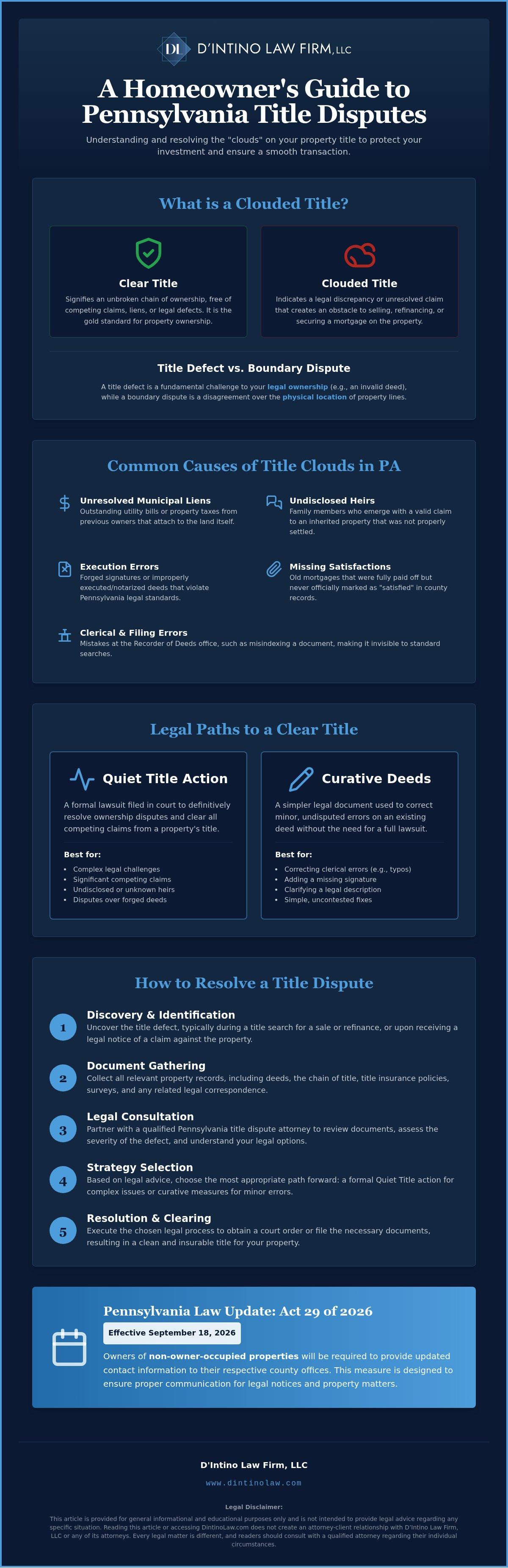
A property title represents your legal bundle of rights to own, use, and transfer a specific piece of land. In Pennsylvania, maintaining a “clear” title is the gold standard of homeownership. It signifies that the history of the property, often called the chain of title, is unbroken and free of competing claims. When a discrepancy appears, it creates what lawyers call a “clouded title.” This cloud acts as a legal obstacle that prevents you from selling your home or securing a mortgage. Resolving these complex ownership hurdles often begins with a formal Quiet title action, a legal process designed to clarify who truly owns the land. When these clouds appear, consulting a title dispute attorney Pennsylvania homeowners rely on is the most effective way to clear the path forward.
People often confuse physical boundary disputes with legal title defects. A boundary dispute typically involves a disagreement over the exact location of a fence or driveway. A title defect is different. It’s a fundamental challenge to your ownership status. For example, if a previous owner’s spouse never signed the deed, your legal right to the property is technically incomplete. Pennsylvania courts require these defects to be cured before a title insurance company will issue a “clean” policy to a future buyer. This isn’t just a minor technicality; it’s a direct threat to your financial investment.
Common Causes of Title Clouds in PA
Title issues rarely happen by accident; they’re usually the result of historical oversight or clerical mistakes. Clerical errors at the local Recorder of Deeds office can misindex a document, making it invisible during a standard search until it’s too late. Other common causes include:
- Unresolved municipal liens: Utility claims or property taxes left behind by previous owners that attach to the land itself.
- Undisclosed heirs: Family members who emerge years later to claim an interest in an inherited estate that wasn’t settled properly.
- Execution errors: Forged or improperly executed deeds that weren’t notarized correctly according to Pennsylvania standards.
- Missing satisfactions: Old mortgages that were paid off but never formally marked as satisfied in the county records.
How Title Disputes Surface
Most homeowners don’t know they have a title problem until they try to do something with the property. A title search conducted during a home sale or refinancing is the most common trigger for discovery. You might also receive a surprise notice of a lien or a foreclosure action stemming from a debt you didn’t even know existed. In some cases, a neighbor’s new survey might reveal that a structure on your land actually belongs to them, sparking a conflict that requires legal resolution. These situations are high-stakes and demand a methodical response to ensure your ownership rights remain intact. Partnering with a title dispute attorney Pennsylvania families trust can help you navigate these sudden challenges with strategic clarity.
Legal Disclaimer: This article is provided for general informational and educational purposes only and is not intended to provide legal advice regarding any specific situation. Reading this article or accessing DintinoLaw.com does not create an attorney-client relationship with D’Intino Law Firm, LLC or any of its attorneys. Every legal matter is different, and readers should consult with a qualified attorney regarding their individual circumstances.
Types of Real Estate Title Issues for PA Homeowners
Title issues in Pennsylvania aren’t always discovered through a dramatic court filing. Often, they hide in the fine print of historical records, waiting to surface at the worst possible moment. Understanding the specific nature of your hurdle is the first step toward clearing it. While some problems require a formal lawsuit to determine ownership of real property, others might be resolved through simpler administrative fixes. Identifying the right path early saves time and protects your equity. When you’re stuck in a complex web of conflicting records, a title dispute attorney Pennsylvania residents trust can provide the strategic direction needed to resolve the matter decisively.
In many older Pennsylvania neighborhoods, easement disputes are incredibly common. These involve rights of way for shared driveways or utility access that were established decades ago but never clearly documented. Similarly, boundary and encroachment issues arise when a neighbor’s fence or garage sits over your property line. While these might seem like minor neighborly disagreements, they are legal defects that “cloud” your title. Another frequent issue is a gap in the chain of title. This occurs when a deed was never recorded during a past transfer, leaving a missing link in the ownership history that spans years or even generations.
Liens and Financial Encumbrances
Financial claims against a property can halt a sale or refinancing instantly. Mechanic’s liens are a common headache, filed by contractors who claim they weren’t paid for work performed on the home. These liens “attach” to the title, meaning the debt follows the property rather than the individual owner. Federal and state tax liens operate similarly, often appearing unexpectedly during a title search. Judgment liens from past court cases against former owners can also linger in the public record. Because these encumbrances prioritize the creditor’s right to payment, they must be satisfied or legally removed before a clear transfer can occur.
Deed and Ownership Defects
Deed errors are often the result of simple human oversight. An incorrect legal description might accidentally include a portion of a neighbor’s lot or exclude a piece of your own. More serious issues involve deeds signed by individuals who lacked the legal authority to sell, such as a single heir selling a property without the consent of other siblings. You may also encounter “wild deeds,” which are documents recorded outside the logical chain of title. These defects create significant risk for buyers and lenders alike. If you’re facing a complex deed conflict, speaking with an experienced real estate professional can help you decide if a curative deed or a formal Quiet Title action is the best response.
Legal Disclaimer: This article is provided for general informational and educational purposes only and is not intended to provide legal advice regarding any specific situation. Reading this article or accessing DintinoLaw.com does not create an attorney-client relationship with D’Intino Law Firm, LLC or any of its attorneys. Every legal matter is different, and readers should consult with a qualified attorney regarding their individual circumstances.
Quiet Title Actions vs. Curative Deeds
Resolving a title defect doesn’t always mean a trip to the courthouse. Sometimes, a simple administrative correction is enough to clear your path. Other times, you need a firm, “fighter” mentality to defend your ownership against aggressive claimants. Deciding between a curative deed and a formal Quiet Title action is a strategic choice. A title dispute attorney Pennsylvania families rely on can assess the strength of your position and determine if litigation or negotiation offers the best protection for your investment. While curative measures are faster, they require cooperation from other parties that isn’t always available.
The Quiet Title Process in Pennsylvania
If the cloud on your title is a fundamental ownership conflict, you must file a Quiet Title action in the Pennsylvania Court of Common Pleas. This lawsuit is the primary way to legally extinguish competing interests. You’ll file the complaint in the county where the property is located, such as Philadelphia or Montgomery County. The law requires you to notify all “interested parties,” which may include long-lost heirs or defunct corporations. If these parties don’t respond to the notice, the court can grant a default judgment that effectively wipes the slate clean. A dedicated title dispute attorney Pennsylvania residents trust ensures every procedural requirement is met, from service of process to the final recording of the court’s decree.
Negotiated Settlements and Corrective Documents
For minor errors, a curative deed is often the faster, more cost-effective solution. This involves creating a new document, like a Quitclaim deed, to fix technical mistakes or release a specific person’s potential interest. These documents must align with the regulations governing Pennsylvania real estate agreements of sale to ensure they hold up under legal scrutiny. You might also negotiate lien releases with municipal authorities or utility companies to clear financial clouds. Once signed, these corrective documents must be recorded immediately with the local Recorder of Deeds to update the chain of title. This methodical approach can save months of time compared to full-scale litigation.
Title insurance can also be a powerful ally in these situations. If an old financial claim appears, your insurer might handle the negotiation or pay to satisfy the debt. This avoids a lengthy court battle and keeps your sale on track. Litigation is sometimes unavoidable for complex disputes, but a results-oriented approach often uncovers a simpler path. Protecting your home requires a blend of legal precision and strategic thinking. Partnering with a title dispute attorney Pennsylvania property owners count on ensures that no detail is overlooked during this high-stakes process.
Legal Disclaimer: This article is provided for general informational and educational purposes only and is not intended to provide legal advice regarding any specific situation. Reading this article or accessing DintinoLaw.com does not create an attorney-client relationship with D’Intino Law Firm, LLC or any of its attorneys. Every legal matter is different, and readers should consult with a qualified attorney regarding their individual circumstances.
How to Resolve a Title Dispute: A Step-by-Step Guide
Discovering a cloud on your property title often triggers immediate anxiety. You might worry about losing a pending sale or, worse, your entire financial investment. However, most title defects are solvable through a methodical, strategic approach. You don’t have to face this uncertainty alone. By following a clear roadmap, you can move from confusion to a “clean” title that protects your ownership rights. When the stakes are this high, partnering with a title dispute attorney Pennsylvania residents trust ensures that every legal requirement is met with precision.
Step 1: Document Organization
Your resolution process begins with a thorough audit of your records. Before your first legal consultation, locate your original title insurance policy and any property surveys conducted during your purchase. If you’ve received letters from creditors or notices of a lien, keep these in a dedicated folder. It’s helpful to write a brief summary of when and how you first discovered the issue. This timeline helps your legal team identify if the statute of limitations or repose applies to your specific situation. Having these documents ready allows for a much faster assessment of your legal standing.
Step 2: Professional Title Examination
A standard title company search is designed to check for “insurability,” but a legal examination focuses on “marketability.” In Pennsylvania, a comprehensive review often requires tracing the chain of title back 60 years or more. This deep dive into county records helps identify “zombie” liens. These are old debts that were paid off but never formally satisfied in the public record. An attorney can distinguish between these technical errors and legitimate claims from undisclosed heirs. This level of scrutiny is vital for uncovering the root cause of the dispute before any court filings begin.
Step 3: Legal Strategy and Filing
Once the defect is identified, you must choose the most cost-effective path forward. This is the stage where you should consult with a real estate litigation attorney Pennsylvania homeowners rely on for complex cases. Your strategy might involve a Quiet Title action in the local Court of Common Pleas or a negotiated settlement with a claimant. If litigation is necessary, your attorney will prepare the formal complaint and ensure proper service of process to all interested parties. This step is critical; failing to notify a potential claimant can leave the title “clouded” even after a court ruling. If you need help determining your next move, contacting an experienced advocate can provide the clarity you need.
Legal Disclaimer: This article is provided for general informational and educational purposes only and is not intended to provide legal advice regarding any specific situation. Reading this article or accessing DintinoLaw.com does not create an attorney-client relationship with D’Intino Law Firm, LLC or any of its attorneys. Every legal matter is different, and readers should consult with a qualified attorney regarding their individual circumstances.
Why Legal Advocacy is Essential for Title Disputes
Attempting to clear a deed without professional help is like navigating a minefield without a map. In Pennsylvania, the legal requirements for a “clear” title are strict. One misstep in a court filing can leave your ownership rights vulnerable for years. Working with a title dispute attorney Pennsylvania families trust provides the shield you need against these risks. Legal advocacy isn’t just about paperwork; it’s about strategic defense against aggressive claimants who may try to exploit technicalities to claim a portion of your equity. You need an advocate who understands the nuances of local statutes to ensure your property remains yours.
Protecting Your Financial Investment
A clouded title is a financial anchor. It prevents you from selling your home or borrowing against your equity. Even if you don’t plan to move soon, an unresolved defect can haunt your estate for generations. Ensuring that a resolution is permanent and legally binding is the only way to achieve true peace of mind. A “marketable” title is essential for any future transaction. A skilled real estate lawyer Philadelphia homeowners rely on can ensure that your property’s value remains protected. This proactive approach turns a high-stakes legal hurdle into a secure foundation for your future.
The D’Intino Law Firm Approach
At D’Intino Law Firm, LLC, we believe that quality representation requires a personal touch. You won’t be passed off to a junior associate or a faceless corporate team. Attorney John D’Intino Jr. handles your case directly, bringing over 20 years of legal experience to every dispute. Whether you’re in Philadelphia, Montgomery, Bucks, Delaware, or Chester counties, our approach is methodical and results-oriented. We combine a “fighter” mentality in the courtroom with transparent communication during every consultation.
We understand that your home is likely your largest asset. We treat it with the tenacity and personalized attention it deserves. This means ensuring that your legal strategy is tailored to the specific requirements of your local county court. We move swiftly from identifying the challenge to outlining a clear path toward resolution. Our goal is to instill a sense of order and control in the midst of legal uncertainty. By partnering with a title dispute attorney Pennsylvania residents count on, you’re choosing a boutique experience where direct accountability is the primary driver of your success.
Legal Disclaimer: This article is provided for general informational and educational purposes only and is not intended to provide legal advice regarding any specific situation. Reading this article or accessing DintinoLaw.com does not create an attorney-client relationship with D’Intino Law Firm, LLC or any of its attorneys. Every legal matter is different, and readers should consult with a qualified attorney regarding their individual circumstances.
Secure Your Property Rights and Future Value
Resolving a title dispute in Pennsylvania requires more than just identifying an error; it demands a strategic choice between curative deeds and formal litigation. Whether you’re dealing with a “zombie” lien or a complex boundary conflict, the goal is always a marketable title that protects your equity. Navigating the local Court of Common Pleas is a high-stakes journey that shouldn’t be taken alone. Partnering with a seasoned title dispute attorney Pennsylvania residents trust ensures that your ownership rights are defended with precision and tenacity.
With over 20 years of legal experience, Attorney John D’Intino Jr. provides the personalized, direct advocacy you need to clear your deed. Don’t let a clouded title stall your plans or threaten your home’s value. If you’re facing a property ownership conflict, contact D’Intino Law Firm, LLC today to discuss your concerns with an experienced Pennsylvania real estate attorney. We offer free initial consultations to help you understand your legal options and move forward with confidence.
Legal Disclaimer: This article is provided for general informational and educational purposes only and is not intended to provide legal advice regarding any specific situation. Reading this article or accessing DintinoLaw.com does not create an attorney-client relationship with D’Intino Law Firm, LLC or any of its attorneys. Every legal matter is different, and readers should consult with a qualified attorney regarding their individual circumstances.
Common Questions About Pennsylvania Title Disputes
What is a ‘Quiet Title’ action in Pennsylvania?
A Quiet Title action is a formal lawsuit filed in the Pennsylvania Court of Common Pleas to establish a person’s sole right to a property. This legal process “quiets” any competing claims or “clouds” that appear on the deed. If successful, the court issues a decree that is recorded in the county deed office, effectively clearing the public record. It’s the primary tool used to resolve ownership conflicts and ensure a marketable title.
How long does it take to resolve a title dispute in PA?
The timeline depends on the complexity of the defect and the chosen legal strategy. A simple curative deed might take only a few weeks to execute and record. However, a formal Quiet Title action typically takes four to six months. This duration accounts for the mandatory notice periods and court scheduling in Pennsylvania. If potential claimants are difficult to locate, the process can extend longer to ensure all legal requirements for service are met.
Can I sell my house if there is a title dispute?
You can technically list a home with a title dispute, but you won’t be able to close the sale until the issue is resolved. Most buyers and lenders require a “clean” title insurance policy before they’ll proceed with a transaction. A clouded title acts as a legal roadblock that prevents the transfer of ownership. Resolving the dispute early with a title dispute attorney Pennsylvania property owners trust is the best way to keep your sale on track.
Does title insurance cover all title disputes?
Standard title insurance covers many “hidden” defects that existed before you purchased the policy, such as forged deeds or unknown heirs. However, it doesn’t cover every situation. Issues like boundary disputes that a survey would’ve revealed are often excluded under a “survey exception.” Known issues disclosed during the purchase are also typically not covered. You should review your specific policy to determine if your insurer will pay for the legal costs of your defense.
What happens if an heir from 50 years ago claims my property?
Long-lost heirs can create significant “clouds” if they weren’t properly notified during a previous estate settlement or property transfer. While Pennsylvania has specific statutes of limitations for some claims, a Quiet Title action is often necessary to formally extinguish their potential interest. The court requires you to make a good-faith effort to locate and notify any interested parties. If they fail to respond or can’t prove their claim, the court can grant you clear ownership.
Do I need to go to court to fix a deed error?
You don’t always need to go to court for minor technical mistakes. Simple typos or clerical errors can often be resolved through a “Corrective Deed” or a Quitclaim deed signed by the relevant parties. This negotiated approach is faster and less expensive than litigation. However, if the other party is uncooperative or cannot be found, you’ll likely need to file a formal action in the Pennsylvania Court of Common Pleas to fix the record permanently.
What is the difference between a title search and a title examination?
A title search is a collection of public records related to a property’s history, often performed by a title company to check for insurability. A title examination is a deeper legal analysis of those documents. An attorney performs an examination to determine the validity of each link in the chain of title. This process identifies potential legal risks and determines if the title is “marketable,” meaning it’s free from reasonable doubt and safe for a buyer to accept.
How much does a Quiet Title action cost in Pennsylvania?
Costs for a Quiet Title action include county filing fees, service of process costs, and legal fees. For example, the base fee for recording a deed in Philadelphia is currently $278.75, while in Chester County, the base fee is $94.75. Because every case involves different levels of research and potential opposition, a title dispute attorney Pennsylvania families rely on will typically provide a fee structure based on the complexity of the dispute and the specific county requirements.
Legal Disclaimer: This article is provided for general informational and educational purposes only and is not intended to provide legal advice regarding any specific situation. Reading this article or accessing DintinoLaw.com does not create an attorney-client relationship with D’Intino Law Firm, LLC or any of its attorneys. Every legal matter is different, and readers should consult with a qualified attorney regarding their individual circumstances.
Disclaimer
Legal Disclaimer: The information provided on DintinoLaw.com, including articles, blog posts, testimonials, case results, and other content, is for general informational and educational purposes only and does not constitute legal advice or create an attorney-client relationship with D’Intino Law Firm, LLC or any of its attorneys. Visiting this website, submitting a contact form, sending an email, calling, texting, or otherwise communicating with the firm does not establish an attorney-client relationship or obligate the firm to represent you. Do not submit confidential, privileged, or time-sensitive information through this website or electronic communications unless and until the firm has expressly agreed to represent you. Legal rights, procedures, statutes of limitation, filing deadlines, and other requirements vary based on the facts and jurisdiction and may change over time; nothing on this website should be relied upon to determine whether a legal deadline applies to your matter. If you have an urgent legal matter or a potential filing deadline, consult a qualified attorney promptly. Testimonials and statements regarding client experiences are individual opinions and experiences and are not a guarantee of future results. Prior results, verdicts, settlements, or case examples do not guarantee or predict the outcome of any future case, and every matter is different. This website may constitute attorney advertising under applicable Pennsylvania rules. D’Intino Law Firm, LLC makes no representation that the information on this website is complete, current, or applicable to your particular circumstances. For legal advice concerning your specific situation, consult directly with a qualified Pennsylvania attorney. D’Intino Law Firm, LLC | Philadelphia, Pennsylvania | DintinoLaw.com
