


Attorney
What if the police found illegal substances in a vehicle where you were merely a passenger, leaving you to face life-altering felony charges? In Pennsylvania, the concept of constructive possession catches many people off guard, but a seasoned drug charge defense lawyer Philadelphia can help you challenge the prosecution’s narrative from the start. If you’re feeling overwhelmed by the threat of mandatory minimum sentences or the fear of a permanent criminal record, you aren’t alone. It’s natural to feel anxious about how these charges might impact your employment and your family’s stability.
This guide provides the clarity you need to move forward while protecting your constitutional rights. We’ll examine the critical differences between simple possession and possession with intent to deliver (PWID) under state law. You’ll also learn how to identify potential violations during your arrest and discover diversion programs designed to help individuals avoid jail time. Understanding your rights is the first step toward reclaiming your future and ensuring your side of the story is heard in the courtroom.
Key Takeaways
- Learn why exercising your right to remain silent and requesting an attorney immediately are the most critical steps to take following a drug arrest in Pennsylvania.
- Understand the legal distinction between actual and constructive possession to better navigate how state law applies to substances found in shared spaces.
- Discover how a drug charge defense lawyer Philadelphia can use motions to suppress to challenge evidence obtained through illegal searches or seizures.
- Identify diversion programs and alternative sentencing options that may help eligible individuals avoid jail time and protect their long-term employment prospects.
- Recognize the benefits of personalized, hands-on legal representation where you work directly with a seasoned attorney rather than a junior associate.
Immediate Steps to Take After a Philadelphia Drug Arrest
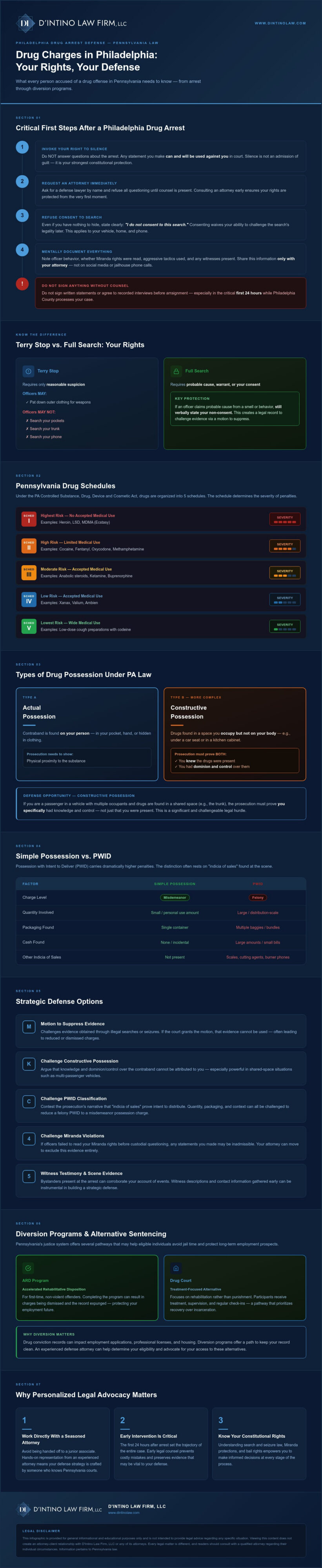
Facing a drug arrest in Pennsylvania is a high-stakes event that can leave you feeling powerless. Your actions in the minutes and hours following an encounter with law enforcement often dictate the strength of your future defense. Many people mistakenly believe they can explain their way out of a situation or convince an officer to let them go. In reality, police officers are trained to gather evidence. Any statement you make can and likely will be used against you in court. Silence is not an admission of guilt; it’s your most powerful constitutional protection.
As soon as you’re taken into custody, you should request a lawyer and refuse to answer any questions about the circumstances of the arrest. Consulting with a drug charge defense lawyer Philadelphia immediately ensures that your rights are shielded from the start. You should also refrain from consenting to any searches of your vehicle, home, or digital devices. Even if you believe you’ve nothing to hide, consenting can limit your ability to challenge the legality of the search later on.
While the details are still fresh, try to mentally document everything that occurred. This includes the behavior of the officers, whether they read your Miranda rights, and if they used aggressive tactics. Don’t discuss your case with anyone other than your attorney. This includes avoiding social media posts and steering clear of case-related talk on recorded jailhouse phone lines. Prosecutors frequently review these recordings for admissions or inconsistencies that can damage your case.
The Critical First 24 Hours in Philadelphia
In Philadelphia County, the arraignment process typically begins shortly after processing. During this time, a bail commissioner reviews the charges to determine if you can be released and under what financial conditions. You shouldn’t sign any written statements or provide recorded interviews during this window without legal counsel present. If there were bystanders or witnesses present during your arrest, try to remember their descriptions or contact information. This data can be instrumental for your drug charge defense lawyer Philadelphia when building a strategic response to the charges.
Protecting Your Constitutional Rights During a Search
Understanding the difference between a “Terry Stop” and a full search is vital for your defense. A Terry Stop allows police to pat down your outer clothing for weapons if they have reasonable suspicion. It doesn’t grant them the right to search your pockets, your trunk, or your phone. If an officer claims they have probable cause based on a smell or suspicious behavior, you should still state clearly, “I do not consent to this search.” Vocalizing your lack of consent creates a clear record that can be used to challenge the evidence in a motion to suppress later in the legal process.
Understanding Pennsylvania Drug Laws and Possession Charges
The foundation of every narcotics case in the Commonwealth is the Pennsylvania Controlled Substance, Drug, Device and Cosmetic Act. This statute outlines how substances are categorized and the specific elements the state must prove to secure a conviction. Pennsylvania organizes drugs into five “Schedules” based on their perceived medical utility and potential for abuse. Schedule I substances, like heroin or LSD, are considered the most dangerous with no accepted medical use, while Schedule V drugs have the lowest potential for abuse. The schedule of the substance involved directly influences the severity of the penalties you face.
Prosecutors don’t just look at what was found; they look at how it was found and in what quantity. A small amount for personal use might lead to a misdemeanor charge, but if the police find “indicia of sales,” the situation escalates quickly. This is where a drug charge defense lawyer Philadelphia becomes essential to dissect the prosecution’s narrative and challenge the classification of the charges.
Actual vs. Constructive Possession in Philadelphia
Actual possession is straightforward; it’s when the contraband is found in your pocket, your hand, or hidden in your clothing. However, many arrests in Philadelphia involve constructive possession. This occurs when the drugs are found in a place you occupy but aren’t physically on your person, such as under a car seat or in a kitchen cabinet. To prove constructive possession, Pennsylvania prosecutors must show you had both the knowledge of the drugs’ presence and the “dominion and control” over them. If you’re in a vehicle with three other people and drugs are found in the trunk, the state must prove you specifically had the intent and power to manage those substances. This is a high evidentiary bar that a strategic defense can often challenge.
Simple Possession vs. Possession with Intent to Deliver (PWID)
Simple possession is typically a misdemeanor intended for those caught with small amounts for personal use. In contrast, Possession with Intent to Deliver (PWID) is a high-stakes felony. You don’t have to be caught in the middle of a sale to face a PWID charge. Prosecutors use circumstantial evidence to “upgrade” the charge, including large quantities of the drug, digital scales, unused glassine baggies, or significant amounts of cash. They may also point to the presence of multiple cell phones as evidence of a distribution operation. Because a PWID conviction carries much harsher sentencing guidelines and can trigger mandatory minimums in certain contexts, attacking the “intent” element of the crime is a primary focus of a robust defense strategy.
Strategic Defense Options for Drug Charges in Philadelphia
An arrest in Pennsylvania isn’t the same as a conviction. Prosecutors must prove every element of their case beyond a reasonable doubt, and they must do so while following strict constitutional rules. A dedicated drug charge defense lawyer Philadelphia starts by looking for procedural errors and civil rights violations. If the police overstepped their authority, the evidence they gathered might be inadmissible. We don’t just accept the prosecution’s version of events; we challenge the integrity of the entire investigation from the moment of the first encounter.
The Motion to Suppress is often the centerpiece of a drug defense. This legal filing asks the judge to throw out evidence obtained through an illegal search or seizure. If the Fourth Amendment was violated, the “fruit of the poisonous tree” doctrine prevents that evidence from being used against you. We also examine the “chain of custody” for any seized substances. If the police or lab technicians failed to document the handling of the evidence properly, the results can be called into question. Additionally, when Philadelphia police rely on confidential informants, we aggressively investigate their background and motives to undermine their credibility.
Challenging the Legality of the Initial Stop
Police can’t pull you over or stop you on the street just because they have a “hunch.” They need reasonable suspicion that a crime is occurring or a traffic violation has happened. We scrutinize police reports for inconsistencies or errors that suggest the stop was unjustified. We also look at the “Plain View” doctrine. While officers can seize contraband they see in the open, they can’t move objects or manipulate your property to “create” a view of something hidden. If the initial stop was flawed, everything that followed it might be legally void.
The Motion to Quash and Preliminary Hearings
The preliminary hearing is your first opportunity to see the Commonwealth’s cards. At this stage, the prosecution must meet a “prima facie” burden, proving a crime likely occurred and you were likely involved. It’s a lower bar than a trial, but it’s a vital testing ground. If the judge allows the case to move forward despite weak evidence, we can file a Motion to Quash. This asks a higher court to review the decision and dismiss the charges because the prosecution failed to meet its basic legal requirements. Through discovery, we gain access to body cam footage and lab reports to find these weaknesses early in the case.
Consequences and Diversion Programs in the Pennsylvania Justice System
A drug conviction in Pennsylvania carries weight far beyond the courtroom walls. While the threat of jail time and steep fines is immediate, the secondary effects can disrupt your life for years to come. In Pennsylvania, even a minor possession charge can trigger a mandatory suspension of your driving privileges. This often happens regardless of whether a vehicle was involved in the alleged offense. For many, losing the ability to drive means losing their livelihood. These stakes are why consulting a drug charge defense lawyer Philadelphia is vital to exploring every available alternative to a traditional conviction.
Eligibility for ARD and Diversion in Philadelphia
If you’re a first-time offender, you might qualify for the Accelerated Rehabilitative Disposition (ARD) program. This is a pre-trial diversionary path that prioritizes rehabilitation over punishment. If you’re accepted, you’ll complete a period of supervision, pay restitution, and possibly perform community service. The District Attorney’s office has the final say on who enters the program, making the advocacy of your attorney essential during the application process. Successfully completing ARD allows you to have the charges dismissed, which is a critical step toward protecting your future and maintaining a clean record. For those struggling with substance abuse, the Philadelphia Drug Court offers a treatment-focused alternative. This program uses intensive supervision and support to address the root causes of the arrest rather than relying solely on incarceration.
Collateral Consequences of a Drug Conviction
The damage of a criminal record extends into your professional and academic life. A drug conviction can disqualify you from receiving Federal Student Aid (FAFSA) or lead to the revocation of professional licenses in fields like nursing, teaching, or law. It can also create significant hurdles when applying for housing or seeking new employment opportunities. Because these consequences are so severe, pursuing criminal record expungement Pennsylvania is often the most effective way to move forward after a legal challenge. Clearing your record ensures that one mistake doesn’t define the rest of your career. If you’re concerned about how these charges will affect your long-term goals, contact D’Intino Law Firm, LLC to discuss your options for a strategic defense.
Why Personalized Advocacy Matters for Philadelphia Drug Defense
Choosing the right legal representation is the most consequential decision you’ll make after an arrest. In the legal world, many high-volume firms operate as “law mills,” where cases are processed quickly and clients rarely speak to the lead attorney. This approach often overlooks the nuances of your specific situation. When you’re facing high-stakes charges, you need a drug charge defense lawyer Philadelphia who treats your case with the individual attention it deserves. A boutique firm provides a level of strategic depth that larger entities simply can’t match.
Local experience in the courts of Philadelphia, Montgomery, and Delaware counties is an invaluable asset. Every jurisdiction has its own procedural quirks and local rules that can influence the outcome of a case. Understanding the specific tendencies of local judges and the policies of the District Attorney’s office allows for a more tailored defense. We don’t use a one-size-fits-all template. Instead, we build a defense that accounts for the specific facts of your arrest, your professional background, and your long-term goals. Just as common misconceptions can derail a drug case, they can be equally damaging in other criminal matters — understanding the truth behind Pennsylvania’s statutes is essential whether you’re facing narcotics charges or need an assault defense attorney Philadelphia PA to challenge the myths surrounding how the Commonwealth prosecutes violent crimes.
Direct Accountability with Attorney John D’Intino Jr.
At our firm, you won’t be handed off to a junior associate or a paralegal. Attorney John D’Intino Jr. handles every case personally, ensuring that you have a direct line of communication with your advocate. With over 20 years of legal experience, he brings a seasoned perspective to both trial strategies and complex negotiations. We intentionally maintain a limited caseload so that every client receives maximum attention and a “fighter” mentality in the face of opposition. Learn more about our approach at D’Intino Law Firm, LLC.
From Consultation to Courtroom: Your Legal Partnership
Your defense begins with an initial consultation where we listen to your side of the story without judgment. We investigate every detail of the police encounter to find constitutional violations or evidentiary weaknesses. While we’re always prepared to take a case to trial if a fair resolution isn’t possible, we simultaneously explore all diversionary options like ARD or Drug Court. This dual-track approach ensures no opportunity for a favorable outcome is missed. Partnering with a dedicated Philadelphia Criminal Defense Lawyer means having a compassionate guide through the complexities of the Pennsylvania justice system.
Protecting Your Future Beyond a Drug Charge
Navigating the Pennsylvania justice system requires a strategic partner who understands the high stakes of your situation. From challenging the legality of an initial stop to applying for diversionary programs like ARD, every step you take now influences your life for years to come. You don’t have to face these complex laws alone or settle for a high-volume law firm that treats your case like a number on a spreadsheet.
By securing a seasoned drug charge defense lawyer Philadelphia, you gain direct access to an advocate with over 20 years of experience who handles every detail of your case personally. Whether we’re fighting for a dismissal at a preliminary hearing or negotiating a path toward expungement, our focus remains on protecting your rights and your livelihood. We offer flexible payment options to ensure that elite, personalized representation is accessible when you need it most. You have the power to take control of your legal journey, and we’re here to stand with you every step of the way.
Contact D’Intino Law Firm, LLC for a free consultation regarding your Philadelphia drug charges.
Legal Disclaimer: This article is provided for general informational and educational purposes only and is not intended to provide legal advice regarding any specific situation. Reading this article or accessing DintinoLaw.com does not create an attorney-client relationship with D’Intino Law Firm, LLC or any of its attorneys. Every legal matter is different, and readers should consult with a qualified attorney regarding their individual circumstances.
Frequently Asked Questions
What is the difference between drug possession and drug trafficking in Philadelphia?
Drug possession is typically a misdemeanor involving small amounts intended for personal use. Drug trafficking, often charged as Possession with Intent to Deliver (PWID) in Pennsylvania, is a felony involving larger quantities or evidence of distribution. A drug charge defense lawyer Philadelphia can review the evidence to see if the state has overcharged a simple possession case as a felony distribution crime based on circumstantial factors like cash or scales.
Can I be charged with a drug crime if the drugs were found in a car I was only a passenger in?
You can be charged even if the substances weren’t on your person through a legal theory called constructive possession. Prosecutors must demonstrate that you had knowledge of the drugs and the ability to maintain dominion and control over them. This often happens in shared vehicles. Defending these cases requires showing a lack of intent or awareness, especially when multiple people have access to the same space where the contraband was discovered.
What should I do if the police searched my car without a warrant?
If the police searched your vehicle without a warrant, the legality of that search depends on whether they had probable cause. While Pennsylvania law regarding vehicle searches has evolved, officers cannot perform a search based on a mere hunch. You should clearly state your lack of consent during the encounter. Afterward, your attorney can file a Motion to Suppress to prevent any illegally seized evidence from being used against you in court.
Will I go to jail for a first-time drug possession charge in Pennsylvania?
Incarceration is not a certainty for a first-time possession charge in Pennsylvania. Many individuals qualify for diversionary programs like ARD or the Philadelphia Drug Court. These programs focus on rehabilitation rather than punishment. Successfully completing these requirements can lead to the dismissal of your charges. A drug charge defense lawyer Philadelphia can help determine your eligibility and advocate for your entry into these programs to avoid a permanent criminal record.
How much does a drug charge defense lawyer in Philadelphia cost?
Legal fees for a drug defense vary significantly based on the complexity of the charges and the attorney’s level of experience. Boutique firms often offer personalized fee structures and flexible payment options to ensure you receive dedicated attention without the overhead of a large corporate firm. During an initial consultation, you’ll receive a transparent overview of the expected costs based on whether the case is likely to reach a plea or go to trial.
What is the ARD program and how do I apply for it in Philadelphia County?
The Accelerated Rehabilitative Disposition (ARD) program is a pre-trial path for first-time, non-violent offenders in Pennsylvania. If accepted, you serve a period of probation instead of facing trial. To apply in Philadelphia County, your attorney must submit a formal request to the District Attorney’s office. Upon successful completion of all program requirements, you can petition the court to have the underlying charges dismissed and your arrest record expunged.
Can a drug conviction be expunged from my record in Pennsylvania?
Expungement in Pennsylvania is generally limited to cases that resulted in a dismissal, a not guilty verdict, or the successful completion of a diversion program like ARD. If you were actually convicted of a drug crime, you might only be eligible for record sealing under Clean Slate laws after a specific period of remaining crime-free. An attorney can evaluate your specific record to determine if you meet the current statutory requirements for clearing your criminal history in Pennsylvania.
What happens if I was arrested for drugs on a college campus like Temple or Drexel?
An arrest on a campus like Temple or Drexel triggers two separate legal battles. You’ll face criminal prosecution in the Pennsylvania court system and a separate disciplinary hearing from the university. These schools have strict codes of conduct that can lead to immediate suspension or expulsion regardless of the criminal court’s outcome. Additionally, a drug conviction can result in the loss of federal student aid, making it vital to have a strategic defense.
Legal Disclaimer: This article is provided for general informational and educational purposes only and is not intended to provide legal advice regarding any specific situation. Reading this article or accessing DintinoLaw.com does not create an attorney-client relationship with D’Intino Law Firm, LLC or any of its attorneys. Every legal matter is different, and readers should consult with a qualified attorney regarding their individual circumstances.
Disclaimer
Legal Disclaimer: The information provided on DintinoLaw.com, including articles, blog posts, testimonials, case results, and other content, is for general informational and educational purposes only and does not constitute legal advice or create an attorney-client relationship with D’Intino Law Firm, LLC or any of its attorneys. Visiting this website, submitting a contact form, sending an email, calling, texting, or otherwise communicating with the firm does not establish an attorney-client relationship or obligate the firm to represent you. Do not submit confidential, privileged, or time-sensitive information through this website or electronic communications unless and until the firm has expressly agreed to represent you. Legal rights, procedures, statutes of limitation, filing deadlines, and other requirements vary based on the facts and jurisdiction and may change over time; nothing on this website should be relied upon to determine whether a legal deadline applies to your matter. If you have an urgent legal matter or a potential filing deadline, consult a qualified attorney promptly. Testimonials and statements regarding client experiences are individual opinions and experiences and are not a guarantee of future results. Prior results, verdicts, settlements, or case examples do not guarantee or predict the outcome of any future case, and every matter is different. This website may constitute attorney advertising under applicable Pennsylvania rules. D’Intino Law Firm, LLC makes no representation that the information on this website is complete, current, or applicable to your particular circumstances. For legal advice concerning your specific situation, consult directly with a qualified Pennsylvania attorney. D’Intino Law Firm, LLC | Philadelphia, Pennsylvania | DintinoLaw.com
