


Attorney
What if you were told that the person who accused you doesn’t actually have the power to drop the charges? It’s a terrifying realization for anyone facing the Pennsylvania legal system. You’re likely feeling overwhelmed by the threat of jail time and confused by technical terms like simple versus aggravated assault. When your future is on the line, relying on street law or common misconceptions can lead to devastating mistakes in your case. Partnering with a dedicated assault defense attorney Philadelphia PA is the first step toward reclaiming control of your situation.
We understand the heavy weight of these charges. In this guide, we’ll expose the truth about how the Commonwealth actually prosecutes these crimes and why some of the most common advice you’ve heard is flat-out wrong. You’ll learn how Pennsylvania’s specific statutes work, the reality of self-defense claims, and how to build a strategic defense that protects your rights. By replacing legal myths with facts, you can move forward with a clear plan to protect your future and your freedom.
Legal Disclaimer: This article is provided for general informational and educational purposes only and is not intended to provide legal advice regarding any specific situation. Reading this article or accessing DintinoLaw.com does not create an attorney-client relationship with D’Intino Law Firm, LLC or any of its attorneys. Every legal matter is different, and readers should consult with a qualified attorney regarding their individual circumstances.
Key Takeaways
- Understand why the Commonwealth, not the victim, controls the fate of your case once charges are filed in Pennsylvania.
- Learn how the legal definition of “simple assault” can apply even in situations where no physical contact ever took place.
- Discover the specific “reasonable belief” standard required to successfully argue self-defense in a Pennsylvania courtroom.
- Identify the critical mistakes most people make when facing assault allegations that can inadvertently strengthen the prosecution’s case.
- See how a personalized approach from an assault defense attorney Philadelphia PA differs from high-volume firms when building a strategic defense.
Understanding Assault Charges in Philadelphia: More Than Just a Fight
Many people believe an assault charge requires a physical altercation or a visible injury. However, Pennsylvania law uses a much broader interpretation. Recognizing the nuances of Understanding Assault Charges involves knowing that the law focuses on the actor’s intent and the potential for harm, not just the final result. You don’t have to land a punch to face serious legal consequences in a Philadelphia courtroom.
Under the Pennsylvania Crimes Code, a person commits simple assault if they attempt to cause or intentionally, knowingly, or recklessly cause bodily injury to another. This means that even an unsuccessful attempt to strike someone can lead to a criminal record. A skilled assault defense attorney Philadelphia PA looks closely at the “mens rea,” or the state of mind, of the person involved. If the government believes you intended to cause harm, they can move forward with charges regardless of whether the other person was actually hurt.
Simple Assault vs. Aggravated Assault in PA
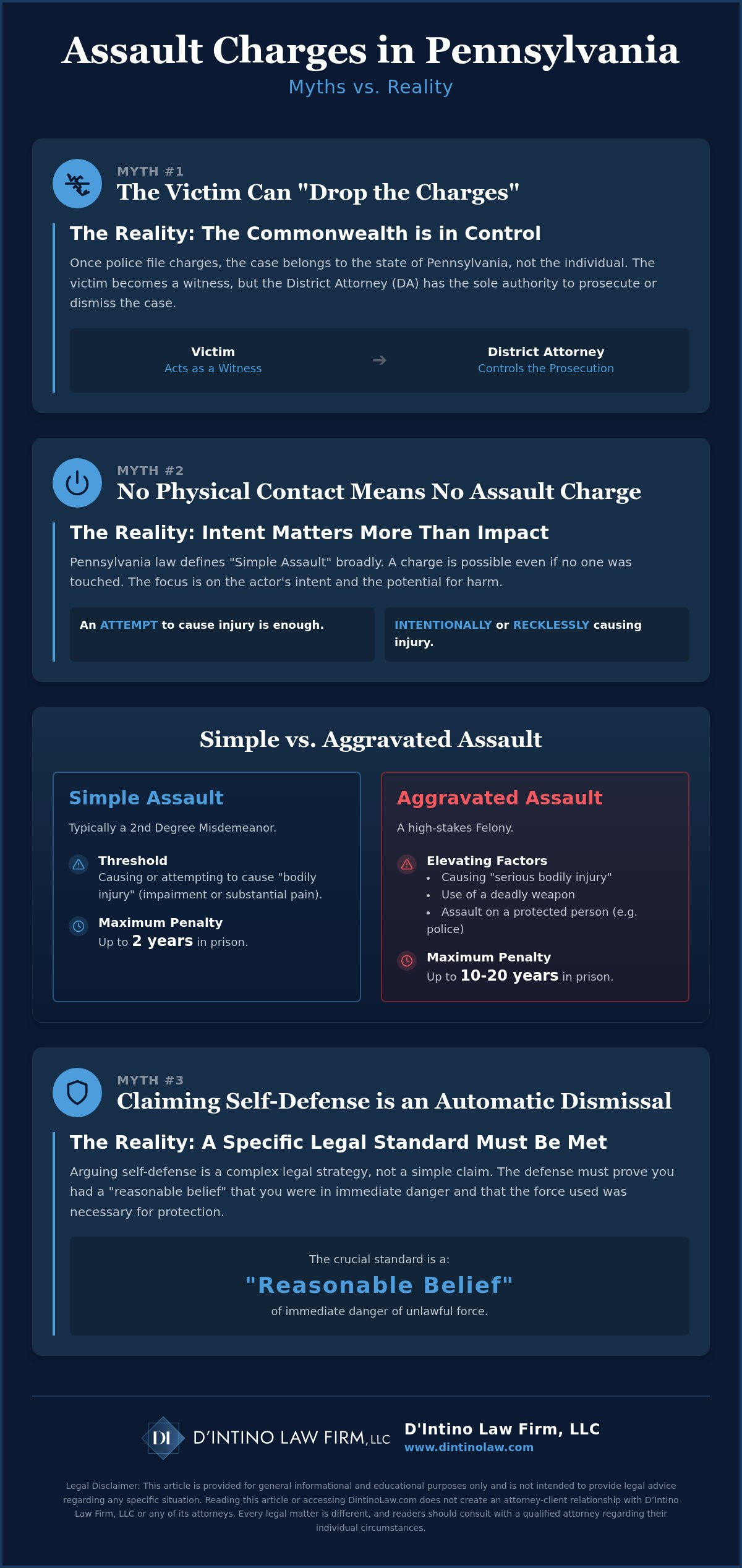
The primary difference between these charges lies in the severity of the injury or the status of the victim under Pennsylvania law. Simple assault is typically graded as a second-degree misdemeanor, punishable by up to two years in prison. However, if the incident involves a deadly weapon or results in “serious bodily injury,” the charge is often elevated to aggravated assault. This is a high-stakes felony that carries the potential for ten to twenty years in prison. If you are facing these escalated charges, working with a Felony Defense Attorney Philadelphia is vital to challenge the prosecution’s evidence with tenacity.
The Legal Threshold for Bodily Injury
Philadelphia courts distinguish between “bodily injury” and “serious bodily injury” based on specific legal thresholds. Bodily injury is defined as the impairment of physical condition or substantial pain. In contrast, serious bodily injury involves attempts to cause harm with extreme indifference to human life, often resulting in a substantial risk of death or permanent disfigurement. An experienced assault defense attorney Philadelphia PA will examine medical records to determine if the injuries alleged by the prosecution actually meet these strict legal definitions.
Prosecutors often rely on “impairment of physical condition” to justify charges when pain is subjective. This might include limited range of motion, severe bruising, or the inability to use a limb temporarily. Because these definitions are flexible, a strategic defense focuses on the lack of objective medical evidence or the absence of the required intent. We bring a fighter mentality to every case, challenging the government’s narrative and ensuring that a simple misunderstanding isn’t inflated into a life-altering felony conviction.
Myth #1: The Victim Can “Drop the Charges” in Pennsylvania
It’s the most common question we hear: “If the other person doesn’t want to press charges anymore, will the case be dismissed?” The short answer is no. In Pennsylvania, criminal charges aren’t a private matter between two individuals. Once the police make an arrest and the paperwork is filed, the case belongs to the Commonwealth. The individual who was involved is considered a witness for the prosecution, not the person in charge of the legal proceedings. Relying on a witness’s promise to “drop the charges” is a dangerous strategy that often leads to unexpected consequences without the guidance of an assault defense attorney Philadelphia PA.
Who Actually Controls the Prosecution?
The District Attorney (DA) holds the ultimate authority over whether to move forward, negotiate a plea, or dismiss a case. Even if a victim expresses a desire to “drop the charges,” the DA may choose to proceed if they believe they have enough evidence to secure a conviction. This is especially common in domestic assault cases where prosecutors are trained to expect victims to change their minds due to fear or family pressure. Prosecutors often rely on evidence beyond witness testimony, such as 911 recordings or “excited utterances.” These are statements made during the heat of the moment that are often admissible in court even if the witness refuses to testify later. If you’re facing these high-stakes decisions, you can consult with a legal professional to understand how the DA’s office builds its case.
What Happens if a Witness Recants?
When a witness recants or changes their story, it doesn’t automatically trigger a dismissal. Philadelphia judges and juries often view sudden changes in testimony with extreme skepticism. Prosecutors may even use a witness’s prior inconsistent statements against them to prove the original version of events was true. There are also significant legal risks for the witness. If they admit they lied in an initial police report, they could face charges for unsworn falsification or perjury.
Strategic defense in these situations requires more than just waiting for a witness to disappear. A seasoned assault defense attorney Philadelphia PA will investigate why the story changed and look for corroborating evidence that supports your version of events. While some look for an easy way out through a witness’s “change of heart,” a stronger path often involves looking at legal justifications like Claiming Self-Defense under Pennsylvania’s specific statutes. We provide the fierce advocacy needed to ensure the truth isn’t lost in the prosecution’s paperwork.
Myth #2: You Can’t Be Charged if There Was No Physical Contact
One of the most dangerous assumptions you can make is that “no contact equals no crime.” Many people believe that if they didn’t actually hit, push, or touch another person, they can’t be arrested for assault. In Pennsylvania, this is a legal fiction. The law doesn’t just punish the successful completion of an act; it also punishes the attempt and the creation of fear. If you’re facing charges for an incident where no physical contact occurred, you need an assault defense attorney Philadelphia PA to help untangle the prosecution’s narrative.
Pennsylvania’s simple assault statute specifically includes “physical menace.” This means that using your body, a weapon, or even a vehicle to put another person in fear of imminent serious bodily harm is enough to trigger a criminal charge. A heated argument in a parking lot can quickly transform into a misdemeanor or felony if the police believe your actions were meant to intimidate or threaten. The difference between a loud disagreement and a criminal offense often comes down to the specific gestures made and the perceived intent behind them.
The Definition of Attempt in PA Statutes
Under the Pennsylvania Crimes Code, an “attempt” occurs when a person takes a substantial step toward committing a crime with the intent to complete it. In the context of assault, this could be as simple as swinging a fist and missing or throwing an object that doesn’t strike its target. The prosecution doesn’t need to show a bruise or a broken bone; they only need to prove you intended to cause bodily injury. Defending against these charges requires a deep dive into the evidence to show that a “substantial step” never actually took place or that your intent was misinterpreted by the alleged victim.
Verbal Threats and Menacing Conduct
While speech is protected by the First Amendment, that protection ends when words become “terroristic threats.” If a verbal statement is intended to terrorize another or causes a building to be evacuated, it crosses the line into criminal conduct. Menacing conduct often involves non-verbal cues, such as cornering someone or reaching for a waistband, that suggest immediate violence. Context is everything in these cases. A seasoned Philadelphia Criminal Defense Lawyer will examine the surrounding circumstances to determine if the threat was truly “imminent” or if the allegations are an exaggeration of a non-criminal dispute.
We work to ensure that the court sees the full picture, not just the snapshot provided by a police report. When no injury exists, the prosecution’s case relies heavily on subjective interpretations of fear. An assault defense attorney Philadelphia PA can challenge these interpretations by highlighting inconsistencies in witness statements or providing evidence that your actions were defensive rather than aggressive.
Legal Disclaimer: This article is provided for general informational and educational purposes only and is not intended to provide legal advice regarding any specific situation. Reading this article or accessing DintinoLaw.com does not create an attorney-client relationship with D’Intino Law Firm, LLC or any of its attorneys. Every legal matter is different, and readers should consult with a qualified attorney regarding their individual circumstances.
Myth #3: Claiming Self-Defense Automatically Results in Dismissal
Many people assume that simply saying “it was self-defense” is enough to make an assault charge disappear. In reality, self-defense, legally known as justification, is an affirmative defense. This means you admit to the physical act but argue that your actions were legally excused because you were protecting yourself or others. It isn’t a magic wand that stops a prosecution in its tracks. Instead, it’s a complex legal argument that requires specific evidence to succeed. An assault defense attorney Philadelphia PA must demonstrate that your actions met the strict standards set by Pennsylvania law.
The core of any justification claim is the “reasonable belief” standard. A judge or jury won’t just look at whether you felt threatened. They’ll ask if a reasonable person in your exact situation would have believed that force was necessary to prevent death, serious bodily injury, kidnapping, or sexual intercourse by force. Furthermore, the force you use must be proportional. You cannot legally use deadly force to respond to a minor shove. If the level of force you used exceeds what was necessary to stop the threat, your self-defense claim may fail.
The Burden of Proof for Justification in PA
At trial, the defense must first raise the issue of self-defense by presenting some evidence that the defendant acted to protect themselves. Once that evidence is introduced, the burden shifts entirely to the prosecution. The Commonwealth must then disprove your self-defense claim beyond a reasonable doubt. This is a high bar for the government, but they’ll attempt to meet it by showing you were the initial aggressor or that you used more force than was required. We take a “fighter” approach to these cases, gathering surveillance footage, witness statements, and expert testimony to reinforce the necessity of your actions. If you’re struggling to prove your side of the story, you should protect your rights during a consultation with our firm.
The “Duty to Retreat” vs. Stand Your Ground
Pennsylvania’s self-defense laws include a concept known as the “duty to retreat.” Generally, if you’re in a public space in Philadelphia and can retreat to complete safety, the law expects you to do so before using force. However, the “Castle Doctrine” provides a significant exception: you have no duty to retreat if you’re inside your own home or an occupied vehicle. Additionally, a 2011 amendment created a limited “Stand Your Ground” provision. This allows you to stand your ground in other places where you have a legal right to be, provided you aren’t engaged in criminal activity and are threatened with a deadly weapon. These nuances are often the deciding factor in whether an assault charge leads to a conviction or an acquittal. We provide the compassionate guidance and strategic thinking needed to navigate these technical legal hurdles.
Legal Disclaimer: This article is provided for general informational and educational purposes only and is not intended to provide legal advice regarding any specific situation. Every legal matter is different, and readers should consult with a qualified attorney regarding their individual circumstances.
Navigating Your Case with an Assault Defense Attorney in Philadelphia, PA
Facing an assault charge is a life-altering event. The moments following your arrest in Pennsylvania are some of the most critical you’ll ever face. While the system moves quickly, a strategic assault defense attorney Philadelphia PA can slow things down and ensure your side of the story is heard. Early intervention allows for a thorough investigation before evidence disappears or memories fade. We don’t just wait for the court date; we actively seek out surveillance footage, interview independent witnesses, and scrutinize every detail of the police report to find inconsistencies.
Police reports are often one-sided narratives that favor the prosecution. They frequently omit the context of the argument or the aggressive actions of the alleged victim. By evaluating these documents alongside physical evidence, we can build a defense that challenges the government’s version of events. In some cases, we may explore alternatives to a traditional trial. For eligible first-time offenders in Pennsylvania, programs like Accelerated Rehabilitative Disposition (ARD) can provide a path to resolving charges without a permanent criminal record. Negotiated pleas are another tool, but they should only be considered when they serve your long-term interests. It’s also important to understand that an assault conviction can have serious downstream consequences, including triggering a probation violation lawyer Philadelphia situation if you’re already under supervision, making early strategic intervention even more critical.
Strategic Advocacy for Assault Allegations
Every incident is unique. A defense that works for one person might be entirely wrong for another. We build our strategies based on the specific facts of your case, whether that involves challenging the “intent” requirement or proving a justification claim. Our firm brings a consistent level of strategic thinking to every matter, whether we’re acting as your assault advocate or as a Drug Charge Defense Lawyer Philadelphia. We’re always prepared to take a case to trial if a fair resolution isn’t offered. Knowing your attorney is a “fighter” who won’t back down gives you leverage during negotiations with the District Attorney.
Why Personalized Attention Matters
In the legal world, many high-volume “law mills” treat clients like file numbers. You might speak to a different associate every time you call. At D’Intino Law Firm, LLC, Attorney John D’Intino Jr. handles every case personally. With 20+ years of legal experience, he provides the direct attorney-to-client representation you deserve. We maintain a limited caseload to ensure that every client receives the deep expertise and tailored service required for high-stakes defense. You’ll always have a compassionate, guiding presence by your side, backed by a fierce commitment to your success. We also offer flexible payment options and free consultations to ensure that elite advocacy is accessible when you need it most. If you’re facing assault charges and feel uncertain about the future, reach out to D’Intino Law Firm, LLC to discuss your legal concerns.
Legal Disclaimer: This article is provided for general informational and educational purposes only and is not intended to provide legal advice regarding any specific situation. Every legal matter is different, and readers should consult with a qualified attorney regarding their individual circumstances.
Take Decisive Action to Protect Your Future
Understanding the reality of Pennsylvania assault laws is the first step toward a successful defense. We’ve debunked the common myths that victims can simply drop charges or that a lack of physical contact means no crime has occurred. In reality, the Commonwealth’s prosecution is aggressive, and self-defense claims require precise legal justification rather than just a simple statement. You don’t have to face these high-stakes challenges alone or rely on the uncertainty of a high-volume law mill. With 20+ years of criminal defense experience, Attorney John D’Intino Jr. provides the direct, hands-on representation you need to navigate the Philadelphia court system. We offer flexible payment options to ensure you have access to a dedicated advocate who will fight for your rights. Don’t let a misunderstanding or a legal myth dictate the rest of your life. Contact D’Intino Law Firm, LLC for a free consultation regarding your Philadelphia assault case. Partnering with a seasoned assault defense attorney Philadelphia PA ensures your side of the story is told with tenacity and strategic precision.
Legal Disclaimer: This article is provided for general informational and educational purposes only and is not intended to provide legal advice regarding any specific situation. Every legal matter is different, and readers should consult with a qualified attorney regarding their individual circumstances.
Frequently Asked Questions
Can I be charged with assault if I didn’t mean to hurt anyone?
Yes, you can face charges even without a specific intent to harm. In Pennsylvania, the legal definition of assault includes recklessly causing bodily injury. This means if you acted with conscious disregard for a substantial and unjustifiable risk, and someone was hurt, the state can prosecute you. Prosecutors don’t always need to prove you had a plan to cause pain. They only need to show your actions were dangerous enough to meet the reckless standard.
What is the difference between simple and aggravated assault in Philadelphia?
The primary distinction in Pennsylvania involves the severity of the injury and the status of the victim. Simple assault is usually a misdemeanor involving bodily injury or the attempt to cause it. Aggravated assault is a felony triggered by serious bodily injury or the use of a deadly weapon. Additionally, assaulting protected individuals like police officers or teachers automatically elevates the charge to a felony, regardless of the severity of the physical harm actually inflicted.
How long do assault charges stay on my record in Pennsylvania?
A conviction for assault remains on your criminal record permanently in Pennsylvania unless it is successfully expunged or sealed. While certain programs like ARD may allow for the eventual expungement of charges for first-time offenders, a standard conviction doesn’t simply disappear over time. These records are visible to employers and landlords during background checks. Consult with an assault defense attorney Philadelphia PA to discuss your options for criminal record expungement in Pennsylvania through the appropriate legal channels.
Can a victim drop assault charges in PA?
No, the individual involved does not have the legal authority to drop charges in Pennsylvania. Once a police report is filed and the District Attorney’s office takes the case, the Commonwealth becomes the plaintiff. While the prosecutor may consider the witness’s wishes, they often proceed with the case based on other evidence like medical records or 911 calls. The decision to dismiss or move forward rests entirely with the government, not the person who made the initial report.
Is it possible to get an assault charge reduced to a lesser offense?
Yes, it’s often possible to negotiate a reduction of charges through a plea agreement or by challenging the prosecution’s evidence. For example, an aggravated assault felony might be reduced to a simple assault misdemeanor if the serious bodily injury threshold isn’t supported by medical documentation. A strategic defense focuses on highlighting these evidentiary gaps. This process requires a thorough evaluation of the facts by an experienced advocate who understands the local tendencies of Philadelphia prosecutors and judges.
What happens at a preliminary hearing for an assault charge?
The preliminary hearing is a critical stage where the judge determines if the Commonwealth has enough evidence to move the case to the Court of Common Pleas. The prosecution must establish a prima facie case, meaning there’s enough evidence to suggest a crime was committed and you were the one who committed it. It isn’t a full trial. However, it’s an essential opportunity for your attorney to cross-examine witnesses and identify weaknesses in the government’s narrative early on.
Do I need a lawyer for a first-time simple assault charge?
Yes, even a first-time misdemeanor conviction carries significant consequences in Pennsylvania, including up to two years in prison and a permanent criminal record. Navigating the system alone increases the risk of making self-incriminating statements or missing opportunities for diversionary programs like ARD. An assault defense attorney Philadelphia PA provides the protection and personalized attention needed to challenge the evidence. Protecting your future requires professional advocacy from someone who understands the nuances of the local court rules and procedures.
Can I claim self-defense if I started the argument?
Claiming self-defense is much more difficult if you were the initial aggressor. Under Pennsylvania law, you generally cannot use force to defend yourself if you provoked the encounter. However, exceptions exist if you clearly communicated your intent to withdraw from the argument and the other person continued to use or threaten force. These situations are fact-intensive and rely heavily on witness testimony and surveillance footage to prove who actually escalated the dispute to the level of physical violence. If you are already on probation, an assault allegation can also trigger a violation detainer, making it essential to consult a probation violation lawyer Philadelphia residents trust to protect their supervision status alongside their criminal defense.
Legal Disclaimer: This article is provided for general informational and educational purposes only and is not intended to provide legal advice regarding any specific situation. Every legal matter is different, and readers should consult with a qualified attorney regarding their individual circumstances.
Disclaimer
Legal Disclaimer: The information provided on DintinoLaw.com, including articles, blog posts, testimonials, case results, and other content, is for general informational and educational purposes only and does not constitute legal advice or create an attorney-client relationship with D’Intino Law Firm, LLC or any of its attorneys. Visiting this website, submitting a contact form, sending an email, calling, texting, or otherwise communicating with the firm does not establish an attorney-client relationship or obligate the firm to represent you. Do not submit confidential, privileged, or time-sensitive information through this website or electronic communications unless and until the firm has expressly agreed to represent you. Legal rights, procedures, statutes of limitation, filing deadlines, and other requirements vary based on the facts and jurisdiction and may change over time; nothing on this website should be relied upon to determine whether a legal deadline applies to your matter. If you have an urgent legal matter or a potential filing deadline, consult a qualified attorney promptly. Testimonials and statements regarding client experiences are individual opinions and experiences and are not a guarantee of future results. Prior results, verdicts, settlements, or case examples do not guarantee or predict the outcome of any future case, and every matter is different. This website may constitute attorney advertising under applicable Pennsylvania rules. D’Intino Law Firm, LLC makes no representation that the information on this website is complete, current, or applicable to your particular circumstances. For legal advice concerning your specific situation, consult directly with a qualified Pennsylvania attorney. D’Intino Law Firm, LLC | Philadelphia, Pennsylvania | DintinoLaw.com
