


Attorney
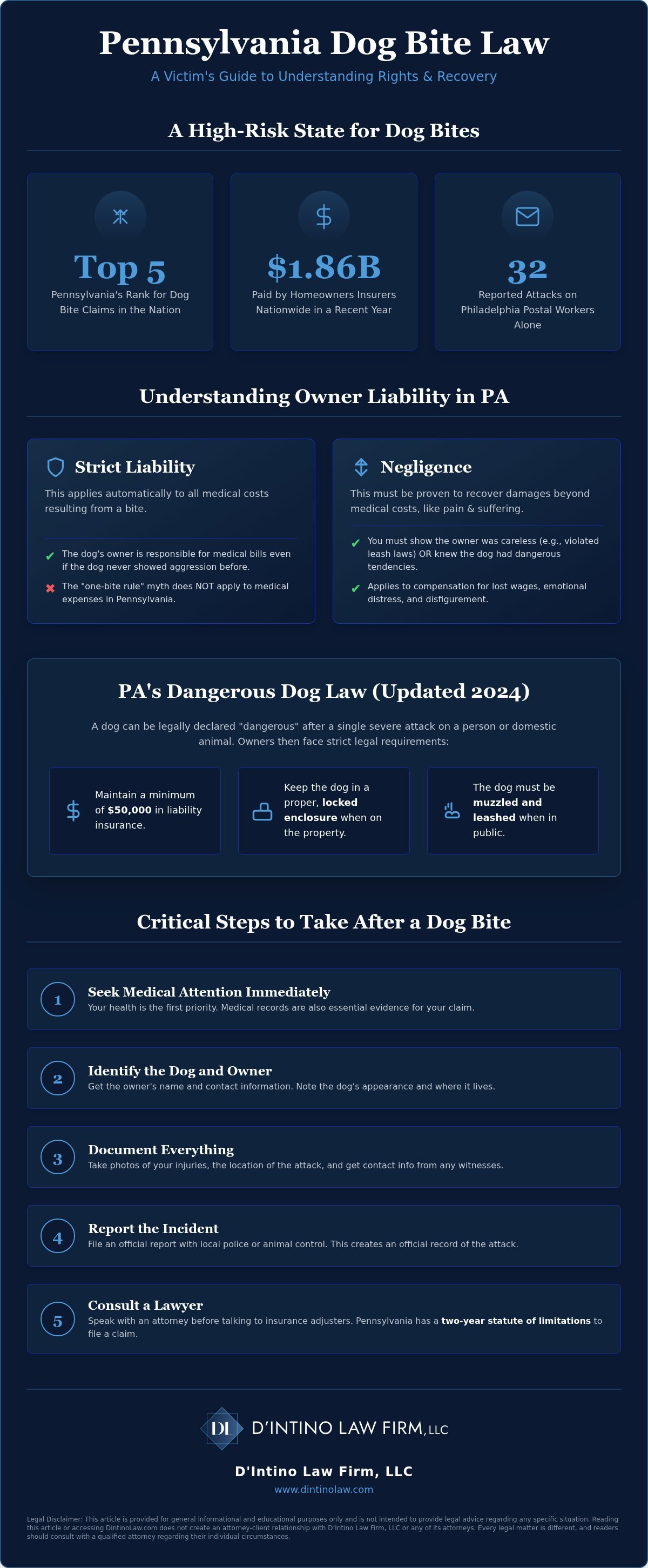
Did you know that Pennsylvania ranked fifth in the nation for dog bite claims in 2025? Homeowners insurers paid out a record $1.86 billion across the country that year. In Philadelphia alone, postal workers faced 32 reported attacks, highlighting a danger that many residents face while walking down their own streets. When a sudden attack leaves you with high medical costs for stitches or surgery, the physical trauma quickly leads to legal and financial stress. Finding a dog bite lawyer Philadelphia families can depend on is the first step toward a strategic recovery.
You might feel anxious about the legal process or fear neighborhood conflict. You shouldn’t have to carry the financial burden of someone else’s negligence. This guide clarifies the complexities of Pennsylvania dog bite laws. We’ll cover strict liability for medical expenses and the 2024 updates to the state’s Dangerous Dog Law. We also preview how to handle insurance adjusters to secure the support you need. By the end, you’ll have a roadmap for both physical and financial recovery.
Key Takeaways
- Learn about Pennsylvania’s strict liability rules that hold dog owners responsible for all medical costs, regardless of the animal’s prior history of aggression.
- Discover why consulting a dog bite lawyer Philadelphia victims trust is essential for meeting the two-year statute of limitations and securing evidence early.
- Understand the 2024 updates to the Pennsylvania Dangerous Dog Law and how local Philadelphia leash ordinances can be used to prove owner negligence.
- Identify the critical steps to take immediately following an attack to ensure your physical safety and protect your right to financial recovery.
- Explore the advantage of a boutique legal experience where you work directly with a seasoned attorney instead of being passed to a case manager.
Understanding Pennsylvania Dog Bite Laws and Owner Liability
Pennsylvania law provides a specific legal framework to protect victims of animal attacks. The primary statute governing these incidents is the Pennsylvania Dog Law (3 P.S. § 459-101 et seq.). This law establishes clear expectations for how owners must manage their animals within the Commonwealth. It doesn’t just offer a path to recovery; it mandates responsible ownership to prevent injuries before they happen. The Pennsylvania Department of Agriculture oversees these regulations, ensuring that dog wardens and local officials have the authority to enforce safety standards across Philadelphia and surrounding counties.
A central pillar of this statute is the “Confinement Law.” Owners are legally required to keep their dogs confined within the limits of their premises or firmly secured by a collar and chain. If a dog is off the property, it must be under the reasonable control of a person. When an owner fails to secure their pet and an attack occurs, they’ve violated a fundamental duty. This violation often serves as a key piece of evidence when a dog bite lawyer Philadelphia residents trust builds a case for compensation. Pennsylvania law also distinguishes between severe and non-severe injuries. Severe injuries include broken bones or disfiguring lacerations that require multiple sutures or cosmetic surgery. These distinctions dictate which types of damages you can pursue.
Strict Liability vs. Negligence in PA
Pennsylvania follows a “mixed” liability system. For medical expenses, the state applies a strict liability standard. This means an owner is responsible for your medical bills even if the dog never showed aggression before. You don’t have to prove the owner was careless to recover these specific costs. However, to recover “non-economic” damages like pain and suffering, you must prove the owner was negligent or knew the dog had dangerous tendencies. The common “one-bite” rule myth suggests a dog gets one free pass; in Pennsylvania, that isn’t true for medical costs. A Dog bite can result in significant financial trauma, and the law ensures victims aren’t left paying for their own ER visits.
The Legal Definition of a “Dangerous Dog”
An amendment to the state’s Dangerous Dog Law took effect in January 2024. This update makes it easier for authorities to declare a dog legally “dangerous” after a single serious incident. To receive this designation, a dog must have attacked or inflicted severe injury on a human or domestic animal without provocation. Once a dog is registered as dangerous, the owner faces strict requirements:
- They must maintain a minimum of $50,000 in liability insurance.
- The dog must be kept in a proper, locked enclosure when on the property.
- The animal must be muzzled and leashed on a short lead when in public.
If you’re attacked by a dog that already has this designation, the owner’s failure to follow these rules significantly strengthens your claim for full damages.
Legal Disclaimer: This article is provided for general informational and educational purposes only and is not intended to provide legal advice regarding any specific situation. Reading this article or accessing DintinoLaw.com does not create an attorney-client relationship with D’Intino Law Firm, LLC or any of its attorneys. Every legal matter is different, and readers should consult with a qualified attorney regarding their individual circumstances.
Common Misconceptions About Dog Attack Claims
Many victims hesitate to pursue a claim because the dog owner is a neighbor, friend, or family member. This hesitation is understandable, but it’s often based on a misunderstanding of how the legal system works. You aren’t typically asking for money directly from your neighbor’s personal savings. Instead, you’re seeking compensation from their homeowners or renters insurance policy. These policies exist specifically to cover unexpected accidents like this. Pursuing a claim helps you manage medical bills without destroying personal relationships.
Another common myth is the “he was just playing” defense. Under Pennsylvania’s dangerous dog laws and general liability rules, a dog’s intent doesn’t excuse the owner’s responsibility. Whether a dog acts out of aggression or over-excitement, the resulting stitches or surgery are real. Owners must control their animals regardless of the dog’s mood or history. Intentionality is rarely a factor in determining if an owner is liable for medical costs.
Provocation is also frequently misunderstood by the public. For an owner to successfully argue provocation, the victim must have done something significant to incite the dog. Simply walking past a house, making eye contact, or petting a dog that seemed friendly doesn’t usually qualify. Most of these cases settle through professional negotiation. You don’t have to worry about a long, dramatic trial; a skilled dog bite lawyer Philadelphia can often reach a fair agreement with the insurance company before a lawsuit is even filed.
The Truth About Homeowners and Renters Insurance
Insurance companies are in the business of protecting their own interests. When you file a claim, you’ll likely deal with an adjuster whose job is to minimize the payout. They might suggest your injuries aren’t severe or claim you were partially at fault to save the company money. Remember, the insurance company has its own legal team; you should have an advocate who understands their tactics. If you’re feeling overwhelmed by insurance calls, speaking with a personal injury attorney can provide the clarity you need to move forward.
Comparative Negligence in Pennsylvania
Pennsylvania follows a “comparative negligence” rule, specifically the 51% rule. This means you can recover damages as long as your share of the fault for the incident is not greater than the negligence of the defendant. If you’re found to be 20% responsible for the encounter, your final award is simply reduced by 20%. In the context of dog attacks, comparative negligence is the legal standard used to determine if a victim’s own actions contributed to the encounter and how that share of fault reduces their financial recovery. If your fault is 51% or higher, you’re barred from recovery in Pennsylvania.
Legal Disclaimer: This article is provided for general informational and educational purposes only and is not intended to provide legal advice regarding any specific situation. Reading this article or accessing DintinoLaw.com does not create an attorney-client relationship with D’Intino Law Firm, LLC or any of its attorneys. Every legal matter is different, and readers should consult with a qualified attorney regarding their individual circumstances.
Types of Damages and Compensation in a Dog Bite Case
In Pennsylvania, the financial burden of an animal attack extends far beyond the initial emergency room visit. Victims are entitled to pursue two primary types of compensation: economic and non-economic damages. Economic damages are the measurable financial losses you’ve incurred. These include past and future medical bills, such as surgeries, physical therapy, and medication. If your injuries prevented you from working, you can also recover lost wages and compensation for diminished earning capacity. Non-economic damages address the intangible losses, like pain, suffering, and loss of enjoyment of life.
Documenting these losses requires meticulous detail. A dog bite lawyer Philadelphia can help you gather the necessary medical records and employment data to build a strong case. Under Pennsylvania Statutes Title 3 P.S. § 459-502, the severity of the injury often dictates the scope of the claim. Permanent disfigurement and scarring are particularly significant in Philadelphia injury cases. These injuries often require future cosmetic procedures, and the law recognizes the long-term impact that visible scars have on a person’s confidence and social interactions. Determining the potential value of your case is a task for a dog bite lawyer Philadelphia who understands local jury trends.
The Psychological Impact of a Dog Attack
The trauma of an attack isn’t always visible. In a dense urban environment like Philadelphia, where dogs are present on every sidewalk and in every park, the psychological toll can be immense. Many victims develop Post-Traumatic Stress Disorder (PTSD), severe anxiety, or a debilitating fear of animals. These emotional injuries are compensable under Pennsylvania law. We often look to therapists or psychologists to provide expert testimony regarding the distress you’ve experienced. This ensures that your mental health needs are treated with the same priority as your physical wounds.
Calculating the Value of Your Injury Claim
Settlement amounts in Philadelphia vary based on several factors. The most critical factor is whether the injury meets the state’s definition of “severe.” A severe injury involves broken bones or lacerations that require multiple sutures. Non-severe injuries are generally limited to medical expenses unless negligence is proven. Other factors include the degree of the owner’s negligence and the limits of the applicable insurance policy. You can learn more about how these variables apply to your specific situation by exploring How Much Is My Injury Claim Worth in Philadelphia?
Legal Disclaimer: This article is provided for general informational and educational purposes only and is not intended to provide legal advice regarding any specific situation. Every legal matter is different, and readers should consult with a qualified attorney regarding their individual circumstances.
Critical Steps to Take After a Dog Bite in Philadelphia
The moments following a dog attack are often chaotic and frightening. Taking decisive action right away protects your health and your legal rights. Consulting a dog bite lawyer Philadelphia residents trust ensures you don’t miss critical deadlines while you focus on healing. Your first priority is always medical attention. Dog mouths harbor dangerous bacteria; even a seemingly minor puncture can lead to a severe infection or rabies. Visit an urgent care center or emergency room in Philadelphia immediately. Professional cleaning and documentation of your wounds create an official record of the injury, which is vital if you later need to prove the extent of the damage.
While at the scene, try to identify the dog and its owner. You need their name, address, and insurance information. If there were witnesses, ask for their contact details too. Use your phone to take clear photographs of your wounds, the dog, the location of the attack, and any broken leashes or gates. This visual evidence is hard to dispute later. Evidence can disappear quickly, so capturing the scene in its immediate aftermath is a strategic necessity for your claim.
Reporting and Documentation
In Philadelphia, you must report the bite to the Animal Care and Control Team (ACCT) and the Department of Public Health. The city mandates a 10-day quarantine for any domestic animal that bites a human to observe for rabies. Filing this report creates a paper trail that proves the owner was notified and the incident occurred. This is especially important if the attack happened on someone’s property. If you were injured due to a hazardous condition like a broken fence, consulting a Premises Liability Lawyer Philadelphia can help you understand how property owner negligence overlaps with dog law.
What Not to Say to Insurance Adjusters
Once you file a claim, the owner’s insurance company will likely contact you. Be extremely cautious. Adjusters often ask for a recorded statement early on, hoping you’ll say something that devalues your claim. They might also offer a “quick settlement” that seems helpful but fails to cover future medical needs or long-term scarring. Do not sign anything or provide a statement until you speak with an attorney. A dog bite lawyer Philadelphia handles these high-pressure conversations for you, acting as a protective barrier. If you’re unsure how to respond to an adjuster, speak with us today to ensure your rights are protected.
Legal Disclaimer: This article is provided for general informational and educational purposes only and is not intended to provide legal advice regarding any specific situation. Every legal matter is different, and readers should consult with a qualified attorney regarding their individual circumstances.
Why a Dedicated Philadelphia Dog Bite Lawyer is Essential
Securing physical and financial recovery after an animal attack requires more than just filling out paperwork. It demands a sophisticated understanding of local ordinances and state statutes. In Pennsylvania, the statute of limitations for personal injury claims is generally two years from the date of the incident. If you miss this window, you lose your right to pursue compensation forever. A dog bite lawyer Philadelphia victims rely on ensures that every filing is accurate and timely, protecting your ability to hold negligent owners accountable.
Local knowledge matters when you’re dealing with the Philadelphia court system and regional insurance adjusters. Every jurisdiction has its own nuances, and having an advocate who knows the local landscape can be a significant advantage. Attorney John D’Intino Jr. brings over 20 years of legal experience to every case, providing the tenacity needed to challenge insurance companies that try to devalue your claim. We understand how local adjusters operate and what evidence they find most persuasive during negotiations. This direct experience helps us anticipate roadblocks before they slow down your case.
The Boutique Firm Advantage
Many large law firms operate like high-volume factories. They often hand off clients to case managers or junior associates who have little involvement in the actual legal strategy. At D’Intino Law Firm, LLC, we believe in direct accountability. You work directly with your attorney throughout the entire process. This personalized approach allows us to develop tailored legal strategies that reflect your specific recovery goals, whether that involves covering future surgeries or addressing psychological trauma. As a dedicated Philadelphia Personal Injury Lawyer, John D’Intino Jr. maintains a limited caseload to ensure every client receives the attention they deserve.
Trial Preparation and Litigation
Insurance companies know which attorneys are willing to go to court and which ones prefer to settle quickly for less. We approach every case with a “fighter” mentality, preparing as if it will go to trial from day one. This level of preparation often leads to better settlement offers because the opposition knows we aren’t afraid to litigate. While most cases reach an agreement before entering a courtroom, your attorney must be prepared for every possibility. We are committed to aggressive advocacy that prioritizes your long-term well-being over a quick, insufficient payout.
If you’re feeling overwhelmed by medical bills and legal uncertainty, you don’t have to face it alone. We invite you to schedule a free, no-pressure consultation to discuss your concerns. We’ll listen to your story, explain your rights under Pennsylvania law, and outline a clear path toward resolution.
Legal Disclaimer: This article is provided for general informational and educational purposes only and is not intended to provide legal advice regarding any specific situation. Every legal matter is different, and readers should consult with a qualified attorney regarding their individual circumstances.
Secure Your Path to Physical and Financial Recovery
Recovering from a dog attack involves more than just healing physical wounds; it’s about ensuring your future isn’t derailed by medical debt or long-term trauma. Pennsylvania law provides clear protections for victims, including strict liability for medical expenses regardless of the animal’s history. By documenting the incident and reporting it to local authorities like ACCT, you lay the groundwork for a strategic recovery. A dog bite lawyer Philadelphia families trust can manage the aggressive tactics of insurance companies while you focus on your health.
At D’Intino Law Firm, LLC, you work directly with John D’Intino Jr. He brings over 20 years of experience in Philadelphia law to every case, providing the personalized attention a high-stakes injury requires. We operate on a contingency fee basis, so there is no fee unless we win your case. If you or a loved one has been injured in a dog attack, contact D’Intino Law Firm, LLC today for a free consultation and personalized legal guidance. You don’t have to face this challenge alone.
Legal Disclaimer: This article is provided for general informational and educational purposes only and is not intended to provide legal advice regarding any specific situation. Every legal matter is different, and readers should consult with a qualified attorney regarding their individual circumstances.
Frequently Asked Questions
Does Pennsylvania have a “one-bite” rule for dog owners?
Pennsylvania doesn’t follow a “one free bite” rule. Owners are strictly liable for medical expenses from the very first incident. You don’t have to prove the dog was dangerous to get your doctor bills paid. Proving the owner knew of dangerous tendencies is only necessary when seeking non-economic damages like pain and suffering. This tiered system ensures victims get immediate help with healthcare costs.
Who is responsible for my medical bills after a dog bite in PA?
The dog owner is legally responsible for medical expenses resulting from an attack. Under Pennsylvania law, this is a strict liability standard. In most cases, the owner’s homeowners or renters insurance policy pays these costs. If you’re facing high-stakes medical bills, a dog bite lawyer Philadelphia can help you identify the correct insurance carrier and file a formal claim for reimbursement.
What is the statute of limitations for a dog bite lawsuit in Philadelphia?
Adults must file a personal injury lawsuit within two years of the date the attack occurred. This is a strict deadline in Pennsylvania. If the victim is a minor, the two-year clock doesn’t start until they turn 18. This means a child has until their 20th birthday to seek legal action. It’s vital to gather evidence early while witness memories are still fresh.
Can I still recover compensation if I was partially at fault for the dog bite?
You can still recover compensation as long as you aren’t more than 50% responsible for the incident. Pennsylvania uses a comparative negligence system known as the 51% rule. If a court finds you 20% at fault for provoking the dog, your final compensation is reduced by 20%. If your fault reaches 51%, you’re barred from any recovery. We work to protect you from unfair blame.
What should I do if the dog owner is a friend or neighbor?
Many victims worry about neighborhood conflict, but you’re usually dealing with an insurance company. Claims are typically paid out of homeowners or renters insurance policies rather than the owner’s personal savings. These policies exist to provide a safety net for exactly these situations. Seeking a fair settlement allows you to cover your medical costs without placing a direct financial burden on a friend or neighbor.
Does homeowners insurance cover dog bite injuries in Pennsylvania?
Most homeowners and renters insurance policies provide coverage for dog bite liability. These payouts reached record highs nationally in 2025, with Pennsylvania ranking fifth for the number of claims. However, some insurance companies have “blacklisted” certain breeds or may deny coverage if the dog was previously declared dangerous. It’s important to review the specific policy limits and exclusions to understand your path to recovery.
What qualifies as a “severe injury” in a Pennsylvania dog bite case?
Pennsylvania law defines a severe injury as one that results in broken bones or disfiguring lacerations. These wounds typically require multiple sutures or even cosmetic surgery to repair. If your injury meets this “severe” threshold, the legal process for pursuing full damages becomes more direct. Documenting these injuries with clear photographs and detailed medical records is essential for a successful claim in Philadelphia or surrounding counties.
Do I need a lawyer for a dog bite claim if the insurance company offered a settlement?
It’s often in your interest to consult an attorney before accepting any offer. Insurance adjusters frequently propose “quick settlements” that only cover immediate bills. These offers rarely account for future scar revision surgeries, physical therapy, or the psychological impact of the attack. A dog bite lawyer Philadelphia ensures your settlement reflects the true, long-term value of your injuries. We act as a protective barrier against lowball insurance tactics.
Legal Disclaimer: This article is provided for general informational and educational purposes only and is not intended to provide legal advice regarding any specific situation. Every legal matter is different, and readers should consult with a qualified attorney regarding their individual circumstances.
Disclaimer
Legal Disclaimer: The information provided on DintinoLaw.com, including articles, blog posts, testimonials, case results, and other content, is for general informational and educational purposes only and does not constitute legal advice or create an attorney-client relationship with D’Intino Law Firm, LLC or any of its attorneys. Visiting this website, submitting a contact form, sending an email, calling, texting, or otherwise communicating with the firm does not establish an attorney-client relationship or obligate the firm to represent you. Do not submit confidential, privileged, or time-sensitive information through this website or electronic communications unless and until the firm has expressly agreed to represent you. Legal rights, procedures, statutes of limitation, filing deadlines, and other requirements vary based on the facts and jurisdiction and may change over time; nothing on this website should be relied upon to determine whether a legal deadline applies to your matter. If you have an urgent legal matter or a potential filing deadline, consult a qualified attorney promptly. Testimonials and statements regarding client experiences are individual opinions and experiences and are not a guarantee of future results. Prior results, verdicts, settlements, or case examples do not guarantee or predict the outcome of any future case, and every matter is different. This website may constitute attorney advertising under applicable Pennsylvania rules. D’Intino Law Firm, LLC makes no representation that the information on this website is complete, current, or applicable to your particular circumstances. For legal advice concerning your specific situation, consult directly with a qualified Pennsylvania attorney. D’Intino Law Firm, LLC | Philadelphia, Pennsylvania | DintinoLaw.com
