


Attorney
In 2023, pedestrians accounted for nearly half of all traffic fatalities in Philadelphia, with 57 lives lost on our city streets. This statistic highlights a dangerous reality for anyone walking through neighborhoods like North Broad Street or along Roosevelt Boulevard. If you’ve been struck by a vehicle, the aftermath often brings a blur of rising medical expenses and pressure from insurance adjusters. Seeking guidance from a pedestrian accident attorney Philadelphia PA is a vital step toward protecting your future while you focus on healing.
It’s natural to feel frustrated by the complexity of Pennsylvania insurance laws, especially when you’re also losing income during your recovery. You deserve an advocate who understands these high-stakes situations and treats you like a person, not a case number. This guide explains your legal rights in Pennsylvania and shows how to secure the compensation you need to move forward. We’ll clarify the priority of Personal Injury Protection (PIP) benefits, explain why the “Limited Tort” restriction often doesn’t apply to pedestrians, and provide a clear timeline for your legal journey.
Key Takeaways
- Learn how Pennsylvania’s “51% Rule” for modified comparative negligence affects your ability to recover damages if you were partially at fault.
- Understand the hierarchy of insurance coverage in Pennsylvania and who is responsible for paying the first $5,000 of your medical expenses through PIP.
- Discover why pedestrians often qualify for “Full Tort” benefits even if their own auto insurance policy is listed as “Limited Tort.”
- Identify the critical documents you need, such as a Philadelphia Police Department accident report, to support your claim for compensation.
- Find out how working with a pedestrian accident attorney Philadelphia PA ensures your case receives direct, personal attention from a seasoned advocate.
Pedestrian Safety and Accidents in Philadelphia: The Current Landscape
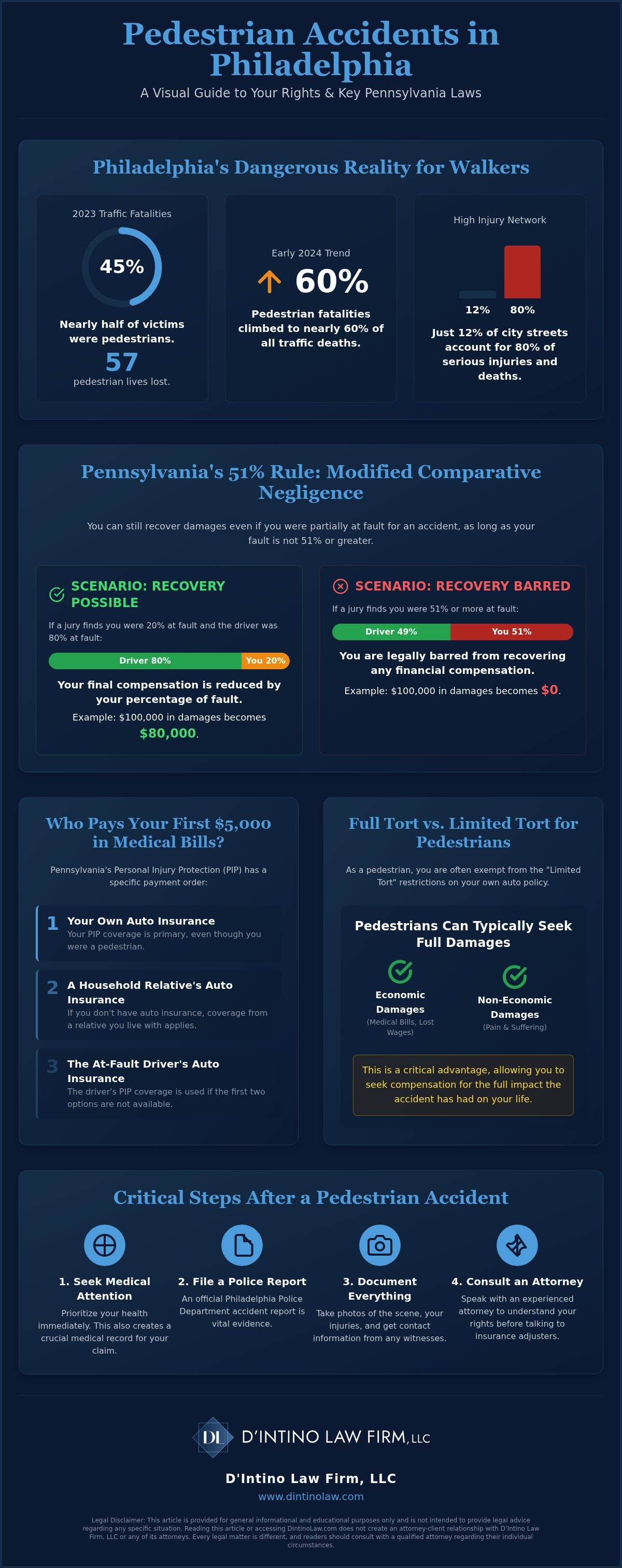
Philadelphia’s streets present a unique set of challenges for those on foot. In 2023, the city saw 126 traffic fatalities, and 57 of those victims were pedestrians. This means pedestrians represent nearly half of all traffic deaths in the city. By early 2024, that percentage climbed even higher, with pedestrians accounting for almost 60% of traffic fatalities. The vulnerability of walkers is often compounded by aging infrastructure, such as narrow sidewalks and poorly timed signals. When an accident occurs, contacting a pedestrian accident attorney Philadelphia PA is essential to understanding how these environmental factors impact your right to recovery.
Accidents aren’t distributed evenly across the city. While intersections are designed for crossing, many incidents occur mid-block where drivers don’t expect foot traffic. Urban corridors like those in Center City or North Philly face heavy vehicle congestion, increasing the risk of a collision. In these high-traffic areas, a momentary distraction by a driver can lead to life-altering consequences. Heavy vehicle traffic, including commercial trucks and delivery vans, significantly increases the force of impact, often leaving pedestrians with little chance of escaping without serious harm.
High-Risk Zones in Philadelphia
Philadelphia’s “High Injury Network” consists of just 12% of the city’s streets, yet these roads account for 80% of all traffic deaths and serious injuries. Roosevelt Boulevard and Broad Street remain some of the most dangerous stretches for walkers. Automated speed enforcement cameras on Roosevelt Boulevard have helped, reducing pedestrian-involved crashes by 50% according to 2024 data, but the risk remains high. Additionally, the presence of SEPTA trolley tracks and dedicated bus lanes adds a layer of complexity to urban navigation. The city’s “Vision Zero” initiative aims to eliminate traffic deaths through better street design, but progress remains slow on many dangerous corridors.
The Severity of Pedestrian Injuries
Without the protection of a vehicle frame, pedestrians often suffer catastrophic harm. Common injuries include traumatic brain injuries (TBIs), spinal cord damage, and complex bone fractures. These conditions often require long-term rehabilitation and lead to a significant loss of income. Beyond the physical pain, families face a heavy emotional and financial burden. Seeking an immediate medical evaluation is critical. It ensures your health is prioritized and creates a formal record for your legal claim. Understanding Jaywalking Laws and how they relate to the accident location is also a key part of the investigative process. A pedestrian accident attorney Philadelphia PA will examine these details to build a case that reflects the true extent of your losses.
Pennsylvania Pedestrian Laws: Understanding Negligence and Liability
Determining who is responsible for a collision involves more than just looking at who hit whom. In Pennsylvania, drivers owe a high “duty of care” to pedestrians because walkers are so vulnerable. This means motorists must stay alert, obey speed limits, and anticipate foot traffic in busy urban areas. However, pedestrians also have legal obligations. You’re expected to follow traffic signals and avoid “sudden darting” into the path of a vehicle that doesn’t have time to stop. When these duties clash, Pennsylvania’s negligence laws determine how much compensation you can recover. Pedestrians also face other dangers on city streets beyond vehicle traffic, including the risk of a dog attack while walking through a neighborhood — situations where a dog bite lawyer Philadelphia residents trust can help you understand your rights under Pennsylvania’s strict liability laws.
The Modified Comparative Negligence Standard
Pennsylvania follows a “modified comparative negligence” system. This means that even if you were partially at fault for the accident, you might still be able to collect damages. For example, if a jury finds a driver was 80% responsible for speeding, but you were 20% responsible for crossing outside a crosswalk, your final check would be reduced by that 20%. If your total damages were $100,000, you’d receive $80,000. In Pennsylvania, you are legally barred from recovering any financial compensation if your own negligence is determined to be 51% or greater. This “51% Rule” makes the initial investigation and evidence collection vital to your case. An experienced pedestrian accident attorney Philadelphia PA can help gather the facts needed to prove the driver’s primary responsibility.
Right-of-Way Rules in Philadelphia PA
The rules for who must yield depend heavily on where the accident happened. According to Pennsylvania Pedestrian Laws, drivers must yield the right-of-way to pedestrians in both marked and unmarked crosswalks at intersections. Drivers must also exercise caution when turning right on red, as they often overlook people stepping into the street. If you’re crossing mid-block where there is no crosswalk, you generally must yield to vehicles. While “jaywalking” isn’t a specific term in the state’s vehicle code, crossing illegally can be used as evidence of negligence against you. Because insurance companies often use these rules to shift blame onto the victim, having a pedestrian accident attorney Philadelphia PA to protect your interests is a strategic necessity. We’ll look at the specific traffic patterns and signal timings to ensure the law is applied fairly to your situation.
Insurance Coverage and the ‘Full Tort’ vs. ‘Limited Tort’ Debate
Pennsylvania’s insurance system is notoriously complex, especially when you’re a pedestrian caught in a collision. The state follows a specific hierarchy of coverage that determines who pays for your medical bills and whether you can sue for pain and suffering. If you were injured while crossing a busy street or navigating around SEPTA trolley tracks, the paperwork can be overwhelming. A pedestrian accident attorney Philadelphia PA is essential for identifying which insurance policy applies to your specific situation so you don’t leave money on the table.
PIP and First-Party Benefits
Pennsylvania is a “no-fault” state regarding medical expenses. This means that your own auto insurance policy is usually the first source of payment for your medical bills, regardless of who caused the accident. According to Pennsylvania’s official pedestrian laws and insurance regulations, the first $5,000 in medical costs is typically covered by Personal Injury Protection (PIP) benefits. If you don’t own a car, the hierarchy moves to a policy held by a relative living in your household. If no household policy exists, the insurance company of the driver who hit you becomes responsible for these initial costs. Once PIP benefits are exhausted, your private health insurance typically takes over as the secondary payer.
Full Tort Rights for Pedestrians
When you buy auto insurance in Pennsylvania, you must choose between “Full Tort” and “Limited Tort.” Many people select Limited Tort to save on monthly premiums, but this choice usually restricts their ability to sue for non-economic damages like pain and suffering unless they suffer a “serious injury.” However, there is a critical “pedestrian exception” that many insurance adjusters fail to mention. Even if you have a Limited Tort policy, you are generally treated as having Full Tort rights if you are struck by a vehicle while walking. This exception allows you to seek compensation for the full emotional and physical toll of the accident without meeting a specific injury threshold.
A philadelphia personal injury lawyer will carefully review your policy and the driver’s policy to confirm your status. In cases involving hit-and-runs, which accounted for nearly half of Philadelphia’s pedestrian deaths in early 2024, you may need to seek coverage through the Pennsylvania Assigned Claims Plan. This state-funded program provides a safety net of up to $15,000 for medical bills and injury claims when no other insurance is available. Identifying these various “buckets” of money is a strategic priority for any pedestrian accident attorney Philadelphia PA looking to secure your financial future.
Immediate Steps After a Philadelphia Pedestrian Accident
The moments after a collision are chaotic and frightening. Your priority must be physical safety and health. Move out of the flow of traffic if you can and call 911 immediately. In Philadelphia, a formal police report is a cornerstone of any legal claim. It provides an objective record of the time, location, and parties involved. Don’t let a driver talk you out of calling the police by offering cash or suggesting you handle it privately. Even if you feel fine, adrenaline often masks serious internal injuries that may not appear for hours or days.
Documenting the Scene and Injuries
If you are physically able, use your phone to capture the scene from multiple angles. Take photos of the vehicle’s position, any visible damage, and the surrounding road conditions. Check for traffic signals or signs that the driver may have ignored. In many Philadelphia neighborhoods, doorbell cameras or the city’s “Real Time Crime Center” cameras may have recorded the incident. Ask nearby business owners or residents if they saw what happened and collect their contact information. These witnesses can provide crucial testimony if the driver later changes their story.
Once you receive medical care, keep a detailed journal of your symptoms. Note how the injuries affect your daily life and track every medical appointment. This documentation becomes vital when a pedestrian accident attorney Philadelphia PA builds your case for compensation. Keeping an organized record of your recovery process helps demonstrate the true impact of the accident on your quality of life.
Avoiding Common Pitfalls
Be extremely careful about what you say to anyone at the scene. Never apologize or admit fault, as insurance companies can use these statements to deny your claim later. This caution extends to insurance adjusters who may call you shortly after the accident. They often push for recorded statements or offer quick settlements that don’t cover the full extent of your long-term needs. Signing an early release could prevent you from seeking further compensation if your condition worsens.
Timing is critical in Pennsylvania. Under state law, the statute of limitations for filing a personal injury lawsuit is generally two years from the date of the accident. However, if your claim involves a government entity or a public transit authority like SEPTA, you must file a formal notice within just six months. Missing these deadlines can permanently bar you from seeking recovery. To ensure your rights are fully protected, you should consult with a pedestrian accident attorney Philadelphia PA as soon as possible.
Strategic Advocacy: How D’Intino Law Firm, LLC Approaches Your Claim
Choosing the right pedestrian accident attorney Philadelphia PA can fundamentally change the outcome of your case. Many large firms operate as “case factories,” where clients are handed off to junior associates or support staff. At D’Intino Law Firm, LLC, we prioritize a boutique experience. Attorney John D’Intino Jr. handles every case personally, ensuring you have a seasoned advocate by your side from the initial consultation through the final resolution. This direct accountability means your questions are answered by the person actually doing the legal work, not a middleman.
Our approach is built on aggressive investigation and strategic preparation. We don’t just wait for the police report to arrive. We proactively gather evidence, which often includes accident reconstruction and expert testimony to clarify exactly how the collision occurred. This is particularly vital in Pennsylvania when the “51% Rule” is in play. By proving the driver’s negligence with scientific precision, we protect your right to recover damages even if the insurance company tries to shift the blame onto you.
Personalized Attention vs. ‘Case Factories’
We intentionally limit our caseload to maintain a high standard of service. This allows us to focus on the specific details of your life and your recovery. You aren’t just a file number here; you’re a person who has faced a life-altering event. We maintain constant availability and responsiveness throughout the legal process so you never feel left in the dark. If your family is dealing with the loss of a loved one due to a driver’s negligence, we provide compassionate support through our wrongful death attorney Philadelphia PA guide, helping you understand the path toward justice.
Building a Comprehensive Damage Claim
Calculating the true value of a claim requires looking far beyond today’s medical bills. We work to identify both economic and non-economic damages to ensure your settlement or verdict covers the long-term reality of your injuries. This includes factoring in future medical needs, specialized rehabilitation, and any diminished earning capacity if you can’t return to your previous job. We also fight for compensation regarding the emotional toll the accident has taken on you and your family. In some cases, a collision is caused by more than just a reckless driver. If a property defect or poor maintenance contributed to your fall or accident, we can also serve as your premises liability lawyer Philadelphia to hold all negligent parties accountable. Similarly, if you were injured by an unleashed or aggressive animal while walking, our team can act as your dog bite lawyer Philadelphia residents rely on to pursue compensation under Pennsylvania’s strict liability statutes.
Preparing every case for trial is our standard practice. While many claims are resolved through negotiation, we believe that an assertive, trial-ready stance leads to better outcomes. When insurance adjusters know we are prepared to present your case to a Pennsylvania jury, they are more likely to offer a resolution that truly reflects your losses. As your pedestrian accident attorney Philadelphia PA, our goal is to provide the tenacity needed to secure justice.
If you have concerns about a recent accident or questions about your rights, we invite you to reach out. Contact D’Intino Law Firm, LLC regarding your legal concerns to discuss your situation with an attorney who is personally invested in your success.
Legal Disclaimer: This article is provided for general informational and educational purposes only and is not intended to provide legal advice regarding any specific situation. Reading this article or accessing DintinoLaw.com does not create an attorney-client relationship with D’Intino Law Firm, LLC or any of its attorneys. Every legal matter is different, and readers should consult with a qualified attorney regarding their individual circumstances.
Securing Your Financial Recovery and Peace of Mind
Recovery after a collision in Pennsylvania requires a strategic approach to insurance and negligence laws. You now know that pedestrians often maintain Full Tort rights and that the state’s hierarchy of coverage provides essential medical benefits. Protecting these rights requires swift action to meet legal deadlines. A pedestrian accident attorney Philadelphia PA helps you navigate these hurdles while you focus on healing.
Attorney John D’Intino Jr. offers over 20 years of experience and handles every case personally. You receive the direct accountability of a seasoned advocate invested in your success. We work on a contingency basis; there are no fees unless we recover compensation. Contact D’Intino Law Firm, LLC for a free consultation regarding your pedestrian accident claim. We are ready to provide the assertive support you need to move forward.
Legal Disclaimer: This article is provided for general informational and educational purposes only and is not intended to provide legal advice regarding any specific situation. Reading this article or accessing DintinoLaw.com does not create an attorney-client relationship with D’Intino Law Firm, LLC or any of its attorneys. Every legal matter is different, and readers should consult with a qualified attorney regarding their individual circumstances.
Frequently Asked Questions
What if I was hit by a car while walking but don’t have my own car insurance?
You can still receive medical benefits even if you don’t own a vehicle. In Pennsylvania, the insurance hierarchy dictates that you first look to a household relative’s auto policy for coverage. If that is not available, the insurance company of the driver who hit you is responsible for your initial medical bills through Personal Injury Protection (PIP). If no insurance exists at all, the Pennsylvania Assigned Claims Plan provides a safety net for your expenses.
Can I still file a claim if I was crossing the street outside of a crosswalk in Philadelphia?
Yes, you can still pursue a claim for your injuries. Pennsylvania uses a modified comparative negligence system, which means you can recover damages as long as you aren’t more than 50% at fault. While crossing outside a crosswalk might reduce your final compensation if you’re found partially negligent, it doesn’t automatically bar you from recovery. A pedestrian accident attorney Philadelphia PA can help prove the driver’s primary responsibility for the collision.
How long do I have to file a pedestrian accident lawsuit in Pennsylvania?
The general statute of limitations is two years from the date of the accident. This is a strict deadline set by Pennsylvania law. If your claim involves a government entity, such as a city vehicle or SEPTA, you must provide a formal notice of intent to sue within just six months. Missing these deadlines will likely result in the loss of your right to seek any financial compensation for your losses.
Who is responsible if a hit-and-run driver strikes a pedestrian?
Responsibility primarily lies with the fleeing driver, but you have other avenues for recovery. You may use your own uninsured motorist (UM) coverage if you have an auto policy. If no personal or household insurance is available, you can apply for benefits through the Pennsylvania Assigned Claims Plan. This plan covers medical bills and basic injury losses for victims of unidentified drivers who are struck while walking on Pennsylvania streets.
Will my insurance rates go up if I file a claim after being hit as a pedestrian?
Generally, no. Pennsylvania law prohibits insurance companies from increasing your premiums if you weren’t at fault for the accident. Since you were a pedestrian struck by a vehicle, the claim is typically filed against the driver’s liability policy or under your own “no-fault” medical benefits. Your insurer shouldn’t penalize you for using the medical coverage you’ve already paid for. We can help you navigate these communications to protect your standing.
What kind of compensation can I recover in a Philadelphia pedestrian accident case?
You can seek both economic and non-economic damages. Economic damages cover tangible losses like medical bills, physical therapy, and lost wages. Non-economic damages address intangible impacts such as pain and suffering, emotional distress, and loss of enjoyment of life. Because pedestrians in Pennsylvania are often exempt from Limited Tort restrictions, you can usually sue for these non-economic damages even if you have a basic insurance policy with Limited Tort selected.
How is fault determined if both the driver and the pedestrian were partially responsible?
Fault is determined by examining evidence like witness statements, camera footage, and police reports. Pennsylvania follows the “51% Rule” for modified comparative negligence. If you’re found to be 20% responsible for the accident, your total compensation is reduced by 20%. However, if your fault reaches 51%, you cannot recover any damages from the other party. A pedestrian accident attorney Philadelphia PA ensures your side of the story is heard clearly.
Do I need to go to court for a pedestrian accident claim?
Not necessarily. Most personal injury claims in Philadelphia are settled through negotiations with insurance companies before a trial ever begins. However, if the insurer refuses to offer a fair settlement that covers your full losses, filing a lawsuit and appearing in court may be required. We prepare every case as if it is going to trial to ensure we are ready for any outcome that protects your future.
If you have questions about your specific situation or need help navigating the aftermath of a collision, we invite you to reach out. Contact D’Intino Law Firm, LLC regarding your legal concerns to discuss your path forward with an experienced advocate.
Legal Disclaimer: This article is provided for general informational and educational purposes only and is not intended to provide legal advice regarding any specific situation. Every legal matter is different, and readers should consult with a qualified attorney regarding their individual circumstances.
Disclaimer
Legal Disclaimer: The information provided on DintinoLaw.com, including articles, blog posts, testimonials, case results, and other content, is for general informational and educational purposes only and does not constitute legal advice or create an attorney-client relationship with D’Intino Law Firm, LLC or any of its attorneys. Visiting this website, submitting a contact form, sending an email, calling, texting, or otherwise communicating with the firm does not establish an attorney-client relationship or obligate the firm to represent you. Do not submit confidential, privileged, or time-sensitive information through this website or electronic communications unless and until the firm has expressly agreed to represent you. Legal rights, procedures, statutes of limitation, filing deadlines, and other requirements vary based on the facts and jurisdiction and may change over time; nothing on this website should be relied upon to determine whether a legal deadline applies to your matter. If you have an urgent legal matter or a potential filing deadline, consult a qualified attorney promptly. Testimonials and statements regarding client experiences are individual opinions and experiences and are not a guarantee of future results. Prior results, verdicts, settlements, or case examples do not guarantee or predict the outcome of any future case, and every matter is different. This website may constitute attorney advertising under applicable Pennsylvania rules. D’Intino Law Firm, LLC makes no representation that the information on this website is complete, current, or applicable to your particular circumstances. For legal advice concerning your specific situation, consult directly with a qualified Pennsylvania attorney. D’Intino Law Firm, LLC | Philadelphia, Pennsylvania | DintinoLaw.com
