


Attorney
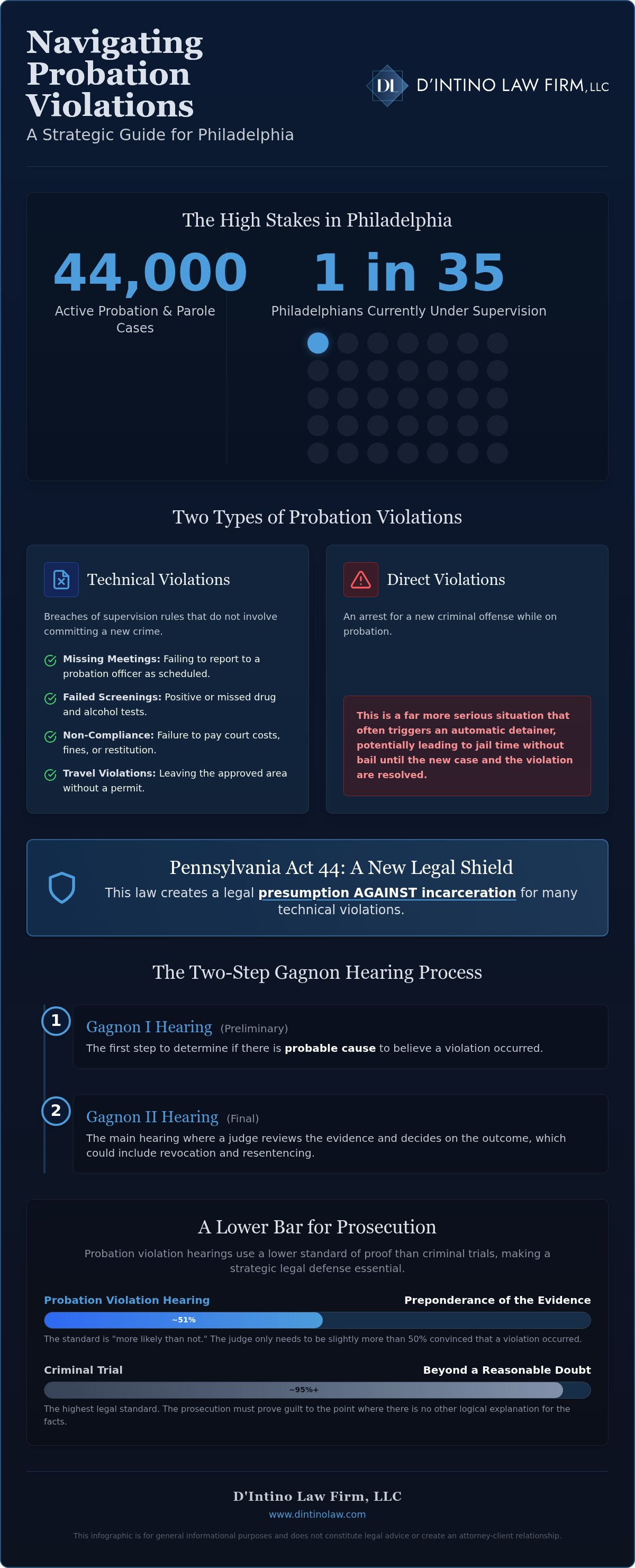
With roughly 1 in every 35 Philadelphians currently under supervision, the Philadelphia Adult Probation and Parole Department manages a staggering 44,000 cases. It’s an overwhelming system where a single technical mistake can feel like an immediate ticket back to a cell. If you’re facing these high stakes, talking to a probation violation lawyer Philadelphia is the first step toward protecting your future. You likely feel the weight of this pressure every day, fearing that one missed appointment or a misunderstood rule will undo all the progress you’ve made. It’s a stressful reality, especially when the threat of a detainer looms over your family and your job.
The good news is that a violation notice isn’t a final verdict. You can challenge the prosecution’s case using the latest 2026 legal standards. Under Pennsylvania Act 44, there’s now a legal presumption against incarceration for technical violations, which provides powerful tools to keep you home. This article provides a strategic checklist to help you navigate Gagnon I and II hearings, move to lift your detainer, and focus on reinstating your probation terms.
Legal Disclaimer: This article is provided for general informational and educational purposes only and is not intended to provide legal advice regarding any specific situation. Reading this article or accessing DintinoLaw.com does not create an attorney-client relationship with D’Intino Law Firm, LLC or any of its attorneys. Every legal matter is different, and readers should consult with a qualified attorney regarding their individual circumstances.
Key Takeaways
- Understand the critical distinctions between Gagnon I and Gagnon II hearings to navigate the Pennsylvania court process with confidence.
- Learn how the 2026 legal standards under Pennsylvania Act 44 create a strong presumption against incarceration for technical probation violations.
- Identify the essential documentation and immediate actions needed to build a robust defense package and challenge a potential detainer.
- Discover how a probation violation lawyer Philadelphia uses strategic motions to advocate for your release and the reinstatement of your supervision terms.
- Gain insight into the benefits of direct, hands-on representation where your case is handled personally by an attorney with over 20 years of local experience.
Understanding Probation Violations in Philadelphia
In Pennsylvania, a Violation of Probation (VOP) occurs when you fail to comply with the specific terms set by a judge during your original sentencing. It’s a breach of a court order, not just a minor administrative oversight. The Philadelphia Adult Probation and Parole Department (APPD) supervises approximately 44,000 individuals, and their primary role is to monitor your compliance. When they believe a violation has occurred, they notify the court, which can lead to a warrant for your arrest or a detainer that keeps you in custody until a hearing. Understanding the nuances of Understanding Probation is the first step in protecting your rights. If you find yourself in this position, a probation violation lawyer Philadelphia can help you understand the specific allegations against you and build a defense to keep you out of prison.
The stakes in a VOP hearing are exceptionally high. Unlike a standard criminal trial, the judge has broad discretion. If a violation is proven, the judge can revoke your probation entirely and impose any sentence that was legally available at the time of your original conviction. This means a technical slip-up could potentially lead to years in state prison if not handled with a strategic defense.
Technical Violations: Common Pitfalls
Technical violations are breaches of the rules of your supervision that don’t involve committing a new crime. Since the implementation of Pennsylvania Act 44 on June 11, 2024, the law now presumes that incarceration is not the appropriate response for these minor infractions. However, you can still face jail time if the court finds you are a threat to public safety or have repeatedly ignored the rules. Common technical violations include:
- Missing scheduled meetings: Failing to report to your probation officer as required is one of the most frequent triggers for a VOP.
- Failed drug or alcohol screenings: Testing positive for controlled substances or missing a required test can lead to immediate reports to the court.
- Financial non-compliance: Failure to pay court costs, fines, or restitution as ordered.
- Travel restrictions: Leaving Philadelphia or Pennsylvania without receiving an official travel permit from your officer.
Direct Violations: New Criminal Charges
A direct violation occurs when you’re arrested for a new crime while still on probation. This is a far more serious situation because it often triggers an automatic detainer, especially if the new charges are felonies. In these cases, you might be held in jail without bail until both the new case and the probation violation are resolved. If you’re facing new allegations, the strategy used by your assault defense attorney Philadelphia PA can directly impact your VOP outcome. Successfully defending against the new charges or negotiating a favorable resolution is often the most effective way to prevent a judge from revoking your probation and sending you back to prison. When the pressure is on, a probation violation lawyer Philadelphia will fight to show the court that a new arrest shouldn’t result in the loss of your freedom.
The Gagnon Hearing Process: What to Expect
Pennsylvania law protects your due process rights through a mandatory two-hearing requirement. These are known as Gagnon I and Gagnon II hearings. Unlike a traditional criminal trial where the prosecution must prove guilt “beyond a reasonable doubt,” VOP hearings use a lower “preponderance of the evidence” standard. This means the judge only needs to find it’s more likely than not that you violated a condition of your supervision. Because the bar for the prosecution is lower, having a probation violation lawyer Philadelphia is vital to challenging the evidence presented against you.
In Philadelphia, the judge makes the final determination, but the probation officer acts as the primary witness for the Commonwealth. They provide the report that outlines your alleged failures and often make a recommendation for sentencing. Philadelphia courts handle a significantly higher volume of cases than many other Pennsylvania County Probation Offices, which often leads to a faster pace in the courtroom. You need a defense that is both concise and persuasive to stand out in a crowded docket.
Gagnon I: The Detainer Hearing
The Gagnon I hearing is a preliminary step to determine if there’s probable cause for the violation. This is the stage where the “detainer” is usually addressed. A detainer is a court order that keeps you in custody until your final hearing, even if you could otherwise post bail on a new charge. It’s a frustrating and frightening situation that can lead to weeks or months of incarceration before you even have a chance to explain yourself. A skilled lawyer can argue for the detainer to be lifted immediately, focusing on your community ties and compliance history to get you back home.
Gagnon II: The Violation Hearing
The Gagnon II hearing is the formal revocation hearing. Here, the judge decides if a violation actually occurred and determines the appropriate penalty. You have the right to present your own evidence, call character witnesses, and offer mitigating circumstances to explain the situation. This is your chance to show the judge that incarceration isn’t the only solution. Whether you’re aiming to have your probation reinstated or seeking a modified sentence, the way your story is told to the court matters. If you’re feeling overwhelmed by the process, consulting with an experienced advocate can provide the clarity and direction you need.
Legal Disclaimer: This article is provided for general informational and educational purposes only and is not intended to provide legal advice regarding any specific situation. Reading this article or accessing DintinoLaw.com does not create an attorney-client relationship with D’Intino Law Firm, LLC or any of its attorneys. Every legal matter is different, and readers should consult with a qualified attorney regarding their individual circumstances.
The 2026 Philadelphia Probation Defense Checklist
Suspecting a violation of your supervision is a high-pressure situation that requires immediate, calculated action. In Philadelphia, the speed at which the Adult Probation and Parole Department moves can be overwhelming. If you believe you’ve missed a drug test or failed to report, the worst thing you can do is wait for a warrant to be issued. Instead, you should proactively gather information and secure representation from a probation violation lawyer Philadelphia. Taking control of the narrative early often makes the difference between a lifted detainer and months of unnecessary incarceration.
Step 1: Immediate Legal Consultation
Don’t attempt to “explain away” a violation to your probation officer without a lawyer present. Anything you say can be used as an admission of guilt during your Gagnon hearings. If the violation stems from a new arrest, you may need a felony defense attorney Philadelphia to handle the substantive charges while your VOP lawyer manages the detainer. Your attorney can review the Philadelphia County Probation and Parole Contact Information to communicate with your officer directly. This professional barrier protects you from self-incrimination. In some cases, your lawyer may even arrange a voluntary surrender, which demonstrates respect for the court and can be a powerful argument for your release.
Step 2: Evidence and Mitigation Gathering
A successful defense relies on proof of your progress and stability. You need a “mitigation package” that shows the judge you’re a productive member of the community. Don’t wait for your hearing date to start collecting these documents. You’ll need clear, verifiable evidence to counter the probation officer’s report. Focus on the following items:
- Employment and Education: Recent pay stubs, a letter from your employer confirming your schedule, or enrollment verification from a school or vocational program.
- Treatment Compliance: Attendance logs from AA/NA meetings, certificates of completion from counseling, or letters from treatment providers.
- Community Ties: Character letters from family members, religious leaders, or community mentors that speak to your personal growth.
- Hardship Documentation: If a technical violation occurred due to a medical emergency or family crisis, provide hospital records or death certificates to verify your claim.
Preparing for the Philadelphia courtroom environment means being organized and ready to present these facts decisively. When you walk into the Justice Juanita Kidd Stout Center for Criminal Justice, your documentation should be ready to present to the judge. This level of preparation shows the court that you take your supervision seriously and are committed to complying with Pennsylvania law.
Legal Disclaimer: This article is provided for general informational and educational purposes only and is not intended to provide legal advice regarding any specific situation. Every legal matter is different, and readers should consult with a qualified attorney regarding their individual circumstances.
Strategies to Lift a Detainer and Avoid Prison
Lifting a detainer is often the most urgent hurdle in a VOP case. In Philadelphia, a detainer acts as a hold that keeps you in jail even if you have bail on a new charge or if the violation is purely technical. To fight this, your probation violation lawyer Philadelphia will file a Motion to Lift Detainer. This motion asks the sentencing judge to release you pending the final Gagnon II hearing. Success requires more than just a request. It requires a compelling argument that you aren’t a flight risk or a danger to the community. When your freedom is at stake, you need a probation violation lawyer Philadelphia who knows how to push back against the prosecution’s narrative.
Negotiating with the District Attorney and the Probation Department is a critical part of this strategy. Sometimes, an agreement can be reached where the Commonwealth agrees to lift the detainer in exchange for increased supervision or entry into a specific program. Proposing alternative sanctions like house arrest or intensive treatment often provides a middle ground. It satisfies the court’s need for accountability without resorting to incarceration.
Utilizing 2026 Pennsylvania Probation Reforms
The legal landscape changed significantly with the implementation of Pennsylvania Act 44. Since June 11, 2024, there’s a strong presumption against ordering prison time for technical violations. For a first-time technical violation, the law now caps incarceration at 14 days. A second violation is capped at 30 days. These statutory guidelines are designed to be rehabilitative rather than purely punitive. Your defense must ensure the court adheres to these latest rules. This prevents an overzealous judge from imposing a sentence that exceeds these new legal limits.
Presenting a Comprehensive Mitigation Plan
A judge is far more likely to release you if they see a concrete path forward. This plan should highlight a stable residence and a reliable support system. It’s about proving that you have more to lose by failing than by succeeding. We often use our experience with criminal record expungement Pennsylvania to demonstrate a client’s long-term commitment to rehabilitation. Showing the court that you’ve previously taken steps to clear your name proves you value your freedom. It shows you understand the weight of a clean record. If you’re currently held on a detainer, contact D’Intino Law Firm, LLC to discuss a strategic motion for your release.
Legal Disclaimer: This article is provided for general informational and educational purposes only and is not intended to provide legal advice regarding any specific situation. Every legal matter is different, and readers should consult with a qualified attorney regarding their individual circumstances.
Why Direct Representation from John D’Intino Jr. Matters
Large law firms often treat probation violations as routine administrative tasks. They might assign your case to a junior associate who lacks the deep roots needed to navigate the Philadelphia court system effectively. When you hire a probation violation lawyer Philadelphia at D’Intino Law Firm, LLC, you get a “No Hand-Off” guarantee. This means John D’Intino Jr. personally handles every aspect of your defense. With over 20 years of experience in Pennsylvania law, he understands how local judges view specific violations and what evidence they find most compelling. He knows the rhythms of the Justice Juanita Kidd Stout Center for Criminal Justice and the specific expectations of the Philadelphia Adult Probation and Parole Department.
A limited caseload allows for a personalized strategy that isn’t possible at high-volume firms. This direct attorney-client interaction is critical during high-stakes Gagnon hearings. You aren’t just another file on a desk; you’re an individual with a family and a future worth protecting. John brings trial-ready advocacy to every hearing, ensuring your side of the story is told with the same intensity as a major criminal trial. This hands-on approach ensures that no detail of your mitigation package is overlooked.
A Strategic Fighter in Your Corner
John D’Intino Jr. has built a reputation as a tenacious advocate for those facing probation revocations. He doesn’t just show up; he fights. Whether it’s challenging the technicality of a missed appointment or presenting a complex mitigation package for a direct violation, he provides direct accountability. You’ll know exactly who is standing next to you at the defense table. The firm prioritizes transparent communication and offers flexible payment options, so you can focus on your case without the added stress of financial uncertainty. This boutique experience means you have a seasoned expert personally invested in your success.
Contact D’Intino Law Firm, LLC Today
If you’re worried about a detainer or an upcoming hearing, the time to act is now. You can schedule a free, confidential consultation to discuss your situation and begin building your defense. Before your first meeting with John D’Intino Jr., gather any relevant paperwork, such as your probation terms or notice of violation. The firm can take immediate steps to address your detainer and communicate with the Philadelphia Adult Probation and Parole Department on your behalf. We are here to provide the elite, tailored service you need during this life-altering situation. Don’t wait for the system to decide your future. Reach out to D’Intino Law Firm, LLC regarding your legal concerns today.
Legal Disclaimer: This article is provided for general informational and educational purposes only and is not intended to provide legal advice regarding any specific situation. Every legal matter is different, and readers should consult with a qualified attorney regarding their individual circumstances.
Take Decisive Action to Protect Your Future
Facing a probation violation in Pennsylvania is a high-stakes challenge, but it’s a procedural battle you can win. By understanding the Gagnon hearing process and leveraging 2026 legal protections under Act 44, you can advocate for a resolution that keeps you home. Building a robust mitigation package and challenging a detainer are the first steps toward reclaiming your life. Partnering with a probation violation lawyer Philadelphia provides the hands-on defense needed for these complex proceedings.
John D’Intino Jr. brings over 20 years of experience. He provides trial-ready advocacy and direct accountability. You’ll work directly with him, ensuring your case receives the personalized attention it deserves. Contact D’Intino Law Firm, LLC today for a free consultation regarding your probation concerns. We are ready to stand by your side and protect your freedom.
Legal Disclaimer: This article is provided for general informational and educational purposes only and is not intended to provide legal advice regarding any specific situation. Every legal matter is different, and readers should consult with a qualified attorney regarding their individual circumstances.
Frequently Asked Questions
What is the difference between a Gagnon I and a Gagnon II hearing?
A Gagnon I hearing is a preliminary proceeding held to determine if probable cause exists to believe you violated your probation. It’s also the stage where a judge decides whether to maintain or lift a detainer. The Gagnon II hearing is the formal revocation hearing. During this second stage, the court makes a final determination on the violation and decides if your probation should be reinstated, modified, or revoked in favor of incarceration.
Can I be sent to jail for a first-time technical probation violation in Philadelphia?
Under Pennsylvania Act 44, there’s a strong legal presumption against jail time for technical violations. For a first-time technical offense, the law generally caps incarceration at 14 days. A judge can only exceed these limits if they find you pose a specific threat to public safety or have absconded. Working with a probation violation lawyer Philadelphia ensures the court follows these 2026 sentencing caps and prioritizes rehabilitative measures over prison.
How long does it take to get a probation detainer lifted?
The timeline varies based on the court’s docket, but a motion to lift a detainer can be filed and argued as early as the Gagnon I hearing. If the motion isn’t addressed then, your attorney can request a separate detainer hearing. This process usually takes a few weeks. Promptly gathering your mitigation evidence and having an advocate communicate with the probation department can sometimes speed up the court’s decision-making process.
Will I automatically go to jail if I am arrested on new charges while on probation?
Incarceration isn’t automatic, but a new arrest often triggers a “lodged detainer.” This hold prevents you from being released even if you post bail on the new charges. You’ll likely remain in custody until a judge addresses the detainer at a hearing. Successfully defending the new substantive charges is the most effective way to prevent a permanent revocation of your probation and a subsequent prison sentence for the direct violation.
Can a private lawyer help me more than a public defender in a VOP case?
A private attorney like John D’Intino Jr. provides direct accountability and a limited caseload that ensures your file gets personalized attention. Public defenders are often overwhelmed with hundreds of cases, which can lead to limited communication. With private representation, you work directly with a seasoned advocate who handles the Gagnon hearings himself. This “no hand-off” approach allows for a more detailed mitigation package and a consistent strategy throughout your case.
What happens if I miss a meeting with my probation officer in Philadelphia?
Missing a meeting is considered a technical violation. Your probation officer might issue a warning, but they also have the authority to report the violation to the court and request a warrant. If you miss a meeting, you should contact your officer immediately to explain the situation. Documenting a valid reason, such as a medical emergency or a transportation breakdown, is essential for your probation violation lawyer Philadelphia to argue against a detainer.
Are there new laws in Pennsylvania that help with probation violations in 2026?
The most significant reform remains Pennsylvania Act 44 of 2023, which went into effect in mid-2024. This law created mandatory sentencing caps for technical violations and established a “presumption against total confinement.” In 2026, Philadelphia courts are more focused on data-driven outcomes and rehabilitative sanctions. These rules limit a judge’s ability to send you to prison for minor mistakes like failed drug tests or missed appointments, provided you aren’t a public safety risk.
What should I bring to my probation violation hearing?
You should bring a comprehensive “mitigation package” that proves your stability and compliance. This includes recent pay stubs, proof of school enrollment, and certificates from any completed treatment programs or counseling sessions. Character letters from employers, family, or community leaders are also highly persuasive. These documents show the judge that you’re a productive member of society. Providing this evidence helps your attorney argue that your probation should be reinstated rather than revoked.
Legal Disclaimer: This article is provided for general informational and educational purposes only and is not intended to provide legal advice regarding any specific situation. Every legal matter is different, and readers should consult with a qualified attorney regarding their individual circumstances.
Disclaimer
Legal Disclaimer: The information provided on DintinoLaw.com, including articles, blog posts, testimonials, case results, and other content, is for general informational and educational purposes only and does not constitute legal advice or create an attorney-client relationship with D’Intino Law Firm, LLC or any of its attorneys. Visiting this website, submitting a contact form, sending an email, calling, texting, or otherwise communicating with the firm does not establish an attorney-client relationship or obligate the firm to represent you. Do not submit confidential, privileged, or time-sensitive information through this website or electronic communications unless and until the firm has expressly agreed to represent you. Legal rights, procedures, statutes of limitation, filing deadlines, and other requirements vary based on the facts and jurisdiction and may change over time; nothing on this website should be relied upon to determine whether a legal deadline applies to your matter. If you have an urgent legal matter or a potential filing deadline, consult a qualified attorney promptly. Testimonials and statements regarding client experiences are individual opinions and experiences and are not a guarantee of future results. Prior results, verdicts, settlements, or case examples do not guarantee or predict the outcome of any future case, and every matter is different. This website may constitute attorney advertising under applicable Pennsylvania rules. D’Intino Law Firm, LLC makes no representation that the information on this website is complete, current, or applicable to your particular circumstances. For legal advice concerning your specific situation, consult directly with a qualified Pennsylvania attorney. D’Intino Law Firm, LLC | Philadelphia, Pennsylvania | DintinoLaw.com
