


Attorney
Did you know that the first offer an insurance company sends is often designed to see how little you’ll accept rather than what your case is actually worth? When you’re facing a stack of medical bills and the stress of missed paychecks, that initial check might look like a lifeline. However, accepting it too soon could mean leaving thousands of dollars on the table. You’re likely asking yourself, “how much is my injury claim worth Philadelphia?” while trying to manage the physical and emotional toll of an accident.
We understand the anxiety that comes with financial uncertainty and the pressure to settle quickly. This 2026 valuation guide is designed to replace that confusion with clarity. You’ll learn exactly how settlements are calculated under Pennsylvania legal standards and what factors truly drive the value of a case in our local courts. We’ll walk through the critical differences between economic damages and non-economic losses, such as pain and suffering. By the end of this article, you’ll have a realistic framework for your recovery and the strategic steps needed to ensure you aren’t forced to settle for less than you deserve.
Key Takeaways
- Learn how “boarded damages” and non-economic losses form the foundation of a comprehensive personal injury claim in Pennsylvania.
- Discover the critical factors that influence how much is my injury claim worth Philadelphia, including injury severity and the clarity of liability.
- Understand the specific calculation methods, such as the Multiplier Method, used to put a fair value on pain and suffering.
- Explore the “Philadelphia Factor” and how filing in the local Court of Common Pleas compares to neighboring jurisdictions.
- Identify how a personalized, trial-ready strategy helps you avoid the low-ball offers common with high-volume settlement mills.
Understanding Economic vs. Non-Economic Damages in Pennsylvania
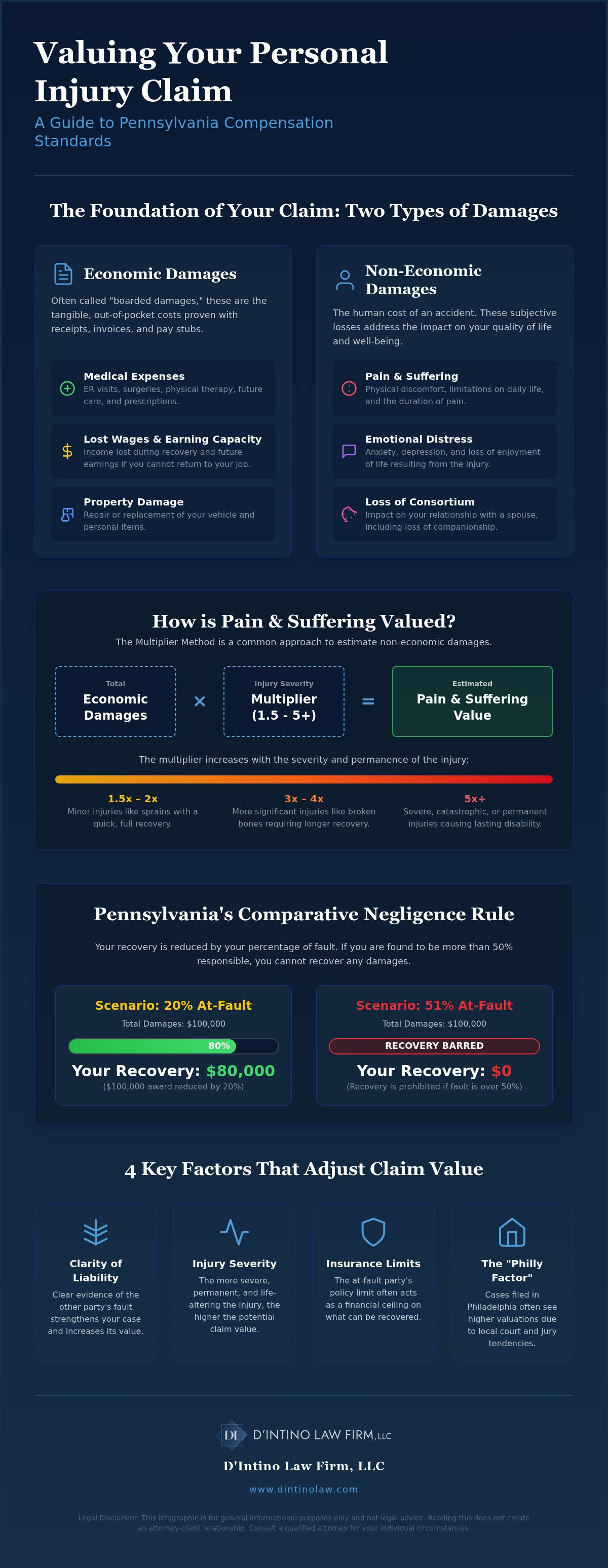
In the Pennsylvania legal system, the financial recovery you seek is divided into two main categories: economic and non-economic damages. Attorneys often refer to economic losses as “boarded damages.” These are the objective, out-of-pocket costs we can prove with receipts, invoices, and pay stubs. They form the foundation of your case. If you’re wondering how much is my injury claim worth Philadelphia, the answer starts with a meticulous itemization of these costs. Without a clear paper trail, insurance companies will quickly attempt to minimize your losses.
A strategic approach involves projecting future medical needs and lost earning capacity. If an injury prevents you from returning to your specific career path, that long-term loss must be part of the calculation. We look at what you’ve already spent and what you’ll need to survive in the years ahead. Capturing these details early prevents you from being stuck with bills long after your case has closed.
Types of Economic Damages You Can Recover
Economic damages are the “hard numbers” of your claim. We focus on capturing every single expense to ensure your recovery is full and fair.
- Medical expenses: This includes ER visits, surgeries, physical therapy, and any specialized care you’ll need in the future. It also covers medical equipment and prescriptions.
- Lost wages: We calculate the income you lost while recovering. This also includes the value of any sick leave or vacation time you were forced to use.
- Property damage: In cases like car accidents, this covers the repair or replacement of your vehicle and any personal items damaged during the incident.
The Scope of Non-Economic Damages in Philadelphia
Non-economic damages address the human cost of an accident. These are more subjective but often represent the most significant part of a settlement in Philadelphia courts. When calculating how much is my injury claim worth Philadelphia, these factors are vital for a complete recovery.
- Physical pain and suffering: This accounts for the actual physical discomfort and the way it limits your daily life. It considers both the intensity and the duration of your pain.
- Emotional distress: Injuries often lead to anxiety, depression, or loss of enjoyment of life. These mental health impacts are valid and recoverable under Pennsylvania law.
- Loss of consortium: This recognizes how your injury has damaged your relationship with your spouse or family members, including the loss of companionship and support.
Key Factors That Influence How Much Your Injury Claim is Worth
Determining how much is my injury claim worth Philadelphia isn’t just about adding up bills. It’s about looking at the specific variables that can either amplify or restrict your recovery. If liability is clear, your case has a higher floor. If there’s a dispute about who caused the accident, the insurance company will use that uncertainty to slash their offer. Every detail, from the moment of impact to the final medical report, plays a role in the final number.
Liability and the Burden of Proof
To win a personal injury case in Pennsylvania, you must prove four specific elements: a duty of care existed, that duty was breached, the breach caused your injury, and you suffered actual damages. Evidence like police reports and witness statements are the tools we use to build this proof. Beyond the facts, a defendant’s behavior matters. If a driver was reckless or intoxicated, a jury is often more inclined to award higher damages.
Pennsylvania’s modified comparative negligence law also plays a major role. If you’re found partially at fault, your award is reduced by your percentage of responsibility. For example, if your case is worth $100,000 but you’re 20% at fault, you’ll only receive $80,000. If you’re more than 50% responsible, you can’t recover any damages at all. This makes early evidence gathering vital to protect your claim’s value.
Insurance Coverage Realities
Even the strongest case faces a “financial ceiling” set by insurance policy limits. If a driver only has the state minimum coverage, that might be all that’s available from their side. This is why Uninsured and Underinsured Motorist (UM/UIM) coverage is so important for Philadelphia residents. It protects you when the other person’s insurance falls short of covering your total losses.
Commercial policies, such as those for trucking companies or large businesses, usually have much higher limits than private auto insurance. This can significantly change the valuation of a claim. Another major factor in Pennsylvania is your tort election. If you chose “limited tort” on your own policy, you’ve restricted your right to sue for pain and suffering unless your injury meets a “serious” threshold. “Full tort” gives you unrestricted rights to seek non-economic damages regardless of the injury’s severity. Understanding these insurance nuances is why having a dedicated personal injury advocate is essential for protecting your financial future.
Common Calculation Methods for Pain and Suffering
While medical bills are easy to track, calculating pain and suffering is more subjective. There isn’t a single “standard” formula in Pennsylvania. Instead, legal professionals and insurance adjusters use specific frameworks to estimate these non-economic losses. When you ask how much is my injury claim worth Philadelphia, the answer often depends on which of these methods best captures your unique experience. Insurance companies frequently use software to generate a range, but these programs often fail to account for the human element of a claim.
The Multiplier Method Breakdown
This is the most frequent approach used by insurance companies and attorneys. It starts with your total economic damages, like medical bills and lost wages, and multiplies that sum by a number usually between 1.5 and 5. The multiplier method serves as a tool for scaling human impact relative to medical costs.
- 1.5x to 2x: Used for minor injuries with relatively short recovery times and no permanent effects.
- 3x to 4x: Applied to significant injuries that require surgery, extensive physical therapy, or long-term medication.
- 5x or more: Reserved for catastrophic injuries, permanent disability, or severe scarring.
Catastrophic injuries justify the highest multipliers because they fundamentally alter a person’s quality of life. In these high-stakes cases, the “human cost” far outweighs the literal price of the medical procedures. A trial-ready approach ensures that the multiplier used reflects the true severity of the disruption to your life. For readers seeking similar dedicated representation in other regions, the Fenderson Law Firm applies these same rigorous standards to personal injury cases in Florida.
The Per Diem (Daily Rate) Approach
The per diem method assigns a specific dollar value to every day you lived with pain or physical limitations. This calculation spans from the date of the accident until you reach “maximum medical improvement” (MMI). MMI is the point where a doctor determines your condition likely won’t improve further with additional treatment.
Justifying a daily rate often involves looking at your prior earnings or specific lifestyle impacts. For instance, if your injury prevents you from caring for your children or participating in a lifelong hobby, the daily rate should reflect that loss. This method is often more effective than the multiplier when medical bills are relatively low, but the daily suffering is high. Philadelphia juries often view these mathematical models as helpful guides rather than rigid rules. They tend to respond more strongly to a compelling narrative of how the injury changed your daily existence. Understanding these calculation methods is a vital step in answering how much is my injury claim worth Philadelphia.
The ‘Philadelphia Factor’: How Local Jurisdiction Affects Value
Where you file your lawsuit is often just as important as the facts of the case itself. In Pennsylvania, Philadelphia has a long-standing reputation as a “pro-plaintiff” jurisdiction. This means juries here are historically more likely to award higher damages compared to neighboring counties like Bucks, Montgomery, or Chester. When evaluating how much is my injury claim worth Philadelphia, you must consider the local court environment. The Philadelphia Court of Common Pleas is unique, and insurance companies know it. They adjust their strategies based on the specific zip code where the case will be heard.
Venue and Jurisdictional Rules in PA
Pennsylvania law has specific rules about where a case can be filed, known as venue. Generally, a plaintiff can file in the county where the accident happened or where a defendant can be served. If a business has a significant presence in the city, it’s often possible to secure Philadelphia as the venue even if the accident occurred elsewhere. This is a strategic move. Insurance adjusters typically increase their settlement reserves immediately once they see a case is pending in Philadelphia. They understand that the risk of a high jury verdict is much greater here than in more conservative suburban courts. Local court rules also move cases through the system with a specific rhythm; staying ahead of those deadlines requires a trial-ready approach that signals you’re prepared for a courtroom battle.
Historical Verdict Trends in the Region
The trends in Philadelphia reflect the city’s diverse and empathetic jury pool. For instance, slip and fall lawsuits in the city often result in higher settlements because juries understand the hazards of urban infrastructure and the impact of neglected property. Local economic factors also play a role. When a jury calculates lost wages, they look at the cost of living and the specific job market in the Philadelphia metro area. We also utilize Philadelphia-specific expert witnesses who are well-respected by local judges and familiar to local juries. Their testimony can be the difference between a mid-range settlement and a maximum recovery. These experts provide the data necessary to justify higher awards for future medical care and specialized treatment.
Securing the right venue is one of the most powerful tools in a personal injury case. It changes the leverage in every negotiation. If you want to ensure your case is positioned for the best possible outcome, you need a Philadelphia personal injury attorney who understands these local dynamics. Knowing how much is my injury claim worth Philadelphia requires an advocate who isn’t afraid to take a case to trial in the heart of the city to protect your future.
How a Personalized Legal Strategy Maximizes Your Recovery
Many large firms operate as “settlement mills.” These entities focus on high-volume caseloads and quick turnovers rather than the individual needs of a client. When you’re trying to figure out how much is my injury claim worth Philadelphia, the quality of your representation is the most significant variable. A firm that processes hundreds of cases a month may miss the subtle details that increase a claim’s value. They often rely on case managers to handle communication; this means a seasoned attorney might not see your file until it’s time to sign a settlement release. This lack of oversight often leaves money on the table.
Insurance companies keep meticulous records on law firms. They know which attorneys are willing to take a case to trial and which ones will settle for the first reasonable offer. Trial-readiness changes the math in your favor. When an insurance adjuster sees a Philadelphia personal injury lawyer who is prepared to argue in front of a jury, their settlement offers often increase. It’s a strategic game of risk management. Appearing trial-ready forces the carrier to offer a fairer number to avoid the uncertainty of a courtroom.
The D’Intino Law Firm Difference
At D’Intino Law Firm, LLC, we prioritize quality over volume. Attorney John D’Intino Jr. handles every case personally, drawing on over 20 years of experience in the Pennsylvania legal system. You won’t be handed off to an associate or a case manager. This direct accountability ensures that every piece of medical evidence is captured and every “boarded damage” is properly documented. A thorough investigation into the defendant’s background and the specifics of the accident scene can uncover liability factors that generic firms might overlook. This same personalized approach applies whether you were injured in a car accident or need a dedicated motorcycle crash lawyer to fight back against insurance companies that use biker bias to undervalue your claim.
Next Steps for Your Injury Claim
Protecting your recovery starts immediately after the accident. You should avoid giving a recorded statement to insurance adjusters before speaking with an attorney. These statements are often designed to trap you into admitting partial fault, which can trigger Pennsylvania’s comparative negligence rules. Following a car accident checklist helps you preserve evidence like photos, witness contact information, and medical records. Knowing how much is my injury claim worth Philadelphia requires a deep look at the specific narrative of your life after the injury. A free consultation is a low-pressure way to have your case reviewed and determine if an initial insurance offer is actually fair.
If you have questions about your recovery or the value of your case, we invite you to contact D’Intino Law Firm, LLC to discuss your legal concerns. Our team is dedicated to providing the personalized advocacy you need during this challenging time.
Legal Disclaimer: This article is provided for general informational and educational purposes only and is not intended to provide legal advice regarding any specific situation. Reading this article or accessing DintinoLaw.com does not create an attorney-client relationship with D’Intino Law Firm, LLC or any of its attorneys. Every legal matter is different, and readers should consult with a qualified attorney regarding their individual circumstances.
Secure Your Financial Future After a Philadelphia Injury
Accurately valuing a case requires a deep understanding of Pennsylvania legal standards and the specific nuances of local courtrooms. We’ve explored how “boarded damages” form the foundation of your recovery and how the “Philadelphia Factor” creates a unique environment for plaintiffs. Ultimately, determining how much is my injury claim worth Philadelphia comes down to the quality of your evidence and the strength of your legal strategy.
At D’Intino Law Firm, LLC, we offer a boutique experience where quality always comes before volume. With over 20 years of experience in Pennsylvania law, Attorney John D’Intino Jr. handles every case personally. You won’t be handed off to a case manager or an associate. This direct accountability ensures that your story is heard and every damage is captured to help you pursue a full recovery.
We invite you to contact D’Intino Law Firm, LLC for a free consultation regarding your injury claim. You don’t have to face the insurance companies alone. Let us help you navigate the path toward a fair outcome while you focus on your physical healing.
Legal Disclaimer: This article is provided for general informational and educational purposes only and is not intended to provide legal advice regarding any specific situation. Reading this article or accessing DintinoLaw.com does not create an attorney-client relationship with D’Intino Law Firm, LLC or any of its attorneys. Every legal matter is different, and readers should consult with a qualified attorney regarding their individual circumstances.
Frequently Asked Questions
Is there a minimum settlement amount for personal injury in Philadelphia?
There is no legal minimum settlement amount for personal injury cases in Philadelphia. Every recovery is unique and depends on the specific damages involved. Settlements are based on your medical costs, lost wages, and the impact the injury has on your daily life. A minor case with low medical bills will naturally settle for less than a catastrophic injury. Insurance companies often start with low offers to test your expectations.
How much is the average pain and suffering settlement in Pennsylvania?
Pennsylvania law doesn’t establish an “average” amount for pain and suffering. These awards vary wildly based on the severity of the injury and the skill of your advocate. While some use a multiplier of medical bills, others look at the daily impact on your quality of life. Juries in Philadelphia are known for being more empathetic, which can lead to higher non-economic awards than in more conservative neighboring counties.
Can I still claim compensation if I was partially at fault for the accident?
Yes, you can still recover compensation if you were partially at fault, provided your responsibility is 50% or less. Pennsylvania follows modified comparative negligence rules. Your total award is reduced by your percentage of fault. For example, if a jury determines you were 10% responsible for the accident, your final settlement would be reduced by 10%. If your fault exceeds 50%, you are legally barred from recovering any damages.
How long do I have to file an injury claim in Philadelphia?
In Philadelphia, you generally have two years from the date of the accident to file a personal injury lawsuit. This is the Pennsylvania statute of limitations. Missing this deadline usually means you lose your right to seek compensation forever. While two years seems like a long time, evidence can disappear quickly. It’s vital to begin the investigation and evidence-gathering process as soon as possible to protect the value of your claim.
What happens if my medical bills exceed the other driver’s insurance limits?
If your medical bills exceed the at-fault driver’s insurance limits, you may need to look at other sources of recovery. This is where Uninsured or Underinsured Motorist (UM/UIM) coverage on your own policy becomes critical. It can bridge the gap between their policy “ceiling” and your actual losses. In some cases, we can pursue the personal assets of the defendant, though this is often more complex and depends on their individual financial situation.
Do I have to go to court to get a fair settlement for my injury?
You don’t always have to go to court. The majority of personal injury claims in Philadelphia are settled through negotiations before a trial begins. However, being prepared to go to court is essential. If an insurance company knows your attorney isn’t afraid of a courtroom, they are more likely to offer a fair settlement. A trial-ready approach creates the leverage needed to resolve the case on your terms without a judge.
How much does it cost to hire a personal injury lawyer in Philadelphia?
Most personal injury lawyers in Philadelphia, including D’Intino Law Firm, LLC, work on a contingency fee basis. This means you don’t pay any upfront costs or hourly fees. The firm only gets paid if they successfully recover money for you through a settlement or verdict. This fee is typically a pre-agreed percentage of the total recovery. This arrangement ensures that everyone has access to high-quality legal representation regardless of their current financial situation.
What is the difference between full tort and limited tort for my claim’s value?
The main difference lies in your right to sue for pain and suffering. Limited tort usually prevents you from seeking non-economic damages unless your injury is considered “serious” under Pennsylvania law, such as permanent impairment. Full tort gives you the unrestricted right to seek compensation for all losses, including pain and suffering, regardless of the injury’s severity. This choice significantly impacts how much is my injury claim worth Philadelphia when negotiations begin. Riders who selected limited tort coverage and were later injured in a collision should consult with an experienced Pennsylvania motorcycle crash lawyer to understand how this election affects their specific rights to recovery.
Legal Disclaimer: This article is provided for general informational and educational purposes only and is not intended to provide legal advice regarding any specific situation. Reading this article or accessing DintinoLaw.com does not create an attorney-client relationship with D’Intino Law Firm, LLC or any of its attorneys. Every legal matter is different, and readers should consult with a qualified attorney regarding their individual circumstances.
Disclaimer
Legal Disclaimer: The information provided on DintinoLaw.com, including articles, blog posts, testimonials, case results, and other content, is for general informational and educational purposes only and does not constitute legal advice or create an attorney-client relationship with D’Intino Law Firm, LLC or any of its attorneys. Visiting this website, submitting a contact form, sending an email, calling, texting, or otherwise communicating with the firm does not establish an attorney-client relationship or obligate the firm to represent you. Do not submit confidential, privileged, or time-sensitive information through this website or electronic communications unless and until the firm has expressly agreed to represent you. Legal rights, procedures, statutes of limitation, filing deadlines, and other requirements vary based on the facts and jurisdiction and may change over time; nothing on this website should be relied upon to determine whether a legal deadline applies to your matter. If you have an urgent legal matter or a potential filing deadline, consult a qualified attorney promptly. Testimonials and statements regarding client experiences are individual opinions and experiences and are not a guarantee of future results. Prior results, verdicts, settlements, or case examples do not guarantee or predict the outcome of any future case, and every matter is different. This website may constitute attorney advertising under applicable Pennsylvania rules. D’Intino Law Firm, LLC makes no representation that the information on this website is complete, current, or applicable to your particular circumstances. For legal advice concerning your specific situation, consult directly with a qualified Pennsylvania attorney. D’Intino Law Firm, LLC | Philadelphia, Pennsylvania | DintinoLaw.com
