


Attorney
The decisions you make in the first fifteen minutes after a Philadelphia car crash will likely dictate the outcome of your legal and financial recovery for years to come. Knowing exactly what to do after a car accident in Philadelphia is critical when you’re standing on the side of a busy road like Broad Street or the Roosevelt Boulevard. It’s natural to feel overwhelmed by the confusion of Pennsylvania’s “no-fault” insurance laws or the anxiety of mounting medical bills and repair costs.
You shouldn’t have to guess about your next move during such a high-stakes moment. This guide provides a clear, step-by-step framework to protect your health and your legal rights. We’ve built a comprehensive 2026 checklist designed to help you navigate the chaos with confidence. We will cover immediate safety instructions, a framework for gathering evidence at the scene, and how to deal with insurance adjusters without accidentally sabotaging your own claim. By following this methodical path, you can regain a sense of control and ensure that no critical detail is left to chance while you focus on your recovery.
Key Takeaways
- Master the legal requirements for remaining at the scene and maintaining safety on high-traffic Philadelphia roads like I-95 or the Schuylkill Expressway.
- Follow a structured checklist on what to do after a car accident Philadelphia residents can use to gather evidence and protect their legal interests.
- Clarify how Pennsylvania’s “no-fault” laws and tort selections determine how your medical expenses are paid and what damages you can recover.
- Learn why seeking medical care within 72 hours is essential for protecting your health and satisfying insurance notice requirements in Pennsylvania.
- Recognize the signs that your case requires direct legal advocacy to manage aggressive insurance adjusters or resolve disputes over who caused the accident.
Immediate Steps at the Scene: Safety and Legal Duties
The minutes following a crash are often a blur of adrenaline and stress. However, your first priority is understanding your legal obligations under Pennsylvania law. You’re required to stop your vehicle immediately and remain at the scene if there’s any damage or injury. Leaving the scene without exchanging information can lead to serious criminal charges. For readers seeking specialized criminal defense in other jurisdictions, such as Chile, you can discover Abogado Penal Temuco. It’s the first and most vital step in what to do after a car accident Philadelphia drivers should remember to stay on the right side of the law.
Safety comes first, especially on high-volume routes like the Schuylkill Expressway (I-76) or I-95. If your car is operational and blocking a travel lane, Pennsylvania law generally allows you to move it to the shoulder to prevent a secondary collision. If the vehicle is disabled, turn on your hazard lights. Stay inside the car with your seatbelt fastened if traffic is moving at high speeds around you. Only exit the vehicle when you’re certain it’s safe to do so.
Check yourself and your passengers for injuries immediately. Some trauma, such as concussions or internal bleeding, doesn’t always show symptoms right away. If anyone feels dazed, confused, or has a headache, treat it as a medical emergency. Don’t minimize your pain or assume you’re “fine” just because you don’t see blood.
Securing the Accident Scene in Urban Philadelphia
Philadelphia’s narrow one-way streets present unique challenges for accident victims. If you’re stuck in a tight neighborhood corridor, use flares or triangles to alert oncoming drivers who may not see the obstruction until it’s too late. Never attempt to move an injured person unless there’s an immediate threat of fire or explosion. You could worsen a spinal injury by moving someone prematurely.
If you find yourself in a high-crime area or dealing with an aggressive driver, prioritize your personal safety. Lock your doors and wait for the police to arrive before engaging with the other party. If the other driver flees, try to record their license plate number and vehicle description. Don’t give chase, as this puts you and others at further risk.
Contacting Philadelphia Emergency Services
Knowing what to do after a car accident Philadelphia authorities require starts with a call to 911. While some minor fender benders might seem like they only need a non-emergency report, having an official record is vital for your insurance claim. Provide the dispatcher with specific landmarks, such as the nearest intersection or highway mile marker, to ensure a swift response from the Philadelphia Police Department.
Always request a police report. Even if the other driver discourages it or offers to pay cash for repairs, an official report provides an unbiased account of the incident. This document is a foundational piece of evidence if you later pursue a personal injury claim through a boutique firm that understands the local court system.
Legal Disclaimer: This article is provided for general informational and educational purposes only and is not intended to provide legal advice regarding any specific situation. Reading this article or accessing DintinoLaw.com does not create an attorney-client relationship with D’Intino Law Firm, LLC or any of its attorneys. Every legal matter is different, and readers should consult with a qualified attorney regarding their individual circumstances.
The Comprehensive Evidence Collection Checklist
Collecting evidence is about preserving the truth before the scene is cleared and memories fade. In a high-traffic city like Philadelphia, the physical environment changes rapidly. If you don’t act quickly, vital proof of the other driver’s negligence could disappear. This data collection is a cornerstone of what to do after a car accident Philadelphia victims should prioritize to ensure their future claims stand on solid ground.
Essential Information to Exchange with Other Drivers
You need more than just a phone number to protect your rights. To hold the correct parties accountable under Pennsylvania law, you must secure specific details from everyone involved. Use your phone to take clear photos of the following documents:
- Full names and current contact information for all drivers and passengers.
- Driver’s license numbers and vehicle registration details.
- Insurance carrier names and specific policy numbers.
- The make, model, color, and license plate of every vehicle involved.
If witnesses are present, ask for their names and phone numbers. Independent accounts often carry more weight than the statements of the drivers involved because they have no financial stake in the outcome.
Visual Documentation: What Your Photos Must Show
Photos provide an objective record that insurance companies cannot easily dispute. Start with wide-angle shots that capture the entire intersection or stretch of road. These images show the final resting positions of the vehicles, which helps experts determine how the crash happened. Next, take close-ups of the property damage on all vehicles involved. Don’t forget to document the surrounding environment. Photograph skid marks, debris fields, and any traffic signals. If a stop sign was obscured by overgrown branches, that’s a critical piece of evidence. If you find the process of organizing this information overwhelming, consulting with an experienced advocate can help you understand which details are most relevant to your case.
What Not to Say: Protecting Your Liability
Your words at the scene are just as important as the photos you take. Avoid the urge to apologize. In Pennsylvania, an apology can be interpreted as an admission of fault, even if you were just trying to be polite. Stick to the objective facts when speaking with responding police officers. Similarly, don’t discuss your physical condition with the other driver or insurance adjusters. You may be in shock and not yet feel the full extent of your injuries. Simply state that you’ll be seeking a medical evaluation. Admitting you feel fine at the scene can be used against you if symptoms like whiplash or back pain emerge a few days later.
Legal Disclaimer: This article is provided for general informational and educational purposes only and is not intended to provide legal advice regarding any specific situation. Reading this article or accessing DintinoLaw.com does not create an attorney-client relationship with D’Intino Law Firm, LLC or any of its attorneys. Every legal matter is different, and readers should consult with a qualified attorney regarding their individual circumstances.
Navigating Pennsylvania’s Insurance and Liability Framework
Understanding what to do after a car accident Philadelphia drivers face requires a grasp of the state’s complex insurance system. Pennsylvania operates under a choice no-fault system. This doesn’t mean no one is responsible for the crash. Instead, it changes how your initial medical bills are processed and paid. While you focus on healing, the legal framework behind your policy dictates your ability to recover financial compensation for your losses.
The Reality of No-Fault Medical Benefits (PIP)
In Pennsylvania, your own insurance carrier is responsible for paying your medical expenses through Personal Injury Protection (PIP) coverage. This applies regardless of who caused the accident. Most standard policies provide a minimum of $5,000 in medical benefits. In a significant collision, these funds can be exhausted within hours of arriving at the emergency room. Once your PIP limit is reached, your private health insurance typically becomes the primary payer for your ongoing care. It’s a structured process that ensures immediate treatment without waiting for a lengthy liability investigation to conclude.
Limited Tort vs. Full Tort: Your Right to Sue
The distinction between Limited Tort and Full Tort is one of the most misunderstood aspects of Pennsylvania law. Your choice at the time you purchased your policy significantly impacts your legal options after a crash.
- Limited Tort: This option usually offers lower monthly premiums. However, it prevents you from seeking financial recovery for “pain and suffering” unless your injuries meet a specific serious injury threshold. This often involves permanent impairment or significant scarring.
- Full Tort: This selection preserves your unrestricted right to seek compensation for all damages, including non-economic losses like emotional distress and loss of life’s enjoyments.
There are important exceptions where the Limited Tort restriction may not apply. For example, if you’re hit by a vehicle registered in another state or by a driver convicted of driving under the influence, you may be able to pursue a full claim regardless of your policy selection.
Pennsylvania also follows a modified comparative negligence rule. You can recover damages as long as you’re not more than 50% at fault for the accident. However, your final compensation will be reduced by your percentage of responsibility. This same modified comparative negligence standard applies to other personal injury matters in the Commonwealth, including a slip and fall lawsuit where a property owner’s negligence causes injury. Finally, don’t forget the timeline. Pennsylvania law imposes a strict two-year statute of limitations for personal injury lawsuits. If you fail to file your claim within two years of the accident date, you’ll lose your right to seek a legal remedy in court.
Legal Disclaimer: This article is provided for general informational and educational purposes only and is not intended to provide legal advice regarding any specific situation. Reading this article or accessing DintinoLaw.com does not create an attorney-client relationship with D’Intino Law Firm, LLC or any of its attorneys. Every legal matter is different, and readers should consult with a qualified attorney regarding their individual circumstances.
Post-Accident Care: The First 72 Hours
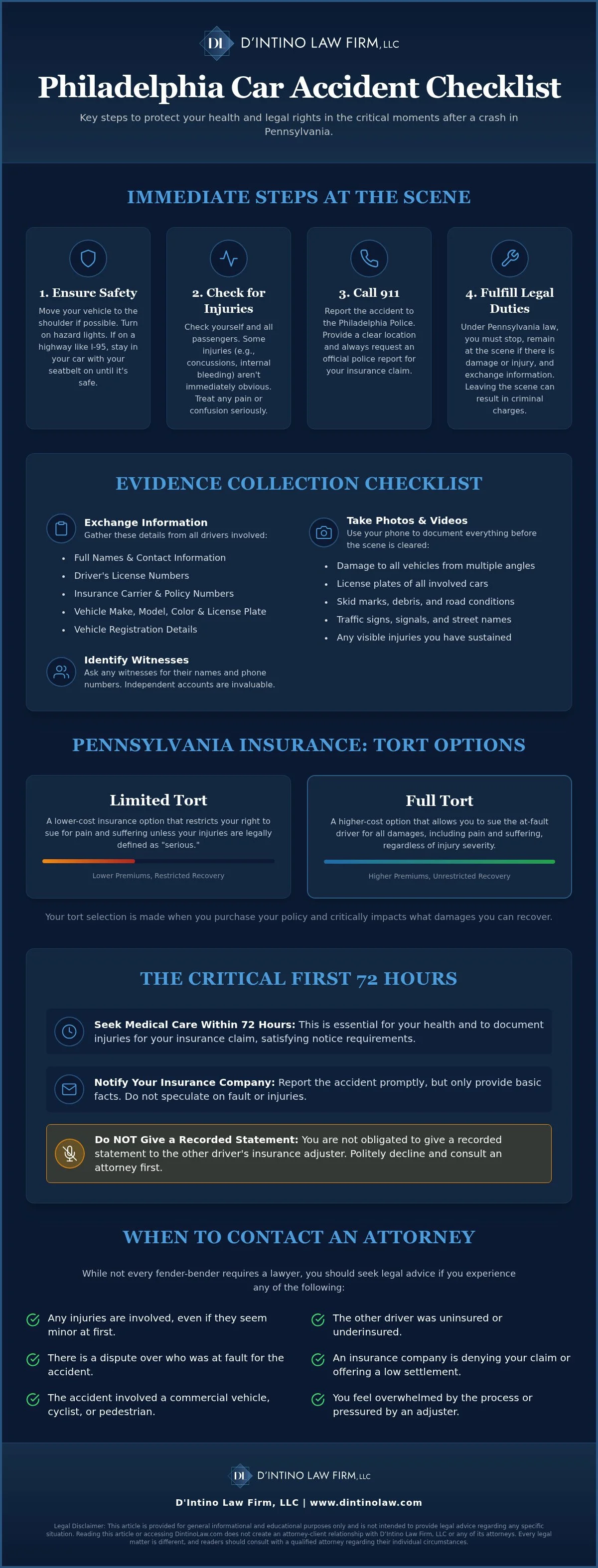
The three days following a collision are just as critical as the moments at the scene. Your body is often in a state of physiological shock, which can hide the true extent of your injuries. Understanding what to do after a car accident Philadelphia residents often overlook involves shifting your focus from the street to your long-term recovery. This window is your primary opportunity to establish a medical record that links your injuries directly to the crash.
Medical Documentation and Adrenaline
Adrenaline is a powerful biological shield. It often masks soft-tissue injuries, such as whiplash or lumbar strains, for several days. You might feel “fine” on Tuesday only to find yourself unable to get out of bed on Thursday. Visit a Philadelphia medical facility like Jefferson Health, Penn Medicine, or a local urgent care center immediately. Don’t wait for symptoms to become unbearable.
Following through with every diagnostic test is essential. If a doctor orders an MRI or X-ray, complete it promptly. Insurance adjusters look for “gaps in treatment” to argue that your injuries aren’t serious or were caused by something else. Consistent medical documentation is the most effective way to counter these tactics. If you’re feeling pressured by an adjuster while trying to recover, speaking with a personal injury lawyer can help you protect your rights and your health.
Dealing with Insurance Adjusters
You have a contractual duty to notify your own insurance company about the accident. This is known as the “Notice” requirement in Pennsylvania. However, you are under no obligation to provide a recorded statement to the other driver’s insurance carrier. These adjusters are trained to ask leading questions designed to make you admit partial fault or minimize your pain.
Be wary of “quick settlement” offers. An insurance company may offer a check within days of the crash. While this cash is tempting when bills are piling up, accepting it usually requires you to sign a release of all future claims. You cannot ask for more money later if you discover you need surgery or long-term physical therapy. Before accepting any offer, it’s worth understanding how much your injury claim is worth in Philadelphia so you can evaluate whether the settlement truly reflects your losses. Wait until you have reached “maximum medical improvement” before discussing final figures.
Finally, secure your official Philadelphia Police Crash Report. You can typically request this through the Philadelphia Police Department’s Records Department online portal or by visiting the district station where the accident occurred. Start a daily pain journal to document how your injuries affect your life. Note specific activities you can no longer perform, such as lifting your children or driving to work. These details provide a human element to your claim that medical codes alone cannot capture. Knowing what to do after a car accident Philadelphia victims must manage involves this disciplined approach to documentation.
Legal Disclaimer: This article is provided for general informational and educational purposes only and is not intended to provide legal advice regarding any specific situation. Reading this article or accessing DintinoLaw.com does not create an attorney-client relationship with D’Intino Law Firm, LLC or any of its attorneys. Every legal matter is different, and readers should consult with a qualified attorney regarding their individual circumstances.
When to Contact a Philadelphia Personal Injury Lawyer
Not every fender bender requires legal intervention. However, when you’re facing serious injuries or a complex liability dispute, the stakes become too high to manage alone. Understanding what to do after a car accident Philadelphia drivers experience often means recognizing when you need a professional to level the playing field against aggressive insurance companies. If your medical bills are mounting or the other driver’s insurer is denying responsibility, it’s time to seek a formal legal evaluation. Knowing exactly what to do after a car accident Philadelphia victims find most helpful is securing a dedicated advocate who understands the nuances of the local court system.
The Advantage of Direct Attorney Involvement
While this guide is specific to Pennsylvania, those involved in accidents in other states should seek local expertise; for example, a car accident lawyer Florida can provide the necessary support for cases in that region, where firms like Charles Injury Law, a Personal Injury Attorney in Fort Lauderdale, specialize in local motor vehicle claims.
Choosing the right representation can significantly alter the trajectory of your case. Many large firms rely on case managers and paralegals to handle the bulk of their client communication. At a boutique firm, you receive direct access to an experienced advocate. John D’Intino Jr. brings over two decades of legal experience to every case, handling the details personally rather than delegating them to a faceless corporate team. This partnership ensures you’re never left wondering about the status of your claim.
This hands-on approach ensures that your case is prepared for trial from day one. While many claims settle out of court, preparing for the possibility of a trial provides the leverage needed to negotiate from a position of strength. An attorney investigates the crash, identifies all liable parties, and calculates the true extent of your damages, including future medical needs and lost earning capacity. You won’t have to worry about upfront costs because personal injury representation typically operates on a contingency fee basis. You only pay if a recovery is secured on your behalf.
Your Path Forward
The road to recovery after a Philadelphia car crash is structured and methodical. You’ve learned how to secure the scene, gather evidence, understand Pennsylvania’s insurance laws, and prioritize your medical care. The final step is establishing a legal strategy that protects your future. By following this checklist, you’ve already taken the necessary steps to preserve your rights and your health.
Focus your energy on your physical and emotional healing while a professional manages the legal hurdles and insurance communications. If you’re ready to take the next step, consider reaching out to a Philadelphia Personal Injury Lawyer: Dedicated Advocacy for Your Recovery. Scheduling a free, no-pressure consultation allows you to discuss your concerns and gain clarity on your legal options without any financial obligation. You deserve an advocate who is personally invested in your success.
Legal Disclaimer: This article is provided for general informational and educational purposes only and is not intended to provide legal advice regarding any specific situation. Reading this article or accessing DintinoLaw.com does not create an attorney-client relationship with D’Intino Law Firm, LLC or any of its attorneys. Every legal matter is different, and readers should consult with a qualified attorney regarding their individual circumstances.
Securing Your Legal Recovery and Peace of Mind
The aftermath of a collision is a period of intense stress, but following a structured plan ensures that your legal rights remain intact. By prioritizing immediate safety, gathering exhaustive evidence at the scene, and seeking medical evaluation within 72 hours, you create a strong foundation for any future claim. Following these steps ensures that you have the evidence needed to challenge insurance companies that might otherwise try to minimize your losses. Understanding Pennsylvania’s specific insurance framework is the final piece of the puzzle that allows you to move forward with confidence.
Knowing what to do after a car accident Philadelphia drivers experience is only the beginning. It’s vital to have an advocate who provides direct communication and brings over 20 years of experience in Pennsylvania courts to your case. At our boutique firm, you work directly with Attorney John D’Intino Jr. rather than a case manager. We operate on a contingency fee basis, so you won’t pay anything unless we recover compensation for you. Contact D’Intino Law Firm, LLC today for a free consultation regarding your car accident claim. We are here to help you regain control and focus on your physical recovery.
Legal Disclaimer: This article is provided for general informational and educational purposes only and is not intended to provide legal advice regarding any specific situation. Reading this article or accessing DintinoLaw.com does not create an attorney-client relationship with D’Intino Law Firm, LLC or any of its attorneys. Every legal matter is different, and readers should consult with a qualified attorney regarding their individual circumstances.
Frequently Asked Questions
Do I have to call the police for a minor car accident in Philadelphia?
Yes, you should call the police even for minor accidents. Pennsylvania law requires reporting if there’s any injury or significant vehicle damage. An official report creates an objective record of the incident. Without it, you may struggle to prove the facts when filing an insurance claim. Even if the damage seems small, hidden mechanical issues or delayed physical symptoms often emerge days later. Having an officer document the scene protects your future rights.
What if the other driver doesn’t have insurance in Pennsylvania?
If the other driver is uninsured, you typically turn to your own policy’s Uninsured Motorist (UM) coverage. This part of your insurance is designed to protect you in exactly this situation. It’s a common concern when deciding what to do after a car accident Philadelphia residents face. Your insurer effectively steps into the shoes of the at-fault driver’s company to provide compensation for your losses up to your specific policy limits.
How do I get a copy of my Philadelphia police accident report?
You can obtain a copy of your report through the Philadelphia Police Department’s Records Department. This is usually done via their online portal or by visiting the district station where the crash occurred in person. You’ll need to provide the date, location, and the incident number given to you by the responding officer. Expect to pay a small administrative fee to process the request. This document is essential for proving the facts to your insurance company.
Can I still recover damages if I was partially at fault for the accident?
Yes, Pennsylvania follows a modified comparative negligence rule. You can still recover compensation as long as you’re not more than 50% responsible for the crash. However, your final financial recovery will be reduced by your percentage of fault. For example, if you’re found to be 20% at fault, your total award will be decreased by 20%. This rule ensures that compensation is distributed fairly based on the specific actions of each driver involved.
How long do I have to file a car accident claim in Philadelphia?
In Pennsylvania, the statute of limitations for personal injury claims is generally two years from the date of the accident. If you fail to file a lawsuit within this window, you lose your legal right to seek compensation in court. While two years might seem like a long time, investigating a crash and negotiating with insurance companies takes significant effort. It’s better to start the process early to preserve evidence and secure witness statements while they’re fresh.
What does ‘Limited Tort’ mean for my ability to recover money?
Limited Tort is an insurance selection that restricts your right to sue for “pain and suffering” damages. Unless your injuries meet a specific “serious injury” threshold, such as permanent impairment or significant scarring, you can only recover out-of-pocket medical bills and lost wages. This is a vital detail to consider when researching what to do after a car accident Philadelphia drivers encounter. Certain exceptions apply, such as being hit by a commercial vehicle or a driver from another state.
Should I see a doctor if I don’t feel hurt immediately after the crash?
Yes, you should always seek a medical evaluation within 72 hours of an accident. Adrenaline often masks the pain of soft-tissue injuries like whiplash or internal trauma. A physician can document your condition and identify issues that aren’t yet visible. From a legal standpoint, a prompt medical visit prevents insurance adjusters from claiming your injuries were caused by a separate event. It also shows that you’re taking your physical recovery and health seriously.
Why is my own insurance company paying my medical bills if the other person hit me?
Pennsylvania is a “no-fault” state regarding medical expenses. This means your own Personal Injury Protection (PIP) coverage pays your initial medical bills regardless of who caused the crash. This system ensures you receive immediate treatment without waiting for a lengthy investigation into fault. Once your PIP limits are exhausted, your private health insurance or a claim against the at-fault driver typically covers the remaining costs. It’s a structure designed to prioritize your health and safety first. If you were injured on someone else’s property rather than in a vehicle, understanding how to pursue a slip and fall lawsuit under Pennsylvania’s premises liability laws can help you determine the right path to compensation.
Legal Disclaimer: This article is provided for general informational and educational purposes only and is not intended to provide legal advice regarding any specific situation. Reading this article or accessing DintinoLaw.com does not create an attorney-client relationship with D’Intino Law Firm, LLC or any of its attorneys. Every legal matter is different, and readers should consult with a qualified attorney regarding their individual circumstances.
Disclaimer
Legal Disclaimer: The information provided on DintinoLaw.com, including articles, blog posts, testimonials, case results, and other content, is for general informational and educational purposes only and does not constitute legal advice or create an attorney-client relationship with D’Intino Law Firm, LLC or any of its attorneys. Visiting this website, submitting a contact form, sending an email, calling, texting, or otherwise communicating with the firm does not establish an attorney-client relationship or obligate the firm to represent you. Do not submit confidential, privileged, or time-sensitive information through this website or electronic communications unless and until the firm has expressly agreed to represent you. Legal rights, procedures, statutes of limitation, filing deadlines, and other requirements vary based on the facts and jurisdiction and may change over time; nothing on this website should be relied upon to determine whether a legal deadline applies to your matter. If you have an urgent legal matter or a potential filing deadline, consult a qualified attorney promptly. Testimonials and statements regarding client experiences are individual opinions and experiences and are not a guarantee of future results. Prior results, verdicts, settlements, or case examples do not guarantee or predict the outcome of any future case, and every matter is different. This website may constitute attorney advertising under applicable Pennsylvania rules. D’Intino Law Firm, LLC makes no representation that the information on this website is complete, current, or applicable to your particular circumstances. For legal advice concerning your specific situation, consult directly with a qualified Pennsylvania attorney. D’Intino Law Firm, LLC | Philadelphia, Pennsylvania | DintinoLaw.com
