


Attorney
Severe psychological trauma can disrupt your life just as profoundly as a broken bone, but proving it in a courtroom is an entirely different battle. If you are struggling with debilitating anxiety, depression, or flashbacks after a serious event, you likely want to know if you can recover emotional distress damages Pennsylvania courts recognize. It makes sense to demand accountability when someone else’s carelessness upends your life, yet many people worry that the lack of a catastrophic physical wound leaves them without a valid claim.
In this guide, you will learn how Pennsylvania law evaluates emotional distress claims, the exact evidentiary standards required, and how injured plaintiffs pursue financial recovery. We break down the legal paths for Negligent Infliction of Emotional Distress (NIED) and Intentional Infliction of Emotional Distress (IIED), explain why objective psychological records matter, and outline how an attorney evaluates non-economic damages to build a solid case.
Key Takeaways
- Discover how emotional distress damages Pennsylvania plaintiffs pursue are categorized, distinguishing standard non-economic suffering from distinct standalone claims.
- Understand the precise legal thresholds required under Pennsylvania common law to establish Negligent Infliction of Emotional Distress (NIED) and Intentional Infliction of Emotional Distress (IIED).
- Learn why objective clinical diagnoses and contemporaneous mental health records are essential to overcome insurer skepticism and substantiate psychological trauma.
- Identify how judges and juries calculate non-economic recovery under Pennsylvania Standard Suggested Jury Instructions without relying on fixed damage formulas.
- Review crucial procedural hurdles, including Pennsylvania’s strict two-year statute of limitations and modified comparative negligence rules, that dictate your ability to seek recovery.
Understanding Emotional Distress Damages Under Pennsylvania Law
Emotional distress damages compensate injured plaintiffs for the genuine psychological trauma, mental anguish, and emotional suffering caused by another party’s negligent or intentional conduct. In civil claims across the Commonwealth, pursuing emotional distress damages Pennsylvania courts recognize requires moving far beyond generalized assertions of stress. Insurance adjusters routinely devalue mental health complaints precisely because psychological suffering leaves no radiographic shadow, surgical scar, or physical invoice. As a result, civil recovery depends heavily on concrete medical verification and exact legal classification.
Parasitic Emotional Distress vs. Standalone Tort Claims
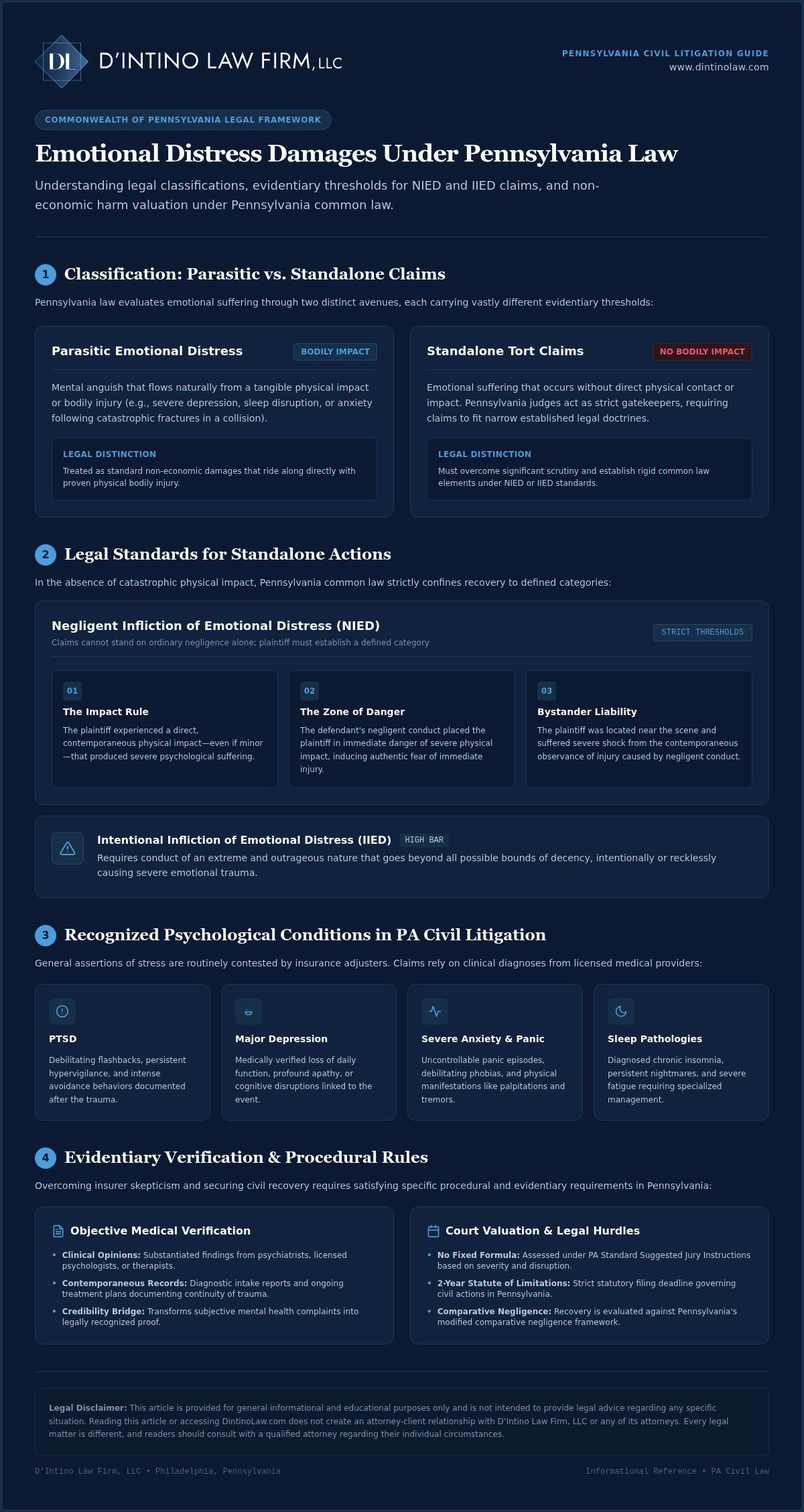
Pennsylvania law evaluates emotional suffering through two distinct avenues: parasitic damages and independent claims. The legal hurdles for each pathway differ significantly.
Parasitic damages represent the mental anguish that flows naturally from a tangible physical impact or bodily injury. For example, a driver recovering from catastrophic fractures after a truck accident often experiences severe depression, fear of driving, and sleep disturbances directly tied to physical impairment. In standard plaintiff-side litigation, these psychological injuries are categorized as non-economic damages that ride along with bodily harm.
Standalone claims operate under a much higher evidentiary bar. When an individual suffers no direct physical contact or bodily impact, they cannot simply claim compensation for emotional turmoil. Instead, they must establish the rigid elements of Negligent Infliction of Emotional Distress (NIED) or demonstrate the outrageous conduct required for Intentional Infliction of Emotional Distress (IIED). Pennsylvania judges act as strict gatekeepers over standalone actions, requiring specific legal exceptions before allowing an emotional injury claim without physical impact to proceed.
Recognized Psychological Conditions in Civil Litigation
Subjective assertions rarely withstand courtroom scrutiny. Adjusters and defense counsel vigorously contest complaints of emotional strain that lack diagnostic substantiation. To establish a compensable injury, plaintiffs typically present formal clinical findings from licensed medical providers documenting specific psychiatric conditions:
- Post-Traumatic Stress Disorder (PTSD): Severe trauma characterized by debilitating flashbacks, hypervigilance, and avoidance behaviors.
- Major Depressive Disorder: Medically documented loss of function, profound apathy, or cognitive disruptions linked to the traumatic incident.
- Severe Anxiety and Panic Disorders: Uncontrollable panic episodes, phobias, or physical manifestations such as heart palpitations and chronic tremors.
- Sleep Pathologies: Diagnosed chronic insomnia, persistent nightmares, and severe fatigue requiring specialized clinical management.
Opinions from treating psychiatrists, licensed psychologists, and clinical therapists provide the foundation for these claims. Contemporaneous medical records, diagnostic intake reports, and ongoing treatment plans transform an invisible emotional injury into credible, legally recognizable proof.
Legal Standards: NIED and IIED Claims in Pennsylvania
Pennsylvania common law sets rigorous boundaries for recovering damages when physical trauma is minimal or absent. Defense attorneys routinely file preliminary objections to dismiss standalone mental anguish lawsuits before they ever reach a jury. To recover emotional distress damages Pennsylvania courts require plaintiffs to fit their claims squarely into established legal theories: Negligent Infliction of Emotional Distress (NIED) or Intentional Infliction of Emotional Distress (IIED).
Negligent Infliction of Emotional Distress (NIED) Requirements
Under Pennsylvania jurisprudence, an NIED claim cannot stand on ordinary negligence alone. An injured party must establish that their psychological injury stems from one of four defined legal categories:
- The Impact Rule: The plaintiff experienced a direct, contemporaneous physical impact, even if minor, that produced the severe emotional suffering.
- The Zone of Danger: The defendant’s negligent conduct placed the plaintiff in immediate danger of severe physical impact, causing an authentic fear of immediate personal injury.
- Bystander Liability: The plaintiff was located near the scene, sensory witnessed the catastrophic injury or death of an immediate family member, and suffered severe emotional shock as a consequence.
- Preexisting Special Relationship: The defendant owed the plaintiff a preexisting contractual or fiduciary duty where severe emotional harm was a foreseeable result of a breach, such as specific obligations between hospital staff and patients.
When presenting an NIED claim, recovery also remains subject to general tort principles, including reductions if the defense claims the plaintiff was partially responsible under Pennsylvania’s comparative negligence statute. If you have questions about how these thresholds apply to your situation, reviewing the facts with an attorney at D’Intino Law Firm, LLC can clarify your available options.
Intentional Infliction of Emotional Distress (IIED) Elements
IIED claims hold defendants accountable for willful or reckless behavior rather than careless errors. Pennsylvania courts apply the Restatement (Second) of Torts § 46 standard, establishing a remarkably high threshold for what qualifies as actionable misconduct.
First, the conduct must be extreme and outrageous. The actions must go beyond all possible bounds of decency, regarded as atrocious and utterly intolerable in a civilized community. Mere insults, bad manners, or petty indignities do not meet this standard. Second, the defendant must have acted intentionally or with reckless disregard of a substantial certainty that severe emotional distress would follow. Finally, Pennsylvania appellate decisions strictly require competent, objective medical evidence to prove the existence and severity of the resulting psychological distress. Without expert medical testimony confirming the trauma, the claim will not survive judicial review.
How Pennsylvania Courts and Insurers Value Non-Economic Harm
Quantifying psychological suffering is one of the most challenging aspects of a civil injury case. Unlike hospital bills or lost earnings, mental anguish does not come with an itemized receipt. Pennsylvania law imposes no statutory cap on non-economic damages in lawsuits against private individuals or corporate defendants. Instead, when calculating emotional distress damages Pennsylvania civil law directs juries to award an amount that fairly and reasonably compensates the plaintiff for their human losses.
Judges rely on the Pennsylvania Standard Suggested Jury Instructions (Civil) to frame this inquiry. Jurors are guided to examine the nature, severity, and anticipated duration of the distress, evaluating how the trauma affects the plaintiff’s daily life both now and in the years ahead.
Factors Influencing the Assessment of Emotional Damages
Because emotional trauma is inherently personal, courts and claim evaluators look for tangible manifestations of psychological harm:
- Severity and Permanence: Whether the condition is short-term or a chronic, lifelong impairment that resists treatment.
- Functional Disruption: Tangible inability to perform work responsibilities, drive safely, maintain household duties, or pursue cherished personal hobbies.
- Relational Impact: Documented strains on marriage, reduced interaction with children, and broader social isolation caused by emotional withdrawal.
- Physical Interdependence: How ongoing bodily pain, disfigurement, or physical limitations trigger and deepen psychological distress.
Common Settlement Approaches Used by Insurance Carriers
Insurance companies approach psychological suffering with deep institutional skepticism. In settlement negotiations, adjusters frequently fall back on informal methods, such as applying a numeric multiplier to medical bills or calculating a per diem daily rate. These rigid metrics often fail to reflect the true weight of debilitating trauma.
Defense adjusters routinely review past medical records to blame symptoms on pre-existing depression, family tension, or unrelated life stresses. Overcoming this skepticism requires building an unbroken evidentiary bridge between the incident and your current condition. Collaborating with a skilled Philadelphia personal injury lawyer provides the trial-tested preparation needed to present compelling psychological evidence and force insurance adjusters to address the full scope of your suffering.
Essential Evidence Needed to Prove Emotional Distress in PA
Subjective descriptions of suffering rarely convince a skeptical insurance adjuster or Pennsylvania jury. Recovering emotional distress damages Pennsylvania courts recognize requires objective, contemporaneous proof that establishes both the severity of the psychological condition and its direct causal connection to the defendant’s acts. Without professional verification, courts often dismiss standalone mental anguish allegations as legally insufficient.
Medical and Mental Health Treatment Records
Consistent, professional clinical care provides the foundation of any psychological injury claim. Detailed therapy notes, formal clinical intake evaluations, and psychiatric treatment plans track your condition from the traumatic event forward. Prescriptions for anti-anxiety medications, antidepressants, or sleep aids supply tangible evidence of biological disruption.
Avoid unexplained gaps in your mental health treatment. Defense attorneys examine clinical charts to pinpoint skipped therapy sessions or delays in seeking help. They will argue that these lapses prove your symptoms were either exaggerated or resolved quickly. Adhering strictly to recommended psychiatric care protects both your personal health and the integrity of your legal claim.
Corroborating Testimony and Objective Documentation
Personal testimony alone leaves room for doubt. Corroborating evidence translates internal suffering into observable, daily realities that jurors can understand:
- Third-Party Observations: Detailed statements from spouses, close family members, coworkers, and friends describing noticeable personality shifts, chronic withdrawal, or sudden functional decline.
- Contemporaneous Symptom Journals: Personal logs documenting specific panic episodes, sleepless nights, flashbacks, and physical side effects like severe migraines or tremors.
- Employment Records: Documentation of unexcused absences, reduced productivity, performance write-ups, or sudden career setbacks directly tied to emotional distress.
- Expert Causation Opinions: Sworn evaluations from treating psychiatrists or forensic psychologists confirming proximate causation under Pennsylvania rules of evidence.
Preserving this evidence early prevents crucial records from disappearing. If you are struggling with severe trauma and need help gathering the objective evidence required under state law, contact D’Intino Law Firm, LLC to schedule an initial consultation.
Navigating Deadlines, Comparative Fault, and Legal Representation
Filing a lawsuit involving severe psychological harm involves navigating strict procedural barriers. In Pennsylvania, failing to satisfy statutory filing deadlines or misunderstanding shared fault principles can destroy an otherwise legitimate claim before it ever reaches a courtroom. Successfully pursuing emotional distress damages Pennsylvania courts allow requires disciplined attention to procedural timelines alongside aggressive factual investigation.
Pennsylvania Statute of Limitations and Procedural Rules
Under 42 Pa.C.S. § 5524, the statute of limitations for personal injury and negligence actions in Pennsylvania is generally two years from the date the injury occurred. Missing this filing deadline permanently bars an injured plaintiff from seeking financial recovery through the court system. While the discovery rule offers limited exceptions in cases where an injury could not reasonably have been detected immediately, courts interpret this exception narrowly.
Shorter deadlines apply if a government entity is involved. Bringing a claim against a Commonwealth agency or local municipality requires formal written notice within six months of the incident under 42 Pa.C.S. § 5522. When mental trauma stems from complex commercial vehicle collisions, partnering with a knowledgeable truck accident attorney in Philadelphia helps preserve critical black-box telemetry, driver logs, and eyewitness accounts before evidence disappears.
Comparative Negligence and Attorney Representation
Pennsylvania adheres to a modified comparative negligence system governed by 42 Pa.C.S. § 7102. Under this 51 percent bar rule, an injured person can recover damages only if their own negligence is 50 percent or less. If a jury determines that the plaintiff is 51 percent or more at fault, they receive zero recovery. When fault is 50 percent or lower, any court award is reduced in direct proportion to that assigned percentage of fault.
Insurance carriers frequently leverage comparative fault arguments to devalue or deny emotional suffering. Adjusters routinely claim that an injured party contributed to the accident or failed to mitigate damages by missing mental health appointments. Dedicated plaintiff advocacy counters these aggressive insurer tactics through thorough trial preparation and objective medical corroboration. If you or a loved one are facing the debilitating aftermath of an accident, consulting D’Intino Law Firm, LLC can provide the personalized legal guidance needed to protect your rights and evaluate your options under Pennsylvania law.
Protecting Your Rights and Securing Full Accountability
Recovering the emotional distress damages Pennsylvania courts recognize requires clear legal positioning and rigorous medical proof. Whether your psychological suffering stems directly from bodily harm or meets the strict criteria for standalone NIED or IIED, insurance carriers won’t acknowledge non-economic losses without objective clinical documentation. Protecting your recovery and holding negligent parties accountable demands a disciplined, evidence-based approach.
With over two decades of litigation experience, Attorney John D’Intino Jr. provides dedicated, hands-on advocacy to injured plaintiffs across Southeastern Pennsylvania. You work directly with your attorney throughout the entire legal process without your case being handed off to case managers. If you are dealing with the traumatic aftermath of a serious accident, discuss your legal options with D’Intino Law Firm, LLC to pursue a personalized litigation strategy focused on your full physical and emotional recovery.
Legal Disclaimer: This article is provided for general informational and educational purposes only and is not intended to provide legal advice regarding any specific situation. Reading this article or accessing DintinoLaw.com does not create an attorney-client relationship with D’Intino Law Firm, LLC or any of its attorneys. Every legal matter is different, and readers should consult with a qualified attorney regarding their individual circumstances.
Frequently Asked Questions
Can you sue for emotional distress without physical injury in Pennsylvania?
Yes, you can pursue emotional distress damages Pennsylvania courts recognize without a physical injury, but only under limited legal exceptions. Pennsylvania allows standalone recovery under Negligent Infliction of Emotional Distress if you were in the zone of danger, witnessed a close relative’s traumatic injury, or had a breach of a special preexisting duty. Standalone claims also apply under Intentional Infliction of Emotional Distress when verified by objective psychiatric evidence.
What is the difference between NIED and IIED under Pennsylvania law?
The core distinction lies in the defendant’s conduct and state of mind. Negligent Infliction of Emotional Distress (NIED) stems from careless behavior and requires meeting specific legal categories, such as bystander proximity or immediate personal danger. Intentional Infliction of Emotional Distress (IIED) requires intentional or reckless actions that are extreme, outrageous, and utterly intolerable in a civilized community, backed by competent medical testimony proving severe psychological harm.
How do insurance companies calculate emotional distress damages?
Insurance carriers evaluate emotional distress damages Pennsylvania claimants seek by examining objective indicators like psychiatric records, prescription history, and missed work. Adjusters often use informal methods, such as applying a multiplier to economic losses or calculating a daily per diem rate. However, insurers aggressively discount subjective suffering unless your medical documentation and third-party witness statements establish clear, severe disruption to your normal daily living.
Can a bystander recover damages for witnessing an accident in Pennsylvania?
A bystander can recover damages under Pennsylvania’s NIED bystander rule if specific legal criteria are met. The plaintiff must be located near the scene of the accident, directly witness the incident with contemporaneous sensory perception, and share a close familial relationship with the victim, such as a parent, child, or spouse. Observing severe injury or death involving a stranger or coworker does not qualify for bystander recovery.
What medical proof is required to support an emotional distress claim in PA?
Pennsylvania courts require competent, objective medical evidence to substantiate an emotional distress claim. This documentation typically includes formal diagnostic reports from licensed psychiatrists or psychologists, clinical therapy notes, and records of prescribed medications for conditions like PTSD, depression, or severe anxiety. Personal testimony alone won’t suffice; you must establish a continuous treatment history directly linking your psychological impairment to the traumatic event.
How long do you have to file an emotional distress lawsuit in Pennsylvania?
Under 42 Pa.C.S. § 5524, Pennsylvania imposes a two-year statute of limitations for personal injury and emotional distress claims, beginning on the date of the incident. Missing this strict deadline generally forfeits your right to recover damages in civil court. If your claim involves a Commonwealth agency or municipal entity, you must also satisfy a mandatory six-month formal notice requirement under 42 Pa.C.S. § 5522.
Are emotional distress damages taxable in Pennsylvania civil settlements?
Taxability depends on whether the emotional distress originated from a physical injury. Under IRS rules and Pennsylvania tax guidelines, emotional distress damages stemming directly from physical injuries or sickness are generally non-taxable. Conversely, settlements for standalone emotional distress without physical harm are typically considered taxable income, except for portions directly reimbursing out-of-pocket medical expenses for psychological treatment. A tax professional can provide specific guidance.
Disclaimer
Legal Disclaimer: The information provided on DintinoLaw.com, including articles, blog posts, testimonials, case results, and other content, is for general informational and educational purposes only and does not constitute legal advice or create an attorney-client relationship with D’Intino Law Firm, LLC or any of its attorneys. Visiting this website, submitting a contact form, sending an email, calling, texting, or otherwise communicating with the firm does not establish an attorney-client relationship or obligate the firm to represent you. Do not submit confidential, privileged, or time-sensitive information through this website or electronic communications unless and until the firm has expressly agreed to represent you. Legal rights, procedures, statutes of limitation, filing deadlines, and other requirements vary based on the facts and jurisdiction and may change over time; nothing on this website should be relied upon to determine whether a legal deadline applies to your matter. If you have an urgent legal matter or a potential filing deadline, consult a qualified attorney promptly. Testimonials and statements regarding client experiences are individual opinions and experiences and are not a guarantee of future results. Prior results, verdicts, settlements, or case examples do not guarantee or predict the outcome of any future case, and every matter is different. This website may constitute attorney advertising under applicable Pennsylvania rules. D’Intino Law Firm, LLC makes no representation that the information on this website is complete, current, or applicable to your particular circumstances. For legal advice concerning your specific situation, consult directly with a qualified Pennsylvania attorney. D’Intino Law Firm, LLC | Philadelphia, Pennsylvania | DintinoLaw.com
