


Attorney
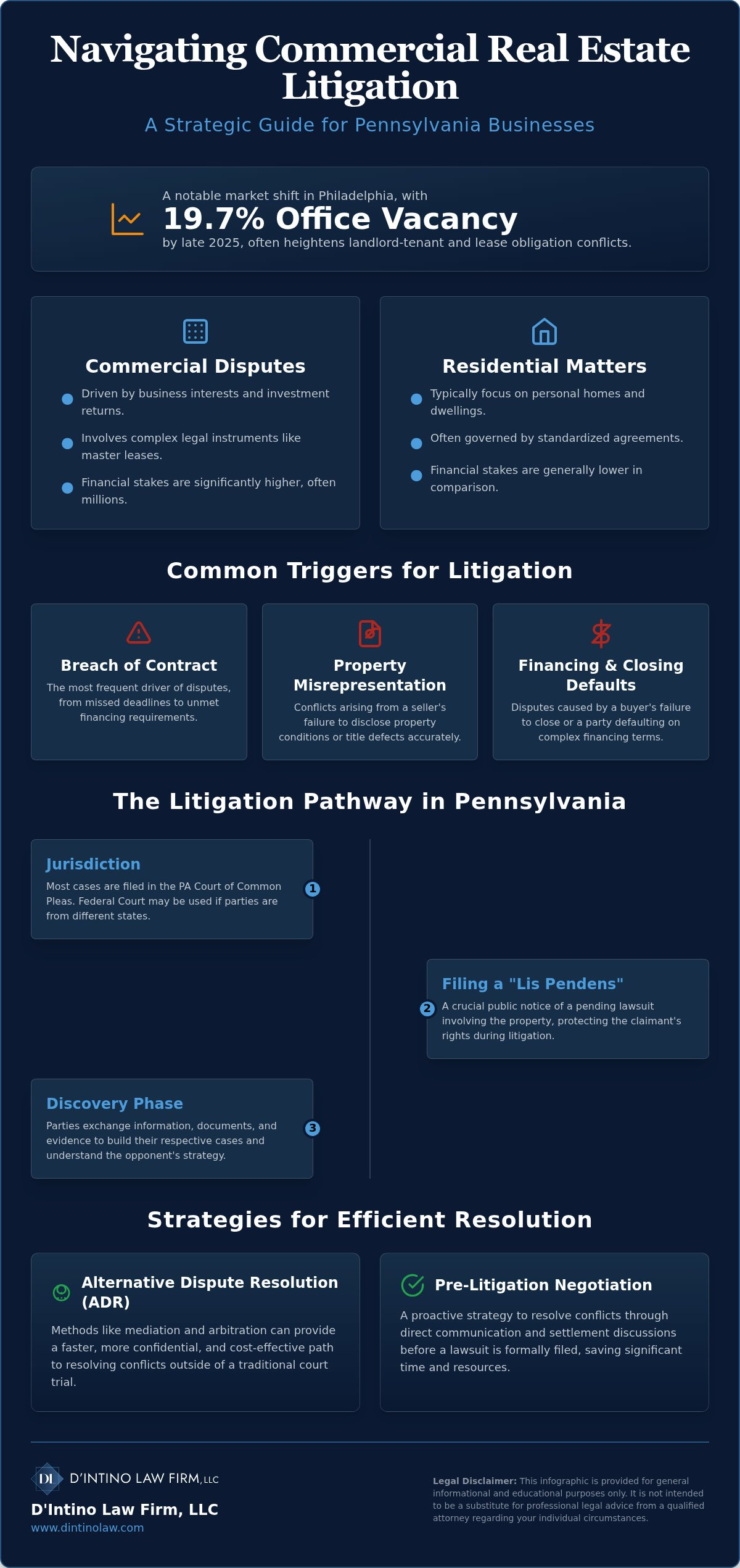
In Philadelphia’s office market, vacancy rates climbed to 19.7% by late 2025, a shift that frequently forces landlords and tenants into high-stakes conflicts over lease obligations and property rights. You’ve worked hard to build your business, and the prospect of a prolonged, expensive court battle is likely your greatest concern. It’s frustrating when contract ambiguities or confusion regarding state versus federal jurisdiction in PA create uncertainty for your investment. You need a clear strategy that prioritizes your specific business goals rather than getting lost in a sea of impersonal legal filings.
This guide provides a comprehensive look at commercial real estate litigation Pennsylvania, helping you understand the common triggers for disputes and the procedural steps required for a resolution. We’ll explore the legal landscape of the Commonwealth, from the power of confession of judgment clauses to specific statutes of limitations for breach of contract and fraud. By identifying a clear path forward, you can protect your assets and find a seasoned advocate who treats your case with the personalized, “fighter” mentality it deserves.
Legal Disclaimer: This article is provided for general informational and educational purposes only and is not intended to provide legal advice regarding any specific situation. Reading this article or accessing DintinoLaw.com does not create an attorney-client relationship with D’Intino Law Firm, LLC or any of its attorneys. Every legal matter is different, and readers should consult with a qualified attorney regarding their individual circumstances.
Key Takeaways
- Distinguish the unique complexities and high financial stakes of commercial property disputes compared to residential real estate matters.
- Identify the most frequent triggers for commercial real estate litigation Pennsylvania, from breach of contract to complex title and boundary defects.
- Navigate the essential stages of the legal process, including the strategic importance of filing a “Lis Pendens” notice and the discovery phase.
- Explore how alternative dispute resolution and aggressive pre-litigation negotiation can provide a more efficient path to resolving property conflicts.
- Understand the benefit of a boutique legal approach where you receive direct, hands-on advocacy from a seasoned attorney with over 20 years of experience.
What is Commercial Real Estate Litigation in Pennsylvania?
Commercial real estate litigation Pennsylvania involves legal conflicts centered on income-producing assets. While residential disputes often focus on personal homes, commercial cases are driven by business interests, investment returns, and contractual compliance. These matters are inherently complex because they involve sophisticated legal instruments like master leases, subordination agreements, and complex financing documents. The financial stakes are significantly higher than in residential law, often involving millions of dollars in capital or lost revenue.
The parties involved usually represent a spectrum of professional interests. You might see developers fighting to clear a title, lenders protecting their collateral, or business tenants disputing lease terms. Because these disputes can paralyze a business operation, pennsylvania real estate lawyers must act as both legal defenders and strategic advisors to navigate the intricate court rules of the Commonwealth.
The Scope of Commercial Property Disputes
Litigation can impact almost any type of commercial property, from sprawling retail centers and industrial warehouses to high-density multi-family developments. These conflicts don’t just happen during ownership; they can arise during acquisition, development, or management. In Philadelphia and surrounding counties like Montgomery and Bucks, localized knowledge is vital. A dispute over an office building in Center City requires a different tactical approach than a boundary conflict in a suburban industrial site. Knowing the specific landscape of Southeastern Pennsylvania ensures that your legal strategy accounts for local market trends and municipal regulations.
State vs. Federal Jurisdiction in PA
Most commercial property disputes are heard in the Pennsylvania Court of Common Pleas. This is the primary venue for handling civil complaints, including those involving deed defects or mortgage foreclosures. However, a case might move to Federal Court if there’s diversity of citizenship (parties from different states) or if the dispute involves federal questions. Understanding the local county rules is essential. For instance, the filing procedures in West Chester or Media can vary from those in the Philadelphia Municipal Court. A methodical approach to these jurisdictional nuances helps maintain control over the litigation timeline and prevents procedural setbacks.
Legal Disclaimer: This article is provided for general informational and educational purposes only and is not intended to provide legal advice regarding any specific situation. Reading this article or accessing DintinoLaw.com does not create an attorney-client relationship with D’Intino Law Firm, LLC or any of its attorneys. Every legal matter is different, and readers should consult with a qualified attorney regarding their individual circumstances.
Common Triggers for Commercial Real Estate Litigation
High-stakes property deals in the Commonwealth often fail when expectations don’t match the written word. Breach of contract remains the most frequent driver of commercial real estate litigation Pennsylvania. These disputes often hinge on Pennsylvania’s Uniform Commercial Code, which governs the sale of goods and certain commercial transactions, alongside common law principles. When you’re managing an income-producing asset, even a minor oversight in a lease or purchase agreement can lead to a financial catastrophe.
Contractual Breaches and Specific Performance
Most litigation begins when a party fails to meet a deadline or financing requirement. Common triggers include a buyer’s failure to close, a seller’s misrepresentation of property conditions, or a default on complex financing terms. When a standard monetary award isn’t enough to fix the damage, you might seek “Specific Performance.” This unique legal remedy asks the court to force the completion of the transaction. You can often avoid these expensive battles through a thorough real estate contract review before the ink dries.
Beyond contracts, structural issues like title defects or boundary encroachments can halt a project indefinitely. In cities like Philadelphia, zoning challenges and permit denials from local municipalities often require aggressive advocacy to keep a project on track. Additionally, contractor payment disputes frequently lead to mechanic’s liens, which can cloud a title and disrupt the priority rights of other lenders. These technical hurdles are common in commercial real estate litigation Pennsylvania, requiring a methodical approach to resolve property priority rights and easement conflicts.
Joint Venture and Partnership Conflicts
While many firms focus on external threats, internal conflicts often cause the most damage. Disputes between business partners or investors in a development project can paralyze operations. These “business divorces” usually involve breaches of fiduciary duty, disagreements over capital calls, or power struggles regarding property management. Resolving these joint venture and partnership disputes requires an attorney who understands the human element of a commercial investment. If you are facing an internal threat to your project, it’s vital to consult with a dedicated legal advocate who prioritizes your business continuity.
Legal Disclaimer: This article is provided for general informational and educational purposes only and is not intended to provide legal advice regarding any specific situation. Every legal matter is different, and readers should consult with a qualified attorney regarding their individual circumstances.
The Litigation Process in Pennsylvania Courts
The journey through commercial real estate litigation Pennsylvania begins with a formal Complaint filed in the Court of Common Pleas. This isn’t just a list of grievances; it’s a strategic document that sets the stage for your entire claim. One of the most powerful tools at this stage is the “Lis Pendens” notice. By filing this with the recorder of deeds, you’re placing a public cloud on the property title. This warns any potential buyers or lenders that the asset is the subject of a legal dispute, effectively preventing the sale or refinancing of the property until the court reaches a decision.
Filing a Commercial Lawsuit in PA
Pennsylvania’s rules of civil procedure require specific fact-pleading. You can’t just make vague allegations. You must provide clear evidence of the breach or dispute from the start. Depending on the property’s location, you’ll likely file in Philadelphia, Media (Delaware County), or West Chester (Chester County). In professional liability cases, such as those involving architects or engineers, you may also need a “Certificate of Merit” to prove the claim has a basis in professional standards. This ensures that only meritorious cases move forward, saving time and resources for all parties involved.
The Role of Expert Witnesses
Commercial property disputes rarely rely on testimony alone. You need objective data to win. Appraisers, structural engineers, and environmental consultants often serve as the backbone of your case. They provide critical insights into property valuation, construction defects, or soil contamination. A “fighter” attorney doesn’t just hire these experts. They know how to dismantle the opposing side’s expert testimony during cross-examination. This level of personalized attention ensures that technical data is used to support your specific business goals, not just fill a file folder.
Once the initial pleadings are settled, you enter the discovery phase. This is an intensive exchange of evidence, including emails, financial records, and sworn depositions. It’s a methodical process that often leads to pre-trial motions, such as a motion for summary judgment. This is a request for the judge to decide the case immediately because the essential facts aren’t in dispute. If the case proceeds to trial, it will be heard in the Court of Common Pleas. Whether it’s a bench trial before a judge or a jury trial, the goal is a resolution that protects your investment and provides a clear path forward.
Legal Disclaimer: This article is provided for general informational and educational purposes only and is not intended to provide legal advice regarding any specific situation. Every legal matter is different, and readers should consult with a qualified attorney regarding their individual circumstances.
Strategies for Resolving and Mitigating Disputes
The goal of any savvy business owner is to avoid the courtroom. While we’re always prepared for trial, resolving a conflict before it escalates is often the most strategic move for your bottom line. Effective management of commercial real estate litigation Pennsylvania requires a dual approach: aggressive negotiation and the strategic use of alternative dispute resolution. By addressing issues early, you can often bypass the high costs and public nature of a full trial.
Mediation and Arbitration in PA
Private arbitration is particularly effective for sensitive commercial development projects. It keeps the details of your business dealings out of the public record and allows for a faster resolution than the state court system. In counties like Philadelphia, the court system often mandates mediation programs to encourage settlements before a case reaches the trial list. You should consider including ADR clauses in your initial commercial contracts. This ensures you have a clear, private path to resolution that doesn’t involve years of public litigation in the Court of Common Pleas.
Aggressive pre-litigation negotiation is your first line of defense. A well-crafted demand letter backed by a fighter mentality can often resolve a dispute before a single court document is filed. This process involves applying strategic pressure to the opposing party by highlighting their legal vulnerabilities. Also, your due diligence records serve as a vital defense. If you’ve maintained thorough documentation of every transaction and maintenance request, you’re in a much stronger position when a claim arises. Title insurance plays a critical role as well. Many ownership or lien disputes can be resolved by leveraging your insurance coverage; this potentially saves you from paying out of pocket for a title defect. A proactive real estate contract review checklist for Pennsylvania buyers and sellers can help you identify and address potential vulnerabilities before they escalate into costly disputes.
Protective Measures for Landlords and Developers
For landlords, the best defense is a clear, ironclad lease. You must provide proper default notices and adhere strictly to the terms of the agreement to avoid procedural delays. When you face a non-paying or disruptive occupant, handling an eviction for commercial tenants requires precision. One procedural misstep can lead to a wrongful eviction claim, turning a simple recovery into a legal trap. This is why you need a dedicated advocate who handles your case personally from start to finish. If you are facing a property dispute, contact D’Intino Law Firm, LLC to discuss a strategy tailored to your specific business goals.
Legal Disclaimer: This article is provided for general informational and educational purposes only and is not intended to provide legal advice regarding any specific situation. Every legal matter is different, and readers should consult with a qualified attorney regarding their individual circumstances.
Personalized Advocacy with D’Intino Law Firm, LLC
When high-stakes commercial investments face legal threats, the choice of counsel often defines the outcome. John D’Intino Jr. provides the direct, hands-on representation necessary for complex commercial real estate litigation Pennsylvania. With over two decades of legal experience, he understands that every property dispute requires a unique tactical response. You won’t be passed off to a junior associate or a paralegal. Instead, you work directly with a seasoned advocate who is personally invested in your business goals. This direct accountability ensures that your strategy remains focused on results rather than billable hours.
A Hands-On Approach to Complex Cases
The boutique nature of D’Intino Law Firm, LLC allows for a “quality over volume” philosophy. This is essential for cases involving intricate financing structures or multi-family developments where a single error can cost millions. We prioritize personalized attention because we know that a one-size-fits-all approach fails in the Court of Common Pleas. Our firm also offers flexible payment options for commercial clients. We believe financial transparency is just as important as legal tenacity. This grounded, supportive approach helps build trust while we maintain a fierce, uncompromising stance against your opposition. We focus on Southeastern Pennsylvania, including Philadelphia, Delaware, and Montgomery counties, to provide localized expertise that larger, faceless firms often lack.
Contact D’Intino Law Firm Today
Protecting your assets in Southeastern Pennsylvania requires a local expert who knows the nuances of the regional court systems. Whether you need to resolve a title defect, navigate a commercial eviction, or address a partnership dispute, we offer the strategic guidance you need to move forward. We encourage proactive consultation to identify potential triggers for litigation before they disrupt your operations. Reach out to D’Intino Law Firm, LLC today to discuss your commercial real estate concerns. We provide a free initial consultation for new litigation matters, ensuring you have a clear path to resolution and an advocate who prioritizes your specific business goals.
Legal Disclaimer: This article is provided for general informational and educational purposes only and is not intended to provide legal advice regarding any specific situation. Every legal matter is different, and readers should consult with a qualified attorney regarding their individual circumstances.
Protect Your Commercial Investment with Strategic Advocacy
Commercial property disputes in the Commonwealth require more than just technical knowledge; they demand a tactical understanding of local court procedures and property rights. You now have a clearer roadmap of the common triggers for commercial real estate litigation Pennsylvania and the methodical steps involved in the Court of Common Pleas. From managing breach of contract claims to resolving complex partnership conflicts, the right strategy prioritizes your financial stability and business continuity.
Attorney John D’Intino Jr. brings over 20 years of legal experience to every case, providing the direct, hands-on representation your high-stakes matter deserves. We serve clients across Philadelphia, Montgomery, Bucks, and Delaware Counties with a “fighter” mentality and a commitment to your specific business goals. You don’t have to face legal uncertainty alone. Schedule a free consultation with D’Intino Law Firm, LLC to discuss your commercial real estate litigation needs. We’re ready to help you navigate these challenges and find a clear path to resolution.
Legal Disclaimer: This article is provided for general informational and educational purposes only and is not intended to provide legal advice regarding any specific situation. Every legal matter is different, and readers should consult with a qualified attorney regarding their individual circumstances.
Frequently Asked Questions
What is the statute of limitations for commercial real estate litigation in Pennsylvania?
In Pennsylvania, the statute of limitations depends on the specific claim you’re filing. For a breach of contract in commercial real estate litigation Pennsylvania, you generally have four years from the date of the breach to file a lawsuit. If your case involves fraud, the limit is shorter at two years. For actions seeking specific performance of a real estate contract, the limit is five years. Missing these deadlines can permanently bar your right to seek a legal remedy. Similarly, if a criminal matter intersects with your property dispute, strict filing deadlines also apply to any post-conviction relief, as outlined in this guide to working with a drug crimes lawyer Philadelphia property owners and investors rely on for challenging unjust outcomes.
Can I recover attorney fees in a PA commercial real estate lawsuit?
You can typically only recover attorney fees in a Pennsylvania commercial lawsuit if a specific statute or the underlying contract allows for it. Most commercial leases and purchase agreements include a prevailing party clause. This clause entitles the winner of the litigation to have their legal costs covered by the losing side. Without such a provision, each party is usually responsible for their own legal expenses under the standard American Rule followed in the Commonwealth.
How long does a typical commercial real estate case take to resolve in Philadelphia?
A typical commercial real estate case in the Philadelphia Court of Common Pleas can take anywhere from 12 to 24 months to reach a trial. The exact timeline depends on whether the court assigns the case to the expedited, standard, or complex litigation track. While many cases settle during the discovery phase or through mediation, complex disputes involving multiple parties or extensive expert testimony often require the full two year period to resolve through a formal verdict.
What is a Lis Pendens and how does it affect my property sale?
A Lis Pendens is a formal notice filed with the recorder of deeds to indicate that a property is subject to an active lawsuit. It serves as a public warning to any potential buyers or lenders that the title is in dispute. In Pennsylvania, this filing effectively freezes the property’s marketability. Most title insurance companies won’t issue a clean policy while a Lis Pendens is active, making it nearly impossible to sell or refinance the asset until the litigation concludes.
Do I need a separate lawyer for zoning disputes and contract litigation?
You don’t necessarily need separate lawyers if your attorney has broad experience in real estate law and litigation. A seasoned advocate can handle both the contractual disputes and the zoning hurdles that often arise during a commercial development project. Managing both issues under one firm ensures a more cohesive strategy. This approach prevents conflicting legal positions and provides a more streamlined, cost effective path toward your business goals in counties like Montgomery or Delaware.
What happens if a commercial tenant breaches their lease in Pennsylvania?
If a commercial tenant breaches their lease, the landlord’s remedies are governed strictly by the written agreement. Pennsylvania law doesn’t imply a warranty of habitability for commercial properties, so the tenant’s duty to pay rent is usually independent of repair issues. Many PA commercial leases also include a Confession of Judgment clause. This powerful tool allows a landlord to obtain an immediate judgment for possession or money damages without a lengthy trial if the tenant defaults on their obligations.
Is mediation mandatory for commercial real estate disputes in PA?
Mediation isn’t universally mandatory across the Commonwealth, but many local courts, including the Philadelphia Court of Common Pleas, strongly encourage or require it before trial. Judges often view alternative dispute resolution as a way to clear crowded dockets and save parties significant costs. Even if not required by a judge, your commercial contract might contain a clause that mandates mediation or arbitration as a prerequisite to filing a formal lawsuit in the state court system.
What are the most common defenses against a breach of contract claim in real estate?
Common defenses in commercial real estate litigation Pennsylvania include impossibility of performance, waiver of rights, and the statute of frauds. A defendant might argue that the plaintiff’s own prior material breach excused them from further performance. Additionally, if a party waited too long to complain about a breach, the defense of laches might apply. These defenses are highly fact specific and require a methodical review of all correspondence and contract documents to build a successful trial strategy.
Legal Disclaimer: This article is provided for general informational and educational purposes only and is not intended to provide legal advice regarding any specific situation. Every legal matter is different, and readers should consult with a qualified attorney regarding their individual circumstances.
Disclaimer
Legal Disclaimer: The information provided on DintinoLaw.com, including articles, blog posts, testimonials, case results, and other content, is for general informational and educational purposes only and does not constitute legal advice or create an attorney-client relationship with D’Intino Law Firm, LLC or any of its attorneys. Visiting this website, submitting a contact form, sending an email, calling, texting, or otherwise communicating with the firm does not establish an attorney-client relationship or obligate the firm to represent you. Do not submit confidential, privileged, or time-sensitive information through this website or electronic communications unless and until the firm has expressly agreed to represent you. Legal rights, procedures, statutes of limitation, filing deadlines, and other requirements vary based on the facts and jurisdiction and may change over time; nothing on this website should be relied upon to determine whether a legal deadline applies to your matter. If you have an urgent legal matter or a potential filing deadline, consult a qualified attorney promptly. Testimonials and statements regarding client experiences are individual opinions and experiences and are not a guarantee of future results. Prior results, verdicts, settlements, or case examples do not guarantee or predict the outcome of any future case, and every matter is different. This website may constitute attorney advertising under applicable Pennsylvania rules. D’Intino Law Firm, LLC makes no representation that the information on this website is complete, current, or applicable to your particular circumstances. For legal advice concerning your specific situation, consult directly with a qualified Pennsylvania attorney. D’Intino Law Firm, LLC | Philadelphia, Pennsylvania | DintinoLaw.com
