


Attorney
A criminal conviction in Pennsylvania is not always the final word on your future. You’re likely feeling the weight of a long-term prison sentence and the crushing frustration of knowing that errors during your trial led to an unfair outcome. It’s overwhelming to face strict filing deadlines while you’re still processing the verdict. Whether you’ve been working with a drug crimes lawyer Philadelphia families rely on or you’re seeking a fresh perspective for your appeal, the path forward requires a precise and aggressive strategy.
We understand that you’re looking for a second chance at a fair trial or a way to reduce an unjust sentence. This guide will help you understand the legal pathways available to challenge a conviction in Pennsylvania and how a dedicated appellate attorney can protect your rights. We’ll examine the critical differences between direct appeals and PCRA petitions, the strict 30-day timelines you must follow, and the common trial errors that could lead to your conviction being overturned.
Key Takeaways
- Learn how the Pennsylvania Superior and Supreme Courts review lower court decisions for specific legal errors rather than re-trying the facts of the case.
- Identify whether errors in your trial, such as improper evidence admission or sentencing mistakes, qualify as reversible errors under Pennsylvania law.
- Understand the critical differences between a direct appeal and a PCRA petition, including the strict 30-day and one-year filing deadlines you must meet.
- Discover why a drug crimes lawyer Philadelphia defendants trust must prioritize meticulous transcript review and technical writing over courtroom theatrics.
- Find out how a seasoned advocate with over 20 years of experience builds a strategic defense to fight for a second chance at a fair trial.
Understanding Criminal Appeals in Pennsylvania
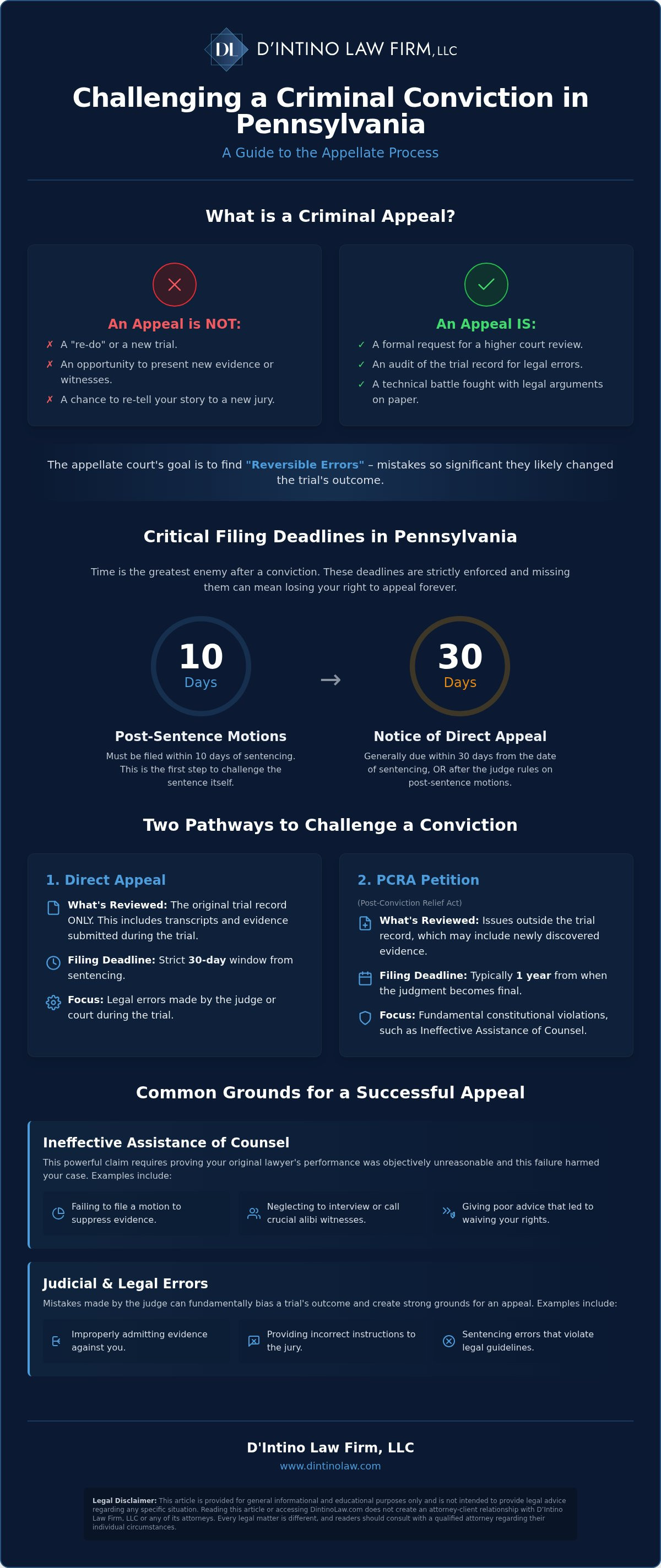
An appeal is a formal request for a higher court to examine a lower court’s decision to see if legal mistakes influenced the outcome. Understanding the Appeals Process is vital because many people mistakenly believe an appeal is a “re-do” where they can tell their story again. In Pennsylvania, the appellate process is a technical battle fought on paper and through legal arguments. It’s about the law, not new testimony.
The Pennsylvania Superior Court usually handles the first level of review for criminal cases. If a case moves further, the Pennsylvania Supreme Court may choose to hear it, though they aren’t required to do so. Unlike a trial where a jury decides facts, these courts determine if the trial judge followed the law correctly. This isn’t a second chance to present witnesses; it’s a rigorous audit of the original proceedings.
The Objective of an Appellate Court
The appellate court’s primary job is to review the trial transcript for procedural or constitutional violations. They look for “reversible errors.” These are mistakes so significant they likely changed the verdict or resulted in an unfair sentence. The court only looks at the “record,” which includes everything said and submitted during the original trial. If you’re working with a drug crimes lawyer Philadelphia families rely on, they’ll spend hours scouring every page of that transcript to find where the system failed you. They aren’t looking for new evidence; they’re looking for where the rules were broken. This requires a meticulous strategist who can spot a single misplaced jury instruction or an improperly admitted piece of evidence that others might miss.
Why the Timeline Matters in PA
Time is your greatest enemy after a conviction. In Pennsylvania, you generally have exactly 30 days from the date of your sentencing to file a Notice of Appeal. This deadline is strictly enforced. If you miss it, you likely lose your right to a direct appeal forever. It’s a high-stakes window that leaves no room for hesitation.
The clock can shift slightly if you file post-sentence motions. These must be filed within 10 days of sentencing. If you file these, the 30-day window for the appeal starts only after the judge rules on those motions. Whether you’re dealing with a complex narcotics case or another serious charge, a drug crimes lawyer Philadelphia knows how to manage these overlapping deadlines. Immediate action is the only way to keep your legal options alive. Waiting even a few days can be the difference between a second chance and a closed door.
Common Grounds for Challenging a Conviction
Winning an appeal isn’t about proving you’re a good person; it’s about proving the trial was legally flawed. In Pennsylvania, appellate courts look for “reversible errors” that significantly impacted the verdict. A judge might have made a “harmless error” that didn’t change the outcome, but a reversible error is a fundamental breach of your rights. Identifying these requires a deep dive into the trial record.
A meticulous review of the trial transcript often reveals hidden grounds for appeal that were missed during the heat of the trial. This process involves examining every objection, every piece of evidence, and every ruling made by the court. Understanding Pennsylvania’s Court Structure helps clarify how these legal challenges move through the system, from the Court of Common Pleas up to the Superior Court.
Ineffective Assistance of Counsel
One of the most powerful grounds for a challenge is the failure of your original attorney to provide a competent defense. In Pennsylvania, this is governed by the Strickland standard. To succeed, you must show that your lawyer’s performance fell below an objective standard of reasonableness and that this failure actually hurt your case. It’s more than just a strategic disagreement. Common examples include:
- Failing to file a motion to suppress evidence in a narcotics case.
- Neglecting to interview or call crucial witnesses who could support an alibi.
- Providing poor strategic advice that led you to waive important constitutional rights.
If you suspect your previous representation failed you, consulting with a drug crimes lawyer Philadelphia clients rely on can help you determine if you have a valid claim for ineffective assistance.
Judicial Discretion and Legal Errors
Judges are human and can make mistakes that bias a trial’s outcome. If a judge improperly admitted evidence that should have been excluded, or excluded evidence that was vital to your defense, it creates a strong basis for appeal. Incorrect jury instructions are another frequent issue. If the judge misstated the law regarding the “burden of proof” or the elements of a crime, the jury could not have reached a valid verdict. Finally, sentencing errors occur when a judge ignores Pennsylvania’s sentencing guidelines or imposes a penalty that exceeds what the law allows. These technical errors are the tools used to dismantle an unfair conviction.
Direct Appeals vs. PCRA Petitions: Key Differences
Pennsylvania law provides two primary paths to challenge a conviction, but they aren’t interchangeable. They follow a strict sequence. You must typically exhaust your direct appeal before you can file a petition under the Post-Conviction Relief Act (PCRA). Each process uses a different “standard of review,” meaning the court looks at your case through a different lens depending on which stage you’re in. While a direct appeal focuses on what happened in the courtroom, a PCRA petition can address what should have happened but didn’t.
The Scope of a Direct Appeal
A direct appeal is your first bite at the apple. It’s limited strictly to the “record,” which consists of the trial transcript, exhibits, and motions filed during the case. You can’t introduce new evidence or claim that a witness lied if that wasn’t addressed during the trial. The appellate court’s job is to determine if the trial judge abused their discretion or made an error of law.
To win here, your trial attorney must have “preserved” the issue. This means they had to object at the exact moment the error occurred. If there’s no objection in the transcript, the appellate court will usually consider the issue waived. The Pennsylvania Rules of Appellate Procedure govern these strict requirements. A drug crimes lawyer Philadelphia defendants trust will meticulously scan the record to ensure every preserved error is highlighted in the appellate brief.
The Power of the PCRA Petition
If your direct appeal is unsuccessful, the PCRA petition becomes your next line of defense. This is the stage where you can raise issues that exist outside the original trial record. The most common PCRA claim is ineffective assistance of counsel, where you argue your trial lawyer’s mistakes were so severe they violated your constitutional right to a fair trial. You can also bring forward newly discovered evidence that wasn’t available during the trial.
Timing is everything with a PCRA. You generally have exactly one year from the date your judgment of sentence becomes final to file this petition. There are very narrow exceptions for government interference or newly discovered facts, but missing this deadline usually bars you from relief. Because the PCRA process involves evidentiary hearings and complex legal standards, it’s a technical battle that requires a seasoned strategist. A drug crimes lawyer Philadelphia families rely on understands that this is often the last opportunity to overturn a wrongful conviction or correct a sentencing injustice.
How to Evaluate a Pennsylvania Criminal Appeals Attorney
Choosing an appellate lawyer is a different process than hiring a trial attorney. While trial work often relies on courtroom theatrics and emotional appeals to a jury, the appellate process happens almost entirely on paper. It requires a specialized skill set focused on deep legal research and technical precision. You need a strategist who knows how to dissect a trial record to find the specific errors that led to your conviction. This isn’t the time for a generalist; it’s the time for a dedicated advocate who understands the nuances of Pennsylvania law. Many families also worry about the financial burden of quality legal representation, and it’s worth knowing that fee arrangements like those offered by a personal injury lawyer no win no fee Philadelphia residents rely on can make elite advocacy more accessible across different practice areas.
Meticulous Attention to Detail
A trial transcript can easily exceed 1,000 pages. Reviewing this volume of information requires a fine-toothed comb to identify subtle procedural flaws that a high-volume firm might miss. Many large firms hand off this tedious work to junior associates or case managers. This is a major risk. A successful appeal depends on the lead attorney personally reviewing every word of the record. This hands-on approach ensures that no constitutional violation or judicial error goes unnoticed. John D’Intino Jr. brings over 20 years of experience to this process, personally reviewing every transcript rather than delegating to a revolving door of associates. If you are searching for a drug crimes lawyer Philadelphia families trust, ensure they are personally invested in every page of your case’s history.
Strategic Brief Writing
The appellate brief is the most critical component of your challenge. It’s the primary document the judges use to understand your case before oral arguments even begin. A generic brief won’t suffice. You need a tailored, case-specific argument that addresses the unique legal hurdles of your trial. Persuasive writing is what influences the court’s perception of a reversible error. It requires a “fighter” mentality that is reflected in the strength of the written word.
When evaluating an attorney, look at their history with the Pennsylvania Superior and Supreme Courts. Experience matters because each court has its own rhythm and expectations. A boutique firm approach, where you have direct attorney-client interaction, provides the focus your case deserves. In a high-stakes legal environment, you need a lawyer who acts as a partner. You aren’t just another file; you’re a person fighting for their future. This personalized attention is a hallmark of elite service. If you’re ready to challenge an unfair verdict, contact an experienced appellate advocate to review your legal options.
Strategic Advocacy for Your Pennsylvania Appeal
D’Intino Law Firm, LLC approaches the complex Pennsylvania appellate landscape with a focus on technical precision and relentless advocacy. Successfully challenging a conviction requires more than just knowing the law; it requires a deep understanding of how appellate judges in Pennsylvania interpret trial records. With over 20 years of experience in the Pennsylvania criminal justice system, John D’Intino Jr. provides the steady, seasoned guidance necessary to navigate these high-stakes proceedings. The firm treats every appeal as a unique mission to identify and expose the legal errors that compromised your right to a fair trial.
A Personalized Partnership
One of the most significant risks in the legal industry is the “hand-off.” In many larger firms, a senior partner might take your case only to pass the actual transcript review and brief writing to a junior associate. At D’Intino Law Firm, LLC, you work directly with John D’Intino Jr. throughout your entire appellate journey. This boutique approach ensures that your case receives the elite, tailored service it requires. You’ll have direct access to your attorney, providing a sense of order and control during an incredibly stressful time. We believe that every client deserves to feel heard and supported, knowing that a dedicated fighter is personally reviewing every page of their trial record.
The Path to Resolution
Moving forward begins with a realistic and honest assessment of your case. During the initial consultation and case review, we examine the strengths and weaknesses of your potential appeal. We don’t offer false hope; we provide a strategic roadmap based on the facts and the law. If the court grants a request for oral arguments, we prepare meticulously to represent your interests before the judges. While our work in the appellate courts is highly technical, our foundation is built on years of experience as a Philadelphia Criminal Defense Lawyer. This trial-level context allows us to see the mistakes that occurred in the courtroom from the perspective of an attorney who has been in the trenches.
The appellate process is demanding and time-sensitive. Whether you’re dealing with a direct appeal or a PCRA petition, the quality of your representation is the most critical factor in your case. If you’re ready to take the next step toward challenging your conviction, contact D’Intino Law Firm, LLC today to discuss your legal concerns and explore your options for relief in Pennsylvania.
Legal Disclaimer: This article is provided for general informational and educational purposes only and is not intended to provide legal advice regarding any specific situation. Reading this article or accessing DintinoLaw.com does not create an attorney-client relationship with D’Intino Law Firm, LLC or any of its attorneys. Every legal matter is different, and readers should consult with a qualified attorney regarding their individual circumstances.
Protecting Your Rights in the Pennsylvania Appellate Courts
Challenging a conviction is a technical battle that demands a precise strategy. You now understand that a successful appeal hinges on identifying reversible legal errors and meeting strict Pennsylvania filing deadlines. Whether you’re addressing judicial mistakes or seeking relief through a PCRA petition, the quality of your legal representation is the most important factor in your case. Working with a seasoned drug crimes lawyer Philadelphia residents trust ensures that your trial transcript is reviewed with the meticulous care it deserves.
John D’Intino Jr. brings over 20 years of experience to every case, providing direct attorney access and personalized service to Philadelphia and the surrounding counties. Contact D’Intino Law Firm, LLC today for a consultation regarding your appeal. Your story doesn’t have to end with a trial court’s error. Taking decisive action now is the first step toward reclaiming your future.
Legal Disclaimer: This article is provided for general informational and educational purposes only and is not intended to provide legal advice regarding any specific situation. Reading this article or accessing DintinoLaw.com does not create an attorney-client relationship with D’Intino Law Firm, LLC or any of its attorneys. Every legal matter is different, and readers should consult with a qualified attorney regarding their individual circumstances.
Frequently Asked Questions
How long do I have to file an appeal in Pennsylvania?
In Pennsylvania, you generally have exactly 30 days from the date of your sentencing to file a Notice of Appeal. This is a strict jurisdictional deadline. If you file post-sentence motions within 10 days of your sentencing, the 30-day clock starts once the judge decides on those motions. Missing these windows can permanently bar your right to a direct appeal. It’s vital to act immediately to preserve your legal options and protect your future.
Can I get a new trial if my lawyer was bad?
You may be eligible for a new trial if you can prove ineffective assistance of counsel. This requires showing that your original lawyer’s performance was deficient and that this deficiency prejudiced your case. In Pennsylvania, these claims are typically raised during the Post-Conviction Relief Act (PCRA) process. You must demonstrate that there’s a reasonable probability the outcome would’ve been different with competent representation. It’s a technical challenge that requires a seasoned legal strategist.
What is the difference between a Direct Appeal and a PCRA?
A Direct Appeal is the first step and focuses only on errors found in the trial transcript or record. A PCRA petition happens later and allows you to bring up issues not in the original record, like newly discovered evidence or constitutional violations. While a Direct Appeal is filed within 30 days, a PCRA petition usually must be filed within one year of your conviction becoming final in Pennsylvania. Each process follows its own strict procedural rules.
Will I stay in prison while my appeal is pending?
Most defendants remain in prison while their appeal is pending in Pennsylvania. While it’s possible to request appeal bail or a stay of execution of the sentence, these requests are frequently denied for serious convictions. The court considers factors like the risk of flight and the merit of the appeal. You should discuss your specific circumstances with a drug crimes lawyer Philadelphia families trust to understand the likelihood of being released during the appellate process.
Can I introduce new evidence in a Direct Appeal?
No, you cannot introduce new evidence during a Direct Appeal. The appellate court only reviews the record, which includes the trial transcript, exhibits, and motions from the original trial. If you have new evidence that wasn’t available before, you must typically wait until the PCRA stage to present it. The appellate judges only decide if the trial judge followed Pennsylvania law correctly based on the information that was provided at the time of the trial.
What happens if I win my criminal appeal in PA?
Winning an appeal doesn’t always mean you go home immediately. The appellate court may vacate your conviction and order a new trial, or they might vacate your sentence and send the case back for re-sentencing. In rare cases where the evidence was legally insufficient, the court could dismiss the charges entirely. The specific outcome depends on the nature of the legal error the court identified in your Pennsylvania case. Every situation is unique and requires careful review.
Do I need a different lawyer for my appeal than I had for my trial?
You aren’t required to change lawyers, but many people find that a fresh set of eyes is beneficial. Appellate law is a highly technical field that requires different skills than trial work. A drug crimes lawyer Philadelphia defendants hire for appeals focuses on research and brief writing rather than cross-examining witnesses. Bringing in a new attorney also allows you to raise claims of ineffective assistance against your original trial counsel without a conflict of interest.
How much does a criminal appeals lawyer cost in Pennsylvania?
The cost of an appellate attorney in Pennsylvania varies based on the complexity of the trial record and the number of legal issues involved. Most firms use flat fees or hourly rates for these services. Because an appeal requires hundreds of hours of transcript review and brief writing, the fees reflect the intensive labor required. D’Intino Law Firm, LLC offers flexible payment options to help families manage the costs of seeking professional legal representation during this difficult time. Families facing financial hardship may also want to explore how no win no fee Philadelphia legal agreements work for related civil matters, as understanding all available fee arrangements can help you make the most informed decisions for your situation.
Legal Disclaimer: This article is provided for general informational and educational purposes only and is not intended to provide legal advice regarding any specific situation. Reading this article or accessing DintinoLaw.com does not create an attorney-client relationship with D’Intino Law Firm, LLC or any of its attorneys. Every legal matter is different, and readers should consult with a qualified attorney regarding their individual circumstances.
Disclaimer
Legal Disclaimer: The information provided on DintinoLaw.com, including articles, blog posts, testimonials, case results, and other content, is for general informational and educational purposes only and does not constitute legal advice or create an attorney-client relationship with D’Intino Law Firm, LLC or any of its attorneys. Visiting this website, submitting a contact form, sending an email, calling, texting, or otherwise communicating with the firm does not establish an attorney-client relationship or obligate the firm to represent you. Do not submit confidential, privileged, or time-sensitive information through this website or electronic communications unless and until the firm has expressly agreed to represent you. Legal rights, procedures, statutes of limitation, filing deadlines, and other requirements vary based on the facts and jurisdiction and may change over time; nothing on this website should be relied upon to determine whether a legal deadline applies to your matter. If you have an urgent legal matter or a potential filing deadline, consult a qualified attorney promptly. Testimonials and statements regarding client experiences are individual opinions and experiences and are not a guarantee of future results. Prior results, verdicts, settlements, or case examples do not guarantee or predict the outcome of any future case, and every matter is different. This website may constitute attorney advertising under applicable Pennsylvania rules. D’Intino Law Firm, LLC makes no representation that the information on this website is complete, current, or applicable to your particular circumstances. For legal advice concerning your specific situation, consult directly with a qualified Pennsylvania attorney. D’Intino Law Firm, LLC | Philadelphia, Pennsylvania | DintinoLaw.com
