


Attorney
Why does the insurance adjuster keep calling you for a recorded statement before you’ve even finished your first week of physical therapy? They know that when medical debt starts to pile up, you might feel pressured to settle before you understand the full car accident settlement timeline Pennsylvania law requires. It’s a high-stakes situation. You’re forced to navigate complex “No-Fault” and “Full Tort” systems while simply trying to heal.
You deserve to know exactly what’s ahead. This guide offers a clear roadmap of the legal journey. We’ll examine the specific phases of a claim, the procedural requirements that can cause friction, and the strategic decisions that determine how long it takes to reach a resolution. By understanding these factors, you can move forward with confidence and avoid the common pitfalls that often lead to unnecessary delays.
Legal Disclaimer: This article is provided for general informational and educational purposes only and is not intended to provide legal advice regarding any specific situation. Reading this article or accessing DintinoLaw.com does not create an attorney-client relationship with D’Intino Law Firm, LLC or any of its attorneys. Every legal matter is different, and readers should consult with a qualified attorney regarding their individual circumstances.
Key Takeaways
- Medical recovery is the most significant variable in your case. Settling before you reach Maximum Medical Improvement can leave you with unpaid future bills.
- Pennsylvania’s two-year statute of limitations creates a firm deadline for filing a claim, so early evidence preservation is critical for your success.
- You’ll gain a clear understanding of the car accident settlement timeline Pennsylvania residents can expect across the five distinct phases of a personal injury claim.
- Insurance company tactics, such as disputing liability or stalling record requests, often create friction that requires strategic intervention to overcome.
- Working with an attorney who provides direct contact prevents the communication breakdowns and delays often found at larger, corporate law firms.
Factors That Influence the Car Accident Settlement Timeline in PA
Every car accident case is a unique puzzle. While some people hope for a quick check, the reality is that the car accident settlement timeline Pennsylvania drivers experience depends on several moving parts. There isn’t a “standard” duration because your medical recovery and the specific details of the crash dictate the pace. We focus on moving your case forward without sacrificing the value of your claim.
The Statute of Limitations in Pennsylvania is the hard legal deadline that requires you to file a personal injury lawsuit within two years of the date of the accident.
When an accident involves three or more vehicles, the timeline often stretches. Each insurance company must conduct its own investigation, and they’ll often point fingers at each other to avoid paying. This complexity stems from several factors:
- Multiple adjusters coordinating schedules for vehicle inspections.
- Conflicting witness statements regarding the sequence of impacts.
- Disputes over which driver’s policy is primary for specific damages.
This environment requires a strategic, evidence-based response to keep the case moving forward and prevent your claim from stalling in a sea of bureaucracy.
The Impact of Pennsylvania Insurance Laws
Pennsylvania’s “choice no-fault” system creates unique hurdles. If you have “Limited Tort” coverage, we must prove you suffered a “serious injury” to seek pain and suffering damages. This adds a layer of investigative work and expert medical testimony that “Full Tort” cases might bypass. Your Personal Injury Protection (PIP) coverage handles initial medical bills regardless of fault, but the broader personal injury claims process requires a deep dive into liability. Pennsylvania follows a modified comparative negligence rule. This means your compensation is reduced by your percentage of fault. If an adjuster claims you were partially responsible, the investigation into those specific percentages will naturally extend the clock.
Insurance Company Response Times
After we notify the insurer, they are typically required to acknowledge the claim within 10 business days. A prompt acknowledgement doesn’t mean a fast settlement. Adjusters often manage hundreds of files at once. These massive caseloads create procedural bottlenecks where your paperwork might sit on a desk for weeks without a glance. It’s vital to distinguish between a standard investigation and “bad faith” delays. While insurers have a right to verify the facts, they don’t have the right to ignore your claim or use stalling tactics as a weapon to pressure you. A hands-on, assertive approach from your attorney ensures your file stays at the top of their pile and moves through the system.
Legal Disclaimer: This article is provided for general informational and educational purposes only and is not intended to provide legal advice regarding any specific situation. Reading this article or accessing DintinoLaw.com does not create an attorney-client relationship with D’Intino Law Firm, LLC or any of its attorneys. Every legal matter is different, and readers should consult with a qualified attorney regarding their individual circumstances.
The 5 Phases of a Pennsylvania Personal Injury Claim
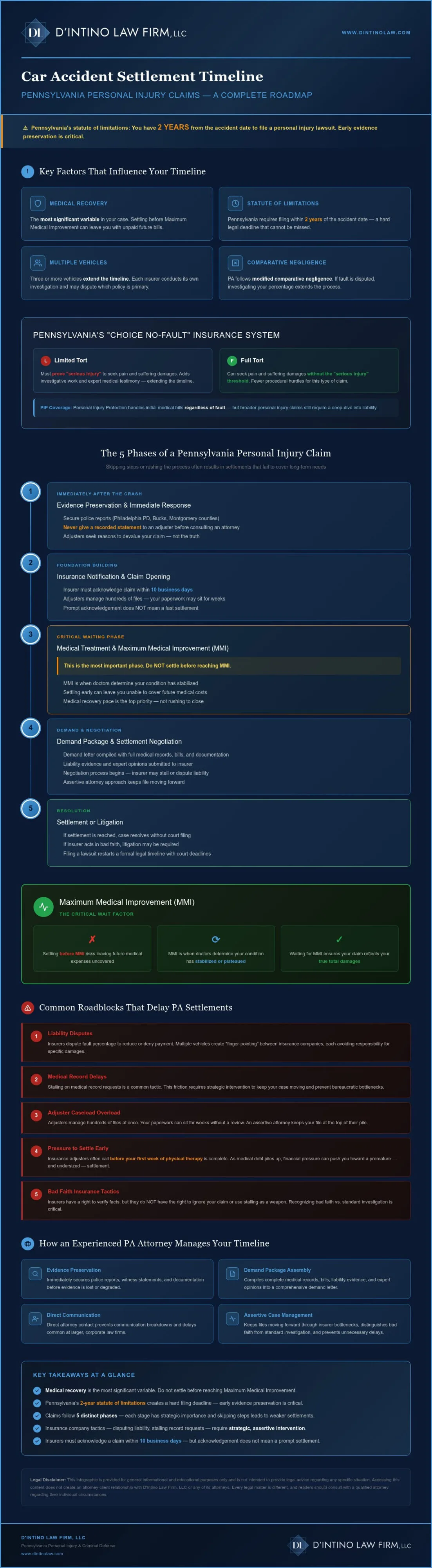
Understanding the car accident settlement timeline Pennsylvania victims must follow helps reduce the stress of the unknown. While your case is unique, most claims progress through five distinct stages. This structure ensures that no evidence is lost and that your physical recovery remains the top priority. Skipping steps or rushing the process often results in settlements that fail to cover long term needs.
Phase 1 & 2: Building the Foundation
The first phase begins the moment the crash occurs. We immediately focus on evidence preservation. This includes securing police reports from local precincts, such as the Philadelphia Police Department or suburban stations in Bucks and Montgomery counties. These documents provide a neutral starting point for liability. You’ll likely receive calls from insurance adjusters during this time. You should never give a recorded statement to an adjuster before consulting an attorney. They aren’t looking for the truth; they’re looking for reasons to devalue your claim. Under Pennsylvania auto insurance requirements, carriers have specific duties, but their primary goal is protecting their bottom line.
Phase two centers on your medical treatment. It’s the longest part of the journey. You must attend every appointment and follow every specialist’s recommendation. Consistent medical documentation creates a paper trail that links your injuries directly to the accident. We wait until you reach Maximum Medical Improvement (MMI) before moving to the next stage. This ensures we aren’t guessing about your future medical costs.
Phase 3 & 4: Negotiation vs. Litigation
Once your medical status is clear, we compile a “Demand Package.” This is a comprehensive file containing your medical records, bills, proof of lost wages, and a legal argument for liability. After the insurance company receives this, the negotiation phase begins. This back and forth period can take several weeks or months. If the insurer refuses to offer a fair amount, we move into phase four: litigation. Filing a lawsuit in Pennsylvania courts signals that we’re serious. It doesn’t mean your case will go to trial, but it often forces the insurance company to take your injuries more seriously. If you’re feeling stuck in the process, you can discuss your specific case with a dedicated advocate who understands these procedural hurdles.
The final phase is settlement distribution. Once an agreement is reached, we resolve any outstanding medical liens or insurance subrogation claims. This ensures that when you receive your check, the money is truly yours to keep. We handle the paperwork so you can focus on moving forward with your life.
Legal Disclaimer: This article is provided for general informational and educational purposes only and is not intended to provide legal advice regarding any specific situation. Every legal matter is different, and readers should consult with a qualified attorney regarding their individual circumstances.
Why ‘Maximum Medical Improvement’ is the Critical Wait Factor
Maximum Medical Improvement, or MMI, is the point where a doctor determines your condition has stabilized. It doesn’t necessarily mean you’re back to 100% of your pre-accident health. Instead, it means further significant recovery is unlikely even with more treatment. This plateau is the single most important variable in the car accident settlement timeline Pennsylvania plaintiffs must navigate. If we rush to settle before a doctor declares MMI, we’re essentially guessing what your future medical needs might be.
In Pennsylvania, once you sign a release, you generally cannot seek further compensation for that specific accident. This is a permanent decision. If your condition worsens or you require a surprise surgery six months later, the insurance company has no legal obligation to pay another dime. Complex injuries like traumatic brain injuries (TBI) or multi-level spinal fractures often take a year or more to reach MMI. We refuse to gamble with your financial future by closing a file before the full extent of your permanent impairment is documented.
The Danger of the ‘Quick Settlement’ Offer
Insurance adjusters are trained to recognize when a victim is under financial stress. They might offer a “quick cash” settlement within days of the crash. These offers are predatory. They rarely account for long term rehabilitation, permanent scarring, or a reduced capacity to earn a living. Our role is to act as a shield between you and these aggressive tactics. We ensure the insurance carrier respects the medical reality of your recovery rather than their own quarterly profit goals.
Coordinating with Pennsylvania Medical Providers
Building a solid case requires meticulous coordination with regional health systems like Penn Medicine or Temple Health. We gather every imaging report, surgical note, and physical therapy log to prove the severity of your injuries. Following the Pennsylvania Insurance Department auto insurance guidelines, we also manage the complex world of medical liens and subrogation. This involves negotiating with your health insurance provider to ensure they don’t take an unfair share of your final recovery. Waiting for expert medical testimony or specialized reports from neurologists and orthopedic surgeons can add months to the process, but this precision is what protects the value of your claim.
Legal Disclaimer: This article is provided for general informational and educational purposes only and is not intended to provide legal advice regarding any specific situation. Every legal matter is different, and readers should consult with a qualified attorney regarding their individual circumstances.
Common Roadblocks That Delay PA Accident Settlements
Even with a clear legal strategy, friction points can slow down your progress. Disputes over liability are among the most common hurdles. When the other driver denies fault, the investigation must deepen. We often have to track down video surveillance from nearby businesses or wait for government records that don’t arrive overnight. These evidentiary challenges directly impact the car accident settlement timeline Pennsylvania victims experience.
The discovery process is another significant factor in the clock. This phase involves interrogatories, which are formal written questions, and depositions, where witnesses provide testimony under oath. Coordinating schedules for multiple attorneys, witnesses, and court reporters takes time. If your case moves into the Philadelphia Court of Common Pleas, you’re also at the mercy of their specific judicial calendar. Scheduling conflicts and court backlogs are realities we manage through proactive communication and persistence.
Issues with Uninsured or Underinsured Motorists
UM/UIM claims follow a different procedural path than standard claims. In these cases, you’re often dealing with your own insurance carrier in a semi adversarial role. These disputes frequently require arbitration rather than a traditional jury trial. You typically have to exhaust the at fault driver’s policy limits before your own underinsured coverage kicks in. This sequential requirement adds a layer of delay that third party liability claims don’t face. If you’re struggling with a carrier that refuses to pay, you can reach out to a Pennsylvania car accident lawyer for a direct review of your options.
Administrative and Court-Related Delays
Southeastern PA courts, including those in Montgomery, Bucks, and Delaware counties, often face significant backlogs. A trial date might be set a year or more into the future. Expert witnesses, such as surgeons or accident reconstructionists, have limited availability. Their review and report preparation can take several weeks to finalize. In specific types of injury litigation, a “Certificate of Merit” may be required to verify the case has a factual basis. This adds another procedural layer that must be cleared before the case can advance toward a resolution.
Legal Disclaimer: This article is provided for general informational and educational purposes only and is not intended to provide legal advice regarding any specific situation. Every legal matter is different, and readers should consult with a qualified attorney regarding their individual circumstances.
How an Experienced Pennsylvania Attorney Manages Your Timeline
Managing the car accident settlement timeline Pennsylvania victims encounter requires more than just filling out forms. It takes a proactive, hands-on approach that anticipates delays before they happen. At D’Intino Law Firm, LLC, we utilize a “Direct Attorney Contact” model. This means you won’t be handed off to a case manager or a junior associate. You work directly with an advocate who has over two decades of experience and personally handles every aspect of your claim.
We don’t wait for the insurance company to ask for information. We gather evidence immediately, from dashcam footage to witness affidavits, to prevent adjusters from using “lack of information” as a stalling tactic. If an insurer uses “delay and deny” strategies, we use litigation as a strategic tool. Filing a lawsuit often forces them back to the negotiating table because they know we’re prepared to present the facts to a jury. The final stage of any claim involves lien resolution. We work to negotiate down medical liens from health insurance providers and hospitals. This technical phase is often where cases stall at larger firms, but we prioritize it to ensure you receive your funds as quickly as possible.
Personalized Strategy for Philadelphia and Surrounding Counties
Every county has its own procedural rhythm. We understand the specific local court rules in Montgomery, Bucks, and Delaware Counties. Attorney John D’Intino Jr. provides direct advocacy in every phase of your case. We maintain a fighter mentality that refuses to accept an inadequate offer. We’ll never push for a fast, low-value settlement just to clear a file. Your long-term recovery and financial stability are our primary drivers.
Next Steps: Your Free Consultation
When you’re ready to discuss your options, we’re here to listen. For our initial meeting, try to bring your police report, insurance documents, and any medical discharge papers you’ve received. We operate on a contingency fee model. This means there are no upfront costs or hourly fees while your case is pending. We only get paid if we make a recovery for you. For more information on our approach, you can visit our page on Philadelphia Personal Injury Lawyer services.
Legal Disclaimer: This article is provided for general informational and educational purposes only and is not intended to provide legal advice regarding any specific situation. Every legal matter is different, and readers should consult with a qualified attorney regarding their individual circumstances.
Take Control of Your Recovery and Legal Journey
Navigating the car accident settlement timeline Pennsylvania law establishes is a complex process that requires both patience and precision. You shouldn’t have to face aggressive insurance adjusters alone while you’re trying to reach Maximum Medical Improvement. We understand the stress of rising medical debt and the confusion caused by the state’s tort systems. Our firm focuses on providing the personalized attention you need to avoid unnecessary delays and protect the true value of your claim.
With over 20 years of experience in Pennsylvania law, Attorney John D’Intino Jr. handles every case personally. You don’t have to worry about being handed off to a case manager. We work on a contingency fee basis, which means you pay nothing unless we recover for you. Facing medical bills and insurance delays? Contact D’Intino Law Firm, LLC today for a free consultation regarding your Pennsylvania car accident claim.
You have the right to a dedicated advocate who fights for your long term stability. We’re ready to help you move forward with confidence.
Legal Disclaimer: This article is provided for general informational and educational purposes only and is not intended to provide legal advice regarding any specific situation. Every legal matter is different, and readers should consult with a qualified attorney regarding their individual circumstances.
Frequently Asked Questions
How long does a typical car accident settlement take in Pennsylvania?
Most car accident settlements in Pennsylvania take anywhere from six months to over a year to reach a final resolution. This window depends heavily on the duration of your medical treatment and the willingness of the insurance carrier to negotiate in good faith. If your case involves complex injuries or disputed liability in counties like Delaware or Montgomery, the process naturally extends to ensure all evidence is properly documented.
Can I speed up my car accident settlement in PA?
You can potentially shorten the car accident settlement timeline Pennsylvania requires by being proactive with your medical appointments and providing all requested documentation to your attorney immediately. Staying organized helps prevent administrative bottlenecks. However, rushing to settle before you reach Maximum Medical Improvement is often a financial mistake. It’s better to wait for a full medical clearance than to accept a low offer that leaves future bills unpaid.
What happens if the insurance company denies my claim or offers too little?
If an insurance carrier denies liability or provides an inadequate offer, the next step is typically filing a formal lawsuit in the appropriate county court. This shifts the case into the litigation phase, which involves discovery and depositions. Filing a suit signals to the insurer that you’re prepared for trial. This pressure often forces adjusters to reconsider their position and offer a more realistic settlement amount during subsequent negotiations.
Will my case have to go to trial in a Pennsylvania court?
Statistically, the vast majority of personal injury cases in Pennsylvania settle before reaching a jury trial. Most disputes are resolved through direct negotiation or mediation. While we prepare every file as if it’s going to the Philadelphia Court of Common Pleas, the goal is often to secure a fair settlement without the added time and stress of a full trial. Trial remains a necessary option only when the insurer refuses to be reasonable.
How long do I have to file a car accident lawsuit in PA?
Under Pennsylvania law, you generally have two years from the date of the accident to file a personal injury lawsuit. This is known as the Statute of Limitations. If you miss this hard deadline, you lose your right to seek compensation for your injuries. It’s vital to contact an attorney early so they can preserve evidence, interview witnesses, and ensure all filings are completed well before this two year window closes.
Does hiring a lawyer make the settlement process take longer?
Hiring a lawyer does not inherently slow down your case; in many instances, it actually prevents the procedural delays that insurance companies use to stall unrepresented victims. An attorney manages the complex paperwork and keeps the adjuster on a strict schedule. While a thorough investigation takes time, it ensures the final settlement reflects the true cost of your recovery rather than a fast, undervalued offer from the insurance company.
What if the other driver doesn’t have insurance in Pennsylvania?
If the at fault driver is uninsured, you will likely need to file an Uninsured Motorist (UM) claim with your own insurance company. This process follows different procedural rules and may require arbitration in a local Pennsylvania venue. These claims can sometimes be more complex because your own insurer effectively steps into the shoes of the at fault driver. We manage these claims to ensure your own carrier honors the policy you’ve paid for.
How much of my settlement goes to medical liens and attorney fees?
The final distribution of your settlement depends on your specific contingency fee agreement and the total amount of outstanding medical liens. Attorney fees are typically a set percentage of the total recovery, and we only get paid if you win. We also work directly with medical providers and health insurers to negotiate down your liens. This aggressive negotiation ensures that the largest possible portion of the settlement stays in your pocket for your recovery.
Legal Disclaimer: This article is provided for general informational and educational purposes only and is not intended to provide legal advice regarding any specific situation. Every legal matter is different, and readers should consult with a qualified attorney regarding their individual circumstances.
Disclaimer
Legal Disclaimer: The information provided on DintinoLaw.com, including articles, blog posts, testimonials, case results, and other content, is for general informational and educational purposes only and does not constitute legal advice or create an attorney-client relationship with D’Intino Law Firm, LLC or any of its attorneys. Visiting this website, submitting a contact form, sending an email, calling, texting, or otherwise communicating with the firm does not establish an attorney-client relationship or obligate the firm to represent you. Do not submit confidential, privileged, or time-sensitive information through this website or electronic communications unless and until the firm has expressly agreed to represent you. Legal rights, procedures, statutes of limitation, filing deadlines, and other requirements vary based on the facts and jurisdiction and may change over time; nothing on this website should be relied upon to determine whether a legal deadline applies to your matter. If you have an urgent legal matter or a potential filing deadline, consult a qualified attorney promptly. Testimonials and statements regarding client experiences are individual opinions and experiences and are not a guarantee of future results. Prior results, verdicts, settlements, or case examples do not guarantee or predict the outcome of any future case, and every matter is different. This website may constitute attorney advertising under applicable Pennsylvania rules. D’Intino Law Firm, LLC makes no representation that the information on this website is complete, current, or applicable to your particular circumstances. For legal advice concerning your specific situation, consult directly with a qualified Pennsylvania attorney. D’Intino Law Firm, LLC | Philadelphia, Pennsylvania | DintinoLaw.com
