


Attorney
Did you know that Pennsylvania is one of the few states where you don’t get a mandatory three-day attorney review period after signing a home purchase agreement? In the Commonwealth, once the signatures are on the page, the contract is legally binding. It’s natural to feel a mix of excitement and anxiety as you face stacks of paperwork. You might worry about hidden liabilities buried in the fine print or feel confused by the latest 2026 Pennsylvania Association of Realtors (PAR) form updates. Performing a diligent real estate contract review is the only way to ensure you aren’t missing a single contingency deadline that could cost you your earnest money deposit.
This guide will help you identify critical red flags and understand your rights under the Seller’s Disclosure Act so you can sign with total confidence. We will examine the essential elements of a sound agreement, from navigating Philadelphia’s specific transfer tax rates to mastering the 2025 mortgage contingency requirements. You’ll learn how to spot problematic clauses before they become expensive legal hurdles. By the end, you’ll have a clear strategy to negotiate better terms and ensure your financial interests remain protected throughout the settlement process.
Key Takeaways
- Pennsylvania law does not provide a standard attorney review period, making it vital to understand every clause before the contract becomes binding.
- A comprehensive real estate contract review helps you identify red flags in the fine print and ensures your financial interests are fully protected.
- Learn the essential components of a valid agreement, including property legal descriptions and clear schedules for earnest money deposits.
- Master the deadlines for inspection contingencies and the requirements of the Pennsylvania Seller Disclosure Act to avoid costly legal disputes.
- Gain insights into how direct legal advocacy can help you negotiate more favorable terms and provide peace of mind during the settlement process.
The Importance of a Real Estate Contract Review in Pennsylvania
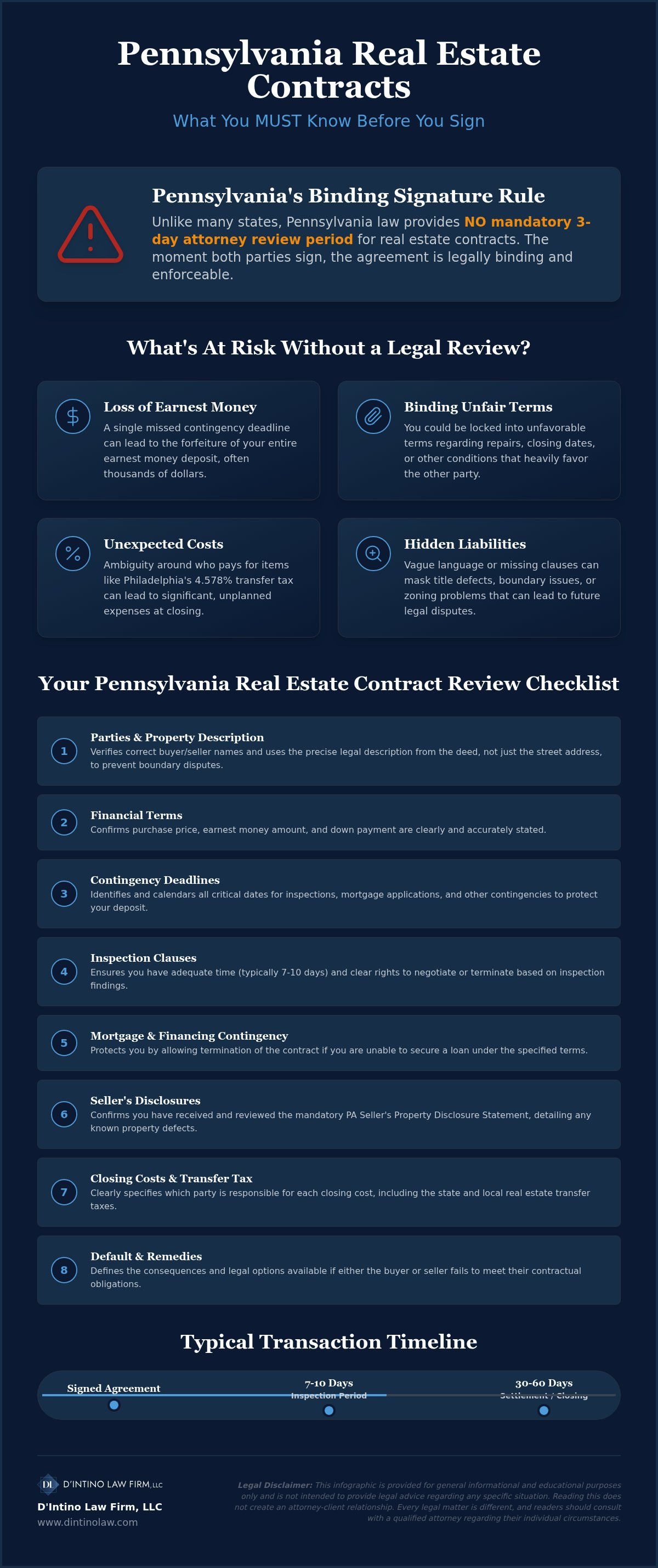
A Real estate contract is more than a list of names and a purchase price. It’s a binding roadmap for one of the largest financial transactions of your life. In Pennsylvania, a real estate contract review is a comprehensive legal analysis designed to ensure every clause aligns with your actual intentions. Unlike some neighboring states, Pennsylvania doesn’t grant a three-day window to change your mind or consult counsel after signing. The moment both parties sign, the deal is active and legally enforceable. This lack of a “cooling off” period makes the pre-signing phase your only opportunity to identify hidden liabilities.
Signing a contract without a professional eye in Philadelphia or Montgomery County carries significant risks. Local nuances, such as Philadelphia’s high transfer tax rate of 4.578%, can lead to unexpected costs if the split isn’t explicitly defined. Without a diligent review, you might find yourself bound to terms that favor the other party’s interests over your own. You shouldn’t leave your financial future to chance when a single overlooked sentence can lead to the loss of your earnest money deposit.
Contract Review vs. Standard Realtor Agreements
Realtors are experts at finding homes and matching buyers with sellers, but they cannot legally interpret the long-term consequences of complex legal language. Most agents use the standard Pennsylvania Association of Realtors (PAR) agreement. While these templates cover the basics, they don’t always account for your unique financial goals or the specific risks of a property. A real estate lawyer Philadelphia provides a layer of protection that a standard form cannot offer. We analyze every custom addendum to ensure it doesn’t create an unfair advantage for the other party. Our role is to identify boilerplate text that might be unfavorable and replace it with language that prioritizes your rights.
Preventing Future Real Estate Litigation
Disputes at the closing table are often the result of vague language signed weeks earlier. A real estate contract review acts as a proactive defense against these conflicts. When terms are clear and deadlines are firm, there’s no room for the “he said, she said” arguments that lead to lawsuits. Think of it as a cost-benefit strategy. The investment in a legal review is a fraction of the cost required for commercial real estate litigation Pennsylvania. We use our experience in the courtroom to predict where a deal might fail. This “fighter” mentality allows us to close loopholes and draft terms that stand up to scrutiny, giving you peace of mind that your interests are secure.
Essential Components of a Valid PA Real Estate Agreement
In Pennsylvania, the Agreement of Sale serves as the master document that dictates every detail of the transaction. For a contract to be legally binding, there must be a “meeting of the minds.” This means both parties agree on the essential terms, including the identity of the buyers and sellers, the purchase price, and the specific property being sold. While a street address is common, a professional real estate contract review will verify the precise legal description from the deed to avoid boundary disputes. This level of detail is necessary because mistakes in property identification can lead to title defects that haunt owners for years.
Pennsylvania law is strict about how these agreements are structured. If you’re entering into a non-traditional arrangement, you must be aware of Pennsylvania’s Installment Land Contract Law, which carries specific disclosure requirements for certain counties. Standard transactions typically follow a timeline of 30 to 60 days for settlement, with inspection periods usually lasting between 7 and 10 days. Missing these deadlines can result in a breach of contract. It’s essential to have an advocate who understands the local pace of business in Philadelphia and Montgomery County to keep the deal on track.
Financial Provisions and Earnest Money
The financial heart of the deal involves the down payment and the earnest money deposit. In Pennsylvania, earnest money is a sum of money provided by the buyer to demonstrate their good faith in completing the purchase, typically ranging from 2% to 5% of the total price. These funds are held in an escrow account by the broker or a title company. If a buyer defaults without a legal excuse, the seller may be entitled to keep this deposit as liquidated damages. A thorough real estate contract review ensures that the conditions for returning or forfeiting these funds are crystal clear. If you have questions about escrow safety, you can consult with a dedicated attorney who can explain the risks of standard boilerplate language.
Property Descriptions and Fixtures
Confusion often arises over what is actually included in the sale. The contract must explicitly list fixtures, such as chandeliers, appliances, or built-in shelving, to prevent last-minute conflicts at the walkthrough. Sellers often assume they can take certain items while buyers assume they stay. Identifying these discrepancies early is part of a strategic review. We also address potential title issues during the initial contract phase. Finding liens or easements before the closing process begins prevents the deal from collapsing at the eleventh hour. Precision in the property description ensures that what you think you’re buying is exactly what is being transferred.
Your Real Estate Contract Review Checklist: 10 Critical Points
A professional real estate contract review transforms a dense stack of paperwork into a clear, actionable checklist. It’s your primary defense against unexpected costs and legal loopholes. When you examine your Pennsylvania Agreement of Sale, you must verify these first five foundational points immediately. First, confirm the absolute accuracy of all personal and property information. Even a minor typo in a name or a parcel number can delay your settlement. Second, ensure the purchase price and payment schedule are unambiguous, including the exact dates for your initial and second deposits. Third, scrutinize the mortgage and financing contingencies. Pennsylvania updated its standard mortgage contingency language on September 1, 2025, so your contract must reflect current standards to protect your deposit if your loan isn’t approved.
Fourth, clarify your inspection rights and the specific terms for negotiating repairs. You don’t want to discover too late that you’ve waived your right to ask for a credit. Fifth, ensure full compliance with the Pennsylvania Real Estate Seller Disclosure Act. Sellers are legally required to disclose known material defects before you sign. If the disclosure form is incomplete or missing, it’s a major red flag that requires immediate attention from your legal advocate.
Contingencies and Due Diligence
- 6. Appraisal Contingency: This clause protects you if the bank’s valuation comes in lower than the purchase price. It should outline whether you can cancel the deal or if the seller must lower the price.
- 7. Home Inspection: In Pennsylvania, the standard timeframe for an inspection is typically 7 to 10 days. Your contract must define the “reply to inspections” period, which is your window to negotiate repairs or credits.
- 8. Title Insurance and Survey: You must ensure the contract requires the seller to provide a “marketable” title, free of liens or undisclosed easements.
Closing and Possession Terms
The final stages of the checklist focus on the transition of ownership. Point nine is the closing date. You need to know if this date is a flexible target or a firm deadline. In Pennsylvania, a “time is of the essence” clause means that all dates and deadlines in the contract are strictly enforceable; missing a deadline by even one day can result in a material breach of the agreement. Finally, point ten covers possession and the final walk-through. This ensures the property remains in the agreed-upon condition at handover. A diligent real estate contract review confirms that the seller will remove all debris and that all systems remain functional until you receive the keys. If the property is damaged during the move-out, your contract should specify your right to hold funds in escrow until repairs are made.
Navigating PA-Specific Disclosures and Deadlines
Pennsylvania law places a heavy burden on sellers to be transparent about the condition of their property. Under the Real Estate Seller Disclosure Act, anyone selling a residential property must provide a signed, written statement of all known material defects. This isn’t a suggestion; it’s a statutory requirement that must be completed before an agreement is signed. During a real estate contract review, we verify that this document is complete and that the seller hasn’t used vague language to mask serious issues. Even if a contract contains an “As-Is” clause, the seller isn’t exempt from disclosing structural, electrical, or plumbing problems they know exist. In Philadelphia and surrounding counties, you must also account for local zoning laws and Use and Occupancy (U&O) requirements, which can halt a sale if the property’s current use doesn’t match city records.
The Pennsylvania Seller Disclosure Law
A seller’s duty doesn’t necessarily end once the contract is signed. If a new defect is discovered before the closing date, the seller must generally amend the disclosure to reflect the change. This protects you from “surprises” like a flooded basement or a failing roof discovered just days before you take possession. A pennsylvania real estate lawyer acts as your shield in these high-stakes moments. We interpret the nuances of what constitutes a “material defect” and help you decide if the new information warrants a price reduction or a termination of the deal. If you’re concerned about a seller’s honesty or the clarity of their disclosures, you can schedule a direct contract evaluation to ensure you aren’t walking into a financial trap.
Critical Deadlines You Cannot Miss
Deadlines in Pennsylvania real estate are unforgiving and often move faster than you expect. You must understand how to calculate time, as some periods use calendar days while others may use business days depending on the specific language in your agreement. The “Inspection Period” usually lasts 7 to 10 days from the execution of the agreement. If you don’t submit your repair requests or termination notice within this window, you effectively accept the property in its current state and waive your right to negotiate.
The “Mortgage Commitment Date” is arguably the most dangerous deadline in the entire document. This is the date by which you must provide a firm commitment from your lender. If you miss this date and don’t secure a written extension, you risk being in breach of contract and losing your entire earnest money deposit. If negotiations over repairs or financing stall, we can help you draft formal extensions to keep the deal alive while protecting your rights. A diligent real estate contract review ensures these dates are realistic for your lender and that you have a clear path to resolution if the timeline shifts during the process.
Strategic Advocacy: Working with D’Intino Law Firm, LLC
Real estate transactions are often the most significant financial moves an individual makes. In Pennsylvania, where the law is complex and deadlines are unforgiving, you need a representative who treats your contract as a strategic shield. John D’Intino Jr. brings over two decades of legal experience to every real estate contract review. This process involves more than just scanning for typos. It’s about anticipating how a specific clause might be used against you if the deal sours. We don’t just process paperwork; we provide a proactive defense for your financial interests and legal rights.
A Hands-On Approach to Real Estate Law
Large firms often treat clients like numbers, handing off critical files to junior associates who lack the experience to spot subtle legal traps. At D’Intino Law Firm, LLC, we reject the “associate hand-off” model. You get a boutique experience where the attorney whose name is on the door handles your case personally. This direct accountability ensures a more meticulous real estate contract review because the person analyzing your agreement is the same person who will defend it in court if necessary. We serve clients across Philadelphia, Montgomery, Bucks, and Delaware counties, offering deep insights into local real estate trends and municipal regulations. Whether you’re purchasing a residential home or a commercial asset, our “fighter” mentality remains the same. We’re fierce in negotiations and compassionate in our support for you.
Contact D’Intino Law Firm, LLC for a Consultation
You shouldn’t sign a legally binding document until you’re 100% certain it aligns with your goals. We invite you to contact us early in the process so we can identify red flags before they become permanent legal hurdles. Our firm prioritizes clear communication and financial transparency. We offer flexible payment options and maintain constant availability to answer your questions. We’re not just your lawyers; we’re your partners in securing a sound future. We’ll guide you through every stage of the legal journey, providing the order and control you need during a high-stakes transaction. If you have concerns about an upcoming real estate deal, we’re ready to provide the personalized attention you deserve.
Please contact D’Intino Law Firm, LLC to discuss your real estate legal concerns and learn how we can protect your interests.
Legal Disclaimer: This article is provided for general informational and educational purposes only and is not intended to provide legal advice regarding any specific situation. Reading this article or accessing DintinoLaw.com does not create an attorney-client relationship with D’Intino Law Firm, LLC or any of its attorneys. Every legal matter is different, and readers should consult with a qualified attorney regarding their individual circumstances.
Secure Your Pennsylvania Property Transfer Today
Pennsylvania real estate law moves fast. Once you sign, the agreement is binding; the pre-signature phase is your only window for protection. A thorough real estate contract review ensures your earnest money is safe and every disclosure meets the Commonwealth’s strict standards. By verifying contingency dates and clarifying fixture lists, you eliminate the ambiguity that often leads to expensive courtroom disputes. Taking this proactive step today ensures a smoother, more secure settlement tomorrow.
Attorney John D’Intino Jr. provides direct representation backed by over 20 years of Pennsylvania legal experience. You’ll receive boutique, personalized service without the associate hand-offs common at larger firms. This hands-on advocacy gives you the “fighter” mentality needed to negotiate better terms and the peace of mind that your investment is sound. Please contact D’Intino Law Firm, LLC to discuss your real estate legal concerns and schedule a consultation today to protect your investment.
Legal Disclaimer: This article is provided for general informational and educational purposes only and is not intended to provide legal advice regarding any specific situation. Reading this article or accessing DintinoLaw.com does not create an attorney-client relationship with D’Intino Law Firm, LLC or any of its attorneys. Every legal matter is different, and readers should consult with a qualified attorney regarding their individual circumstances.
Frequently Asked Questions
Do I really need a lawyer for a real estate contract review in Pennsylvania?
Yes, because Pennsylvania doesn’t have a mandatory three-day attorney review period like some other states. Once you sign, the contract is generally binding. A lawyer identifies hidden liabilities and customizes addenda that standard forms might miss. Attorney John D’Intino Jr. brings over 20 years of experience to every real estate contract review, ensuring your rights are protected before you commit to a major financial obligation in Philadelphia or surrounding counties.
What are the most common red flags in a PA real estate contract?
Common red flags include missing or incomplete seller disclosures, vague property descriptions, and unrealistic contingency deadlines. You should also watch for clauses that attempt to waive the seller’s duty to disclose known material defects. Another warning sign is a lack of clear language regarding the return of your earnest money deposit. A professional review helps spot these issues early, preventing costly disputes during the settlement process in Montgomery or Bucks County.
Can I change the terms of a real estate contract after I’ve signed it?
You can only change the terms if both the buyer and the seller agree to a written amendment. In Pennsylvania, verbal agreements are rarely enforceable in real estate. If you discover an issue during the inspection period, you can negotiate for repairs or credits, which effectively modifies the deal. However, neither party is forced to accept changes once the original Agreement of Sale is executed. This makes the initial review critical for your protection.
How long does a professional real estate contract review usually take?
A thorough review typically takes between 24 and 48 hours, depending on the complexity of the agreement and any custom addenda. Speed is essential because Pennsylvania real estate moves quickly; you don’t want to lose a property to a competing offer while waiting for legal feedback. We prioritize responsiveness to ensure you meet tight deadlines while still receiving a meticulous analysis of every clause and contingency in your specific agreement.
What is the ‘Inspection Contingency’ in a Pennsylvania Agreement of Sale?
The inspection contingency is a clause that gives you a specific window, usually 7 to 10 days, to have the property professionally evaluated. It allows you to negotiate for repairs, request a price reduction, or terminate the contract if significant defects are found. If you don’t submit your reply to inspections within the timeframe stated in your Pennsylvania contract, you generally accept the property’s condition and waive your right to future credits or repairs.
What happens if the seller fails to disclose a known defect in Pennsylvania?
Sellers who fail to disclose known material defects may be liable for damages under the Real Estate Seller Disclosure Act. If you discover a hidden issue after closing that the seller clearly knew about, you might have grounds for a lawsuit to recover repair costs. Proving knowledge can be difficult, which is why having an experienced attorney review the disclosure forms and inspection reports side-by-side is a vital step in protecting your investment. Just as a drug crimes lawyer Philadelphia families trust can challenge evidence that was improperly handled, a skilled real estate attorney can scrutinize disclosure documents to uncover what a seller may have concealed.
Is a real estate contract legally binding if it’s not notarized in PA?
Yes, a real estate contract is legally binding in Pennsylvania without a notary’s seal as long as it contains the essential elements of a contract. These include a clear offer, acceptance, and consideration, which is usually the purchase price. While the deed itself must be notarized for recording purposes at settlement, the underlying Agreement of Sale only requires the signatures of all buyers and sellers to be enforceable in a court of law.
How does the ‘Mortgage Contingency’ protect my deposit?
The mortgage contingency protects your earnest money deposit by making the sale dependent on your ability to secure financing. If your lender denies your loan application for a valid reason before the Mortgage Commitment Date, you can typically terminate the contract and receive a full refund of your deposit. Without this clause, you could be forced to close on the property or forfeit thousands of dollars if your financing falls through at the last minute. If you are also dealing with accident-related financial pressures during a home purchase, understanding how a personal injury lawyer no win no fee Philadelphia residents rely on can help you pursue compensation without upfront costs while protecting your real estate investment simultaneously.
Please contact D’Intino Law Firm, LLC to discuss your real estate legal concerns and learn how we can protect your interests.
Legal Disclaimer: This article is provided for general informational and educational purposes only and is not intended to provide legal advice regarding any specific situation. Every legal matter is different, and readers should consult with a qualified attorney regarding their individual circumstances.
Disclaimer
Legal Disclaimer: The information provided on DintinoLaw.com, including articles, blog posts, testimonials, case results, and other content, is for general informational and educational purposes only and does not constitute legal advice or create an attorney-client relationship with D’Intino Law Firm, LLC or any of its attorneys. Visiting this website, submitting a contact form, sending an email, calling, texting, or otherwise communicating with the firm does not establish an attorney-client relationship or obligate the firm to represent you. Do not submit confidential, privileged, or time-sensitive information through this website or electronic communications unless and until the firm has expressly agreed to represent you. Legal rights, procedures, statutes of limitation, filing deadlines, and other requirements vary based on the facts and jurisdiction and may change over time; nothing on this website should be relied upon to determine whether a legal deadline applies to your matter. If you have an urgent legal matter or a potential filing deadline, consult a qualified attorney promptly. Testimonials and statements regarding client experiences are individual opinions and experiences and are not a guarantee of future results. Prior results, verdicts, settlements, or case examples do not guarantee or predict the outcome of any future case, and every matter is different. This website may constitute attorney advertising under applicable Pennsylvania rules. D’Intino Law Firm, LLC makes no representation that the information on this website is complete, current, or applicable to your particular circumstances. For legal advice concerning your specific situation, consult directly with a qualified Pennsylvania attorney. D’Intino Law Firm, LLC | Philadelphia, Pennsylvania | DintinoLaw.com
