


Attorney
A notice that looks straightforward can raise important questions about a landlord-tenant dispute. Unpaid rent, an alleged lease violation, property access, or eviction can leave landlords and tenants unsure what to do next. The lease, the notice, and Pennsylvania procedure all matter. If you’re looking for a landlord tenant lawyer Delaware County PA, an attorney can review those details and explain the legal issues involved.
This guide covers general Pennsylvania landlord-tenant rules and what may happen when an eviction dispute moves toward court. It explains how to review the lease and written notices, organize useful records, and understand the role of the court process in Delaware County. Whether a dispute involves a residential or commercial tenancy, the facts and documents can affect which legal options may be worth discussing with an attorney.
Key Takeaways
- Lease terms, payment records, communications, and the alleged breach can all shape a Pennsylvania landlord-tenant dispute.
- A notice’s wording and the circumstances around its delivery matter when assessing its potential legal effect.
- An eviction dispute may progress from a notice to a court proceeding, depending on the circumstances.
- Prepare for a legal consultation by organizing key dates, preserving original documents, and listing your questions.
- A landlord tenant lawyer Delaware County PA can review the lease, notice, case history, and records to discuss legal options based on the circumstances.
Landlord-Tenant Disputes in Delaware County, PA: What the Issue Usually Involves
A landlord-tenant dispute is a disagreement connected to a rental relationship. It may involve the lease, rent, the condition or use of the property, a notice, or an effort to seek possession through an eviction proceeding. A lease generally gives a tenant the right to occupy property under agreed terms. For background on this concept, see Leasehold estate. The specific agreement and circumstances still matter.
This article addresses landlord-tenant matters under Pennsylvania law. Rules can differ in other states, so Pennsylvania requirements shouldn’t be treated as nationwide rules. Even within Pennsylvania, the lease, the facts, the stage of a dispute, and the applicable law can affect how an issue is evaluated. Consider a notice or claimed lease breach in context, rather than in isolation.
Which landlord-tenant matters may require legal guidance?
Residential and commercial rental disputes can involve unpaid rent, alleged lease violations, notices to quit, or questions about an eviction proceeding. Other disagreements may concern lease terms or property conditions. The legal issues can differ by tenancy and agreement, so the same assumptions may not fit every rental.
Both landlords and tenants may need help understanding their position. A landlord may be addressing an alleged breach or seeking possession of a property. A tenant may have received a notice or may be trying to understand how a lease term applies. A landlord tenant lawyer Delaware County PA can review relevant documents and circumstances, then explain potential legal considerations without assuming a particular outcome.
Why Delaware County location can matter
The rental property’s location and the procedural stage of a dispute may affect where a matter proceeds. A disagreement being discussed between the parties raises different questions from one that has entered the court process. Delaware County is relevant to the local setting, but the specific court and process depend on the matter’s circumstances. The county alone doesn’t determine the parties’ rights or the result.
Jurisdiction in this article: It discusses Pennsylvania landlord-tenant law, with a focus on rental disputes involving property in Delaware County.
Pennsylvania Landlord-Tenant Law: How Leases, Notices, and Disputes Connect
A rental dispute is rarely explained by one document alone. The lease sets out terms the parties agreed to. Payment records, messages, and other communications can help show what happened and when. The specific problem matters, too: a disagreement about unpaid rent raises different questions from one involving a tenant’s responsibilities or a property condition.
Pennsylvania’s Landlord and Tenant Act of 1951 is an important source of law governing landlord-tenant relationships in the state. How its provisions apply depends on the facts and legal issue. Reading the statute or a lease can provide general information, but may not resolve how the law applies to an individual dispute.
How the lease can shape a landlord-tenant disagreement
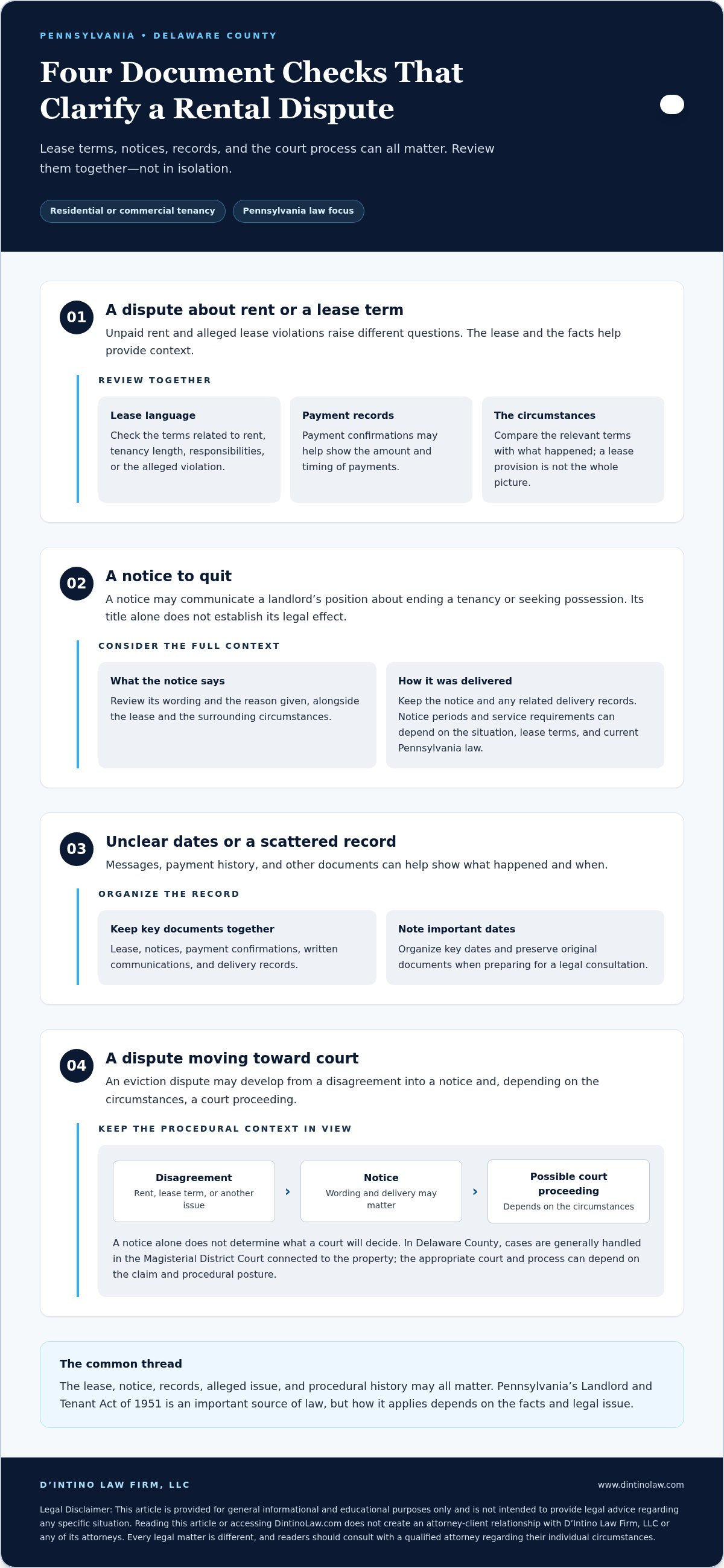
Start with the lease terms related to the dispute. Relevant language may address rent, the length of the tenancy, each party’s responsibilities, or conduct identified as a lease violation. Compare those terms with the facts, and preserve related records such as payment confirmations and written communications. A lease provision shouldn’t be treated as decisive without considering applicable Pennsylvania law and the circumstances.
For example, a disagreement about whether rent was paid may turn on the lease’s payment terms and records showing the amount and timing of payments. This illustrates the kinds of details that may matter, not how a particular dispute should be decided.
What to understand about notices to quit
A notice to quit is a document that may communicate a landlord’s position about ending a tenancy or seeking possession of the property. Its legal effect can depend on its wording, the reason given, how it was delivered, the lease, and the surrounding circumstances. Don’t assume a notice is legally sufficient or ineffective based only on its title.
Notice periods and service requirements can depend on the situation and may be affected by lease terms and current Pennsylvania law. Verify them for the specific issue rather than treating them as universal rules. Keep the notice and any related delivery records with the lease and other communications.
General information is not individual legal advice. A lawyer can review the lease, notice, records, and procedural history to discuss how Pennsylvania law may apply. A landlord tenant lawyer Delaware County PA can explain legal considerations in residential or commercial disputes. To discuss a specific landlord-tenant concern, learn about discussing your circumstances with D’Intino Law Firm.
Eviction in Delaware County: What Landlords and Tenants Should Understand
An eviction dispute may develop from a disagreement about rent, a lease term, or another issue into a notice and, depending on the circumstances, a court proceeding. The steps and legal questions can vary. The lease, the reason for seeking possession, any notice, and the records supporting each party’s position may all matter. A notice alone doesn’t determine what a court will decide.
In Delaware County, landlord-tenant cases are generally handled in the Magisterial District Court connected to the property, though the appropriate court and process can depend on the claim and the case’s procedural posture. A landlord tenant lawyer Delaware County PA can review the documents and case history to explain the issues and possible options under Pennsylvania law. No particular outcome can be assumed in advance.
What may happen after an eviction notice?
If a dispute remains unresolved, a landlord may take the matter to court. A tenant may need to understand the reason stated in the notice and how to respond to any court papers. The parties have different roles, responsibilities, and potential responses. Applicable requirements can depend on the lease, the reason for the dispute, and current law. Check timing, notice periods, and procedural requirements against the facts and current Pennsylvania authority rather than assuming they apply uniformly.
The Unified Judicial System of Pennsylvania provides public court forms and information, including Landlord-Tenant Complaint Forms. A form can help identify documents used in court, but it doesn’t determine how a particular dispute should be handled. An attorney can assess the situation and explain legal options without predicting what a judge will do.
What records may help clarify the dispute?
Organize materials related to the issue and keep them in their original form. Depending on the circumstances, useful records may include:
- The lease and any written changes or addenda.
- Notices received or sent, along with available delivery records.
- Rent payment history, receipts, and account statements.
- Relevant written communications between the parties.
- Photographs, repair requests, or repair records if property conditions are part of the dispute.
Keep communications organized by date and preserve relevant records. If court papers arrive, their contents and procedural context may raise additional questions. A legal review can connect the documents to the specific claims, responses, and applicable Pennsylvania procedures.
How to Prepare for a Delaware County Landlord-Tenant Legal Consultation
A focused consultation starts with a clear account of the issue and the records connected to it. You don’t need to resolve every legal question before speaking with an attorney. A brief summary, organized documents, and a few questions can help make the discussion more specific to your Pennsylvania landlord-tenant concern.
Documents and facts to organize before the discussion
Gather materials related to the dispute, and keep original documents and messages intact. A folder organized by date can make it easier to explain what happened and when. Depending on the issue, useful records may include:
- The lease and any written amendments or addenda.
- Notices received or sent, including available delivery records.
- Rent receipts, payment confirmations, or account statements.
- Relevant emails, texts, letters, or other written communications.
- Photographs, repair requests, or repair records if property conditions are part of the dispute.
Prepare a short chronology using dates you can verify, such as when a notice arrived or a payment was made. Separate what you know from what you believe or what the other party disputes. That distinction helps keep the discussion grounded in available information. Organizing records doesn’t guarantee a particular result, but it can help an attorney understand the circumstances more clearly.
Questions that can make the consultation more useful
Write down questions before the meeting so you can focus on what matters to you. You might ask which Pennsylvania rules could apply, whether additional documents or facts may affect the options, and what procedural issues need attention. If a notice or court document is involved, bring it and ask how its wording and context may affect the matter.
You can also ask how the firm handles direct attorney involvement and what fees or payment options apply. At D’Intino Law Firm, clients work directly with Attorney John D’Intino Jr., and the firm offers free consultations and flexible payment options. You can learn more about the firm’s Philadelphia real estate lawyer overview.
If you’re considering a landlord tenant lawyer Delaware County PA, bring your questions and records to a consultation to discuss your circumstances and potential legal options. Arrange a consultation with D’Intino Law Firm to talk through a Pennsylvania landlord-tenant issue.
Working With a Pennsylvania Landlord-Tenant Lawyer on Next Steps
Legal options in a landlord-tenant dispute depend on the facts, the lease, the documents exchanged, and the stage of the matter. A Pennsylvania attorney can examine those pieces together and explain the issues they raise. That review can clarify which questions deserve attention and what options may be available, without assuming how the dispute will end.
What an attorney may review in a landlord-tenant matter
An attorney may review the lease and amendments, notices, relevant communications, rent or payment history, and the procedural history of the dispute. If a court matter has begun, filed papers and developments in the case may also be relevant. The goal is to understand the record and consider how applicable Pennsylvania law relates to the circumstances.
Details can matter. The reason stated in a notice, the sequence of communications, and differences between the parties’ accounts may shape the legal analysis. Counsel can discuss what the available records establish, what remains unclear, and whether additional information could affect the options. Representation does not guarantee a particular resolution. For broader context about property-related disputes, see this Pennsylvania real estate litigation guide.
Discuss your Delaware County landlord-tenant concerns
D’Intino Law Firm represents clients in Pennsylvania residential and commercial landlord-tenant matters, including eviction disputes, notices to quit, nonpayment of rent, and alleged lease violations. Clients work directly with Attorney John D’Intino Jr., who has more than two decades of experience. A consultation provides an opportunity to describe the issue, ask questions, and discuss possible next steps based on the circumstances.
The firm offers a free consultation and flexible payment options. If you’re considering a landlord tenant lawyer Delaware County PA, you can request a consultation to discuss your landlord-tenant matter. Contacting the firm or reading this article alone does not create an attorney-client relationship; representation begins only through an appropriate agreement.
Take a Clear Next Step on Your Landlord-Tenant Matter
A landlord-tenant dispute calls for a careful look at the lease, the notice, relevant records, and the stage of the matter. In Pennsylvania, the facts and applicable law shape which options may be available. Organizing your documents and questions can help make a conversation with a landlord tenant lawyer Delaware County PA more focused.
D’Intino Law Firm handles Pennsylvania residential and commercial landlord-tenant matters. Attorney John D’Intino Jr. has more than two decades of experience, and clients work directly with him. The firm offers free consultations and flexible payment options. The firm serves clients across Philadelphia, Delaware, Montgomery, Bucks, Berks, Lancaster, Chester, and Lehigh Counties, including Media, West Chester, Conshohocken, Lower Merion, Upper Darby, Gladwyne, Drexel Hill, Ardmore, and Blue Bell. To discuss your concerns and potential legal options, request a free consultation.
Taking time to understand the documents and process can bring greater clarity to a difficult situation. An attorney can review your circumstances and discuss possible next steps without promising a particular result.
Legal Disclaimer: This article is provided for general informational and educational purposes only and is not intended to provide legal advice regarding any specific situation. Reading this article or accessing dintinolaw.com/ does not create an attorney-client relationship with D’Intino Law Firm, LLC or any of its attorneys. Every legal matter is different, and readers should consult with a qualified attorney regarding their individual circumstances.
Frequently Asked Questions
What does a landlord-tenant lawyer do in Delaware County, PA?
A landlord-tenant lawyer may review a lease, notices, communications, payment records, and the procedural history of a Pennsylvania rental dispute. That review can help identify legal issues and explain potential options based on the circumstances. A lawyer may assist either a landlord or tenant, but not every disagreement requires legal representation. This information is general and isn’t a substitute for advice about a specific matter.
Can a landlord evict a tenant without following Pennsylvania procedures?
Pennsylvania eviction matters are subject to applicable laws and procedures, but requirements in a particular dispute depend on the circumstances. The lease, the reason for seeking possession, any notices, and the case’s procedural stage may all be relevant. A general online explanation can’t determine whether specific steps were proper. A Pennsylvania attorney can review the facts and explain legal considerations without predicting what a court will decide.
How long does an eviction take in Delaware County, Pennsylvania?
There isn’t one reliable timeline that applies to every Delaware County eviction matter. Timing may depend on the reason for the case, notice and service issues, court scheduling, and procedural developments. Don’t assume a particular deadline or outcome based on a general online estimate. If you’re involved in a case, an attorney can review its current stage and explain which timing questions may apply to your circumstances.
What happens if a tenant receives a notice to quit in Pennsylvania?
A notice to quit may state the landlord’s reason for seeking possession or communicate a requested next step, but its effect depends on its wording, delivery, circumstances, and applicable Pennsylvania law. Preserve the notice and related records, such as the lease and relevant communications. There isn’t one response period that can safely be applied to every situation. A lawyer can assess the document and explain potential issues based on the facts.
Can a landlord-tenant lawyer help with unpaid rent or a lease violation?
Yes. Pennsylvania landlord-tenant counsel may review the lease, payment history, communications, notices, and any court documents related to unpaid rent or an alleged lease violation. The issues may differ depending on whether the client is a landlord or tenant and on the specific facts. A lawyer can explain possible options, but hiring counsel doesn’t guarantee payment, possession, dismissal, or any other particular result.
Do commercial landlord-tenant disputes follow the same rules as residential disputes in Pennsylvania?
Not necessarily. Both involve rental relationships, but lease terms, property use, and legal issues may differ. Residential rules shouldn’t automatically be assumed to apply in the same way to a commercial tenancy. A Pennsylvania attorney can review the relevant lease and circumstances to identify issues that may affect the parties’ options. The applicable analysis depends on the agreement, facts, and law relevant to the dispute.
What should I bring to a landlord-tenant lawyer consultation?
Bring the lease, notices, payment records, relevant communications, and a concise timeline if available. Useful documents depend on the dispute, so preserve original records and keep related communications organized. A consultation can help identify what additional information may matter. D’Intino Law Firm serves clients in Delaware County and other Pennsylvania counties. Contacting a firm or sharing information alone doesn’t create an attorney-client relationship.
Disclaimer
Legal Disclaimer: The information provided on dintinolaw.com/, including articles, blog posts, testimonials, case results, and other content, is for general informational and educational purposes only and does not constitute legal advice or create an attorney-client relationship with D’Intino Law Firm, LLC or any of its attorneys. Visiting this website, submitting a contact form, sending an email, calling, texting, or otherwise communicating with the firm does not establish an attorney-client relationship or obligate the firm to represent you. Do not submit confidential, privileged, or time-sensitive information through this website or electronic communications unless and until the firm has expressly agreed to represent you. Legal rights, procedures, statutes of limitation, filing deadlines, and other requirements vary based on the facts and jurisdiction and may change over time; nothing on this website should be relied upon to determine whether a legal deadline applies to your matter. If you have an urgent legal matter or a potential filing deadline, consult a qualified attorney promptly. Testimonials and statements regarding client experiences are individual opinions and experiences and are not a guarantee of future results. Prior results, verdicts, settlements, or case examples do not guarantee or predict the outcome of any future case, and every matter is different. This website may constitute attorney advertising under applicable Pennsylvania rules. D’Intino Law Firm, LLC makes no representation that the information on this website is complete, current, or applicable to your particular circumstances. For legal advice concerning your specific situation, consult directly with a qualified Pennsylvania attorney. D’Intino Law Firm, LLC | Philadelphia, Pennsylvania | dintinolaw.com/
