


Attorney
When looking for a financial fraud defense attorney Philadelphia residents can consult, a useful question is not “Can you guarantee a result?” but “How will you assess the facts of my case?” Financial fraud allegations can involve complicated records, communications, and business activity. The label alone may not explain what conduct is at issue or whether a matter is proceeding in Pennsylvania court, federal court, or both.
A case-specific review can help clarify what is known, what remains uncertain, and which questions to discuss with counsel. Look for clear communication about how the attorney will review available information and explain potential options, without promises about how the case will end.
This guide covers questions to ask during a consultation, records and other information that may be relevant, and ways to compare attorneys based on their approach and transparency. It also explains why it is important to preserve records as they are rather than alter or conceal them.
Key Takeaways
- Financial-fraud allegations can involve different legal issues, so clarify what conduct is alleged and which court system is handling the matter.
- When assessing a financial fraud defense attorney Philadelphia, focus on relevant experience, direct communication, and a clear explanation of how the facts will be reviewed.
- Ask how documents, transaction records, communications, timelines, and the source of the allegation may inform a case-specific assessment.
- For a consultation, organize known dates, agency or court contacts, and questions. Do not alter, conceal, or destroy records.
- Attorney John D’Intino Jr. has more than two decades of experience and works directly with clients, including when a matter may require trial preparation.
What a Financial Fraud Allegation in Philadelphia Can Involve
A financial-fraud allegation can raise unfamiliar questions about records, intent, and legal process. The label alone may not identify the conduct under investigation, the offense alleged, or which legal system is involved. In Pennsylvania, the details matter. If a charging document has been filed, its wording and description of the alleged conduct help define the issues for review.
Financial fraud is a broad descriptive label for alleged conduct involving deception and financial activity. It is not one uniform Pennsylvania criminal charge, and an allegation is not a finding of guilt. Allegations may concern disputed transactions, identity use, investment activity, or records that investigators interpret as evidence of deception. A Ponzi scheme is one example of an investment-fraud concept. General information about a scheme does not establish what happened in a particular matter.
Why the exact allegation matters
The specific language used by investigators or in charging papers can point to different legal questions. An allegation may focus on whether someone made a misleading statement, took part in a financial transaction, or created or used a particular record. These are issues to assess, not proof of intent or guilt. Relevant context may include the purpose of a record, the sequence of events, and what the person understood at the time.
Terms such as securities fraud, tax fraud, bank fraud, and insurance fraud should not be treated as interchangeable Pennsylvania offenses. They can describe different alleged conduct and raise distinct legal issues. A careful review starts with the specific offense identified, if any, rather than assuming that a broad label answers the legal question.
Pennsylvania focus and jurisdiction questions
A Philadelphia connection does not, by itself, determine which law applies or where a matter will proceed. Alleged conduct may involve activity in more than one place, or records and communications connected to people or institutions outside Pennsylvania. The relevant legal system depends on the allegations and circumstances. Do not infer jurisdiction from a headline, an investigator’s initial description, or the word “fraud.”
For a Pennsylvania charge, the precise offense and any cited provision of the Pennsylvania Crimes Code should be identified and reviewed in context. Some allegations may also raise federal questions, but whether federal law is involved requires a case-specific assessment. A financial fraud defense attorney Philadelphia residents work with should explain what is known, what remains unclear, and why the alleged conduct matters under the law that may apply.
This distinction makes an early review more focused. Instead of treating every financial allegation as the same, counsel can examine the charging language or other available notice, identify the conduct at issue, and separate established facts from interpretations that need further assessment.
How to Assess a Philadelphia Financial Fraud Defense Attorney
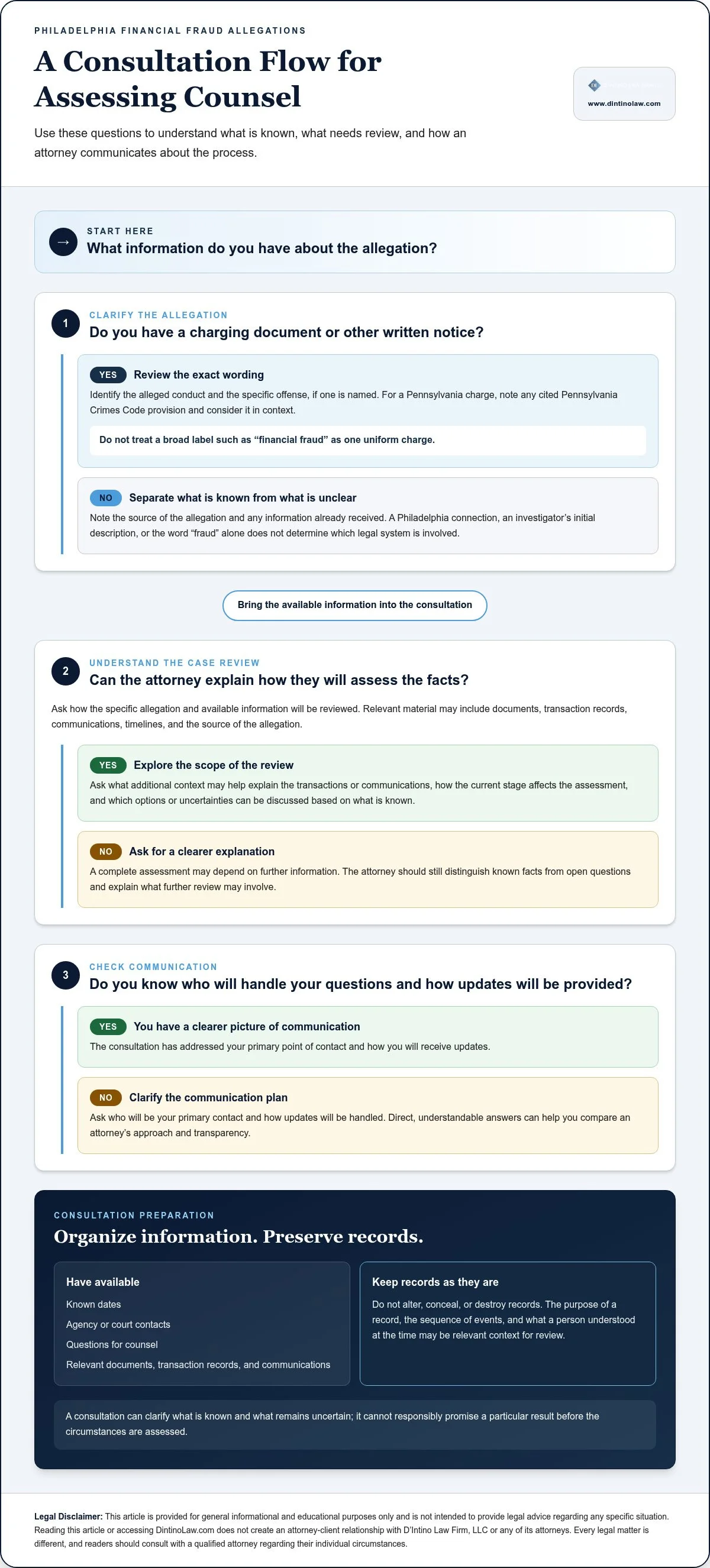
Choosing counsel for a financial-fraud matter involves more than checking a practice-area label. Consider whether the attorney can explain the allegation in plain language, discuss experience relevant to document-heavy or transaction-related cases, and describe how an initial review will work. Ask who will handle your questions and how you will receive updates.
The alleged offense and the matter’s procedural stage shape what an attorney can assess at the outset. Someone responding to an investigation may have different information available than someone reviewing formal charges or preparing for court. A responsible attorney should explain what can be evaluated now and which questions may depend on additional information, rather than suggesting every matter follows the same path.
Questions that reveal how the attorney approaches your case
Use the consultation to understand how counsel approaches the matter, not to seek a guaranteed prediction. Consider asking:
- How will you review the specific allegation and the records currently available?
- What additional context may help you understand the transactions or communications at issue?
- How does the current stage of the matter affect what you can evaluate?
- Who will be my primary point of contact, and how will I receive updates?
- What options and uncertainties can you explain based on what is known so far?
Notice whether the answers address your questions directly. An attorney may not yet be able to offer a complete assessment, but should distinguish known facts from open questions and explain what further review may involve. No attorney can responsibly promise a particular result before examining the circumstances. A guarantee is no substitute for a clear discussion of the facts, applicable law, and uncertainty.
Financial-fraud experience versus general criminal-defense claims
Ask about experience with allegations involving financial records, transactions, or complex communications when those issues are relevant to your matter. The useful question is not simply whether an attorney uses the word “fraud” to describe their practice. Ask how they would examine the available material, identify what the accusation depends on, and consider alternative explanations without assuming that any particular defense will succeed.
Look for specific explanations rather than unsupported rankings or broad claims of success. An attorney should be able to describe their role, how they work with clients, and how they approach a case-specific analysis. A Philadelphia criminal-defense practice can also provide context about counsel’s work in Pennsylvania matters.
Comparing a financial fraud defense attorney Philadelphia residents may consult is ultimately about fit and transparency: relevant experience, direct communication, careful review, and candid explanations. D’Intino Law Firm handles Pennsylvania criminal-defense matters. A consultation is an opportunity to raise questions and discuss your circumstances without a prediction about the outcome. Learn more at D’Intino Law Firm.
Compare Counsel by How They Review Evidence and Case Issues
Records can look different in isolation than when arranged in sequence and considered alongside related communications. A useful initial review identifies what material is available, what it may relate to, and what remains uncertain. The table below offers questions for comparing an attorney’s approach. The relevance and interpretation of any item depend on the specific facts and applicable law.
| Review topic | Question to ask | Why context matters |
|---|---|---|
| Documents and records | How would you assess the purpose, timing, and relationship of the records to the allegation? | A document may be incomplete or unclear without related records and surrounding events. |
| Communications | How would you consider messages or emails alongside the conduct described? | Meaning can depend on who communicated, when, and what was being discussed. |
| Transaction information | What questions would you examine about the transactions at issue? | Entries or transfers may require context about their sequence, participants, and stated purpose. |
| Timeline | How would you organize key dates and compare them with the allegation? | Sequence can help identify gaps, conflicting accounts, or issues that need further explanation. |
| Source of the allegation | What is known about how the concern arose, and what remains unverified? | The origin may help frame the scope of the review without establishing whether an allegation is true. |
What a case-specific review may examine
A lawyer may compare records and communications with a timeline of the events described, looking for connections, missing context, or inconsistencies to explore. Questions about a record’s origin or authenticity may also matter. None of these considerations, by itself, establishes what the evidence proves. The purpose is to understand how available material relates to the allegation under the law that may apply.
Preserve records and communications in their existing form. Do not delete, alter, conceal, or withhold material. If you are unsure what information may be relevant or how to handle it, raise the question with counsel rather than making changes yourself.
Compare explanations, not promises
When comparing a financial fraud defense attorney Philadelphia residents may consult, listen for a disciplined explanation of disputed facts, potentially applicable law, and unanswered questions. A useful review distinguishes general legal considerations from a conclusion about an individual case. It should also account for uncertainty, including facts that may not yet be available.
Consider whether the attorney can explain why a particular record or timeline point may matter without claiming that it proves guilt or establishes a defense. Ask which conclusions are preliminary and what additional information could affect the analysis. Clear answers help you understand the reasoning, not just the confidence behind a pitch.
For Pennsylvania matters, legal analysis should identify the relevant Pennsylvania law and avoid treating a general fraud label as a substitute for the specific allegation. The applicable law and significance of evidence can depend on the facts and procedural circumstances. A careful attorney should explain those limits and avoid promising a particular result before reviewing the case.
What to Prepare for a Financial Fraud Case Consultation
A first conversation can be more focused if you organize a few basic details. You do not need to reconstruct every event or arrive with a complete explanation. A short, factual outline can help an attorney understand what prompted your concern, what information you have, and what questions remain. Preparation supports a discussion but does not determine your legal options or predict how a matter may proceed.
Information that can help organize the discussion
Make a simple list of what you know and what you do not know, if available. Do not guess to fill gaps. You may want to note:
- Known dates or an approximate sequence of events, clearly marked when uncertain.
- The names of agencies or courts involved, and any contact dates or reference details you already have.
- Whether you have received a notice, charging document, or other correspondence, and when it arrived.
- Questions about the allegation, the process, and what information may be relevant to discuss.
If you have received documents or correspondence, note what they are and when you received them. You can ask the attorney how to handle those materials. Keep records and communications as they are. Do not delete, edit, hide, or withhold them, and do not contact potential witnesses to discuss the matter. Avoid posting sensitive details publicly or sharing private records in an open online forum.
What to expect from an initial attorney conversation
An initial discussion may cover the general nature of the concern, information already available, and the apparent stage of the matter. The attorney may ask clarifying questions, identify areas that need further review, and explain possible next steps in general terms. You can also ask who will communicate with you and how questions or updates will be handled.
For a Pennsylvania matter, possible legal options depend on the specific facts and applicable law. An initial conversation is not a final case assessment, and discussing concerns does not automatically create an attorney-client relationship. A useful consultation should clarify what is known, what remains uncertain, and which questions deserve attention, without promising a particular outcome.
D’Intino Law Firm offers a free consultation, and clients work directly with Attorney John D’Intino Jr. during their legal matter. The conversation is an opportunity to raise concerns and discuss the information you have. A financial fraud defense attorney Philadelphia residents meet with should explain the limits of an early review as clearly as its potential value.
To discuss your concerns, schedule a consultation with D’Intino Law Firm and talk through the information available and the questions you have prepared.
Discuss Your Pennsylvania Financial Fraud Concerns with D’Intino Law Firm
A measured next step begins with identifying the allegation and asking for a clear explanation of the issues that may apply. A consultation can help you discuss your concerns and learn what an attorney can assess based on the information available. It is not a promise about the result, and important questions may remain open until the circumstances are reviewed.
A direct, case-specific conversation
Attorney John D’Intino Jr. works directly with clients through their legal matters and has more than two decades of experience. The firm is prepared to take cases to trial when necessary. During a consultation, you can raise questions about the allegation, the information you have, and how a case-specific review may proceed.
The firm offers flexible payment options, which you can discuss as part of the conversation. A free consultation provides an opportunity to raise concerns and learn whether the attorney may be able to assist. An initial conversation does not automatically create an attorney-client relationship.
How to take a measured next step
Consider whether counsel explains the issues clearly, distinguishes known information from unanswered questions, and discusses potential Pennsylvania legal options without promising a particular outcome. The applicable law and available options depend on the facts and circumstances of the matter.
D’Intino Law Firm handles Pennsylvania criminal-defense matters. The firm serves clients in Philadelphia and nearby Pennsylvania communities, including Media, West Chester, Conshohocken, Lower Merion, Upper Darby, Gladwyne, Drexel Hill, Ardmore, and Blue Bell, as well as Montgomery, Bucks, Delaware, Berks, Lancaster, Chester, and Lehigh counties. A free consultation is an opportunity to ask about the review process, communication, and flexible payment options without pressure or promises about results.
Contact D’Intino Law Firm to request a consultation about your Pennsylvania criminal-defense concerns. An initial discussion can provide a starting point for considering your questions and the information available.
Take a Clear Next Step
Uncertainty can make it difficult to know which question to address first. A focused conversation can help clarify the immediate concern and identify what remains to be understood. If you are considering a financial fraud defense attorney Philadelphia residents can consult, look for a discussion grounded in your circumstances, clear about what is known, and honest about what cannot yet be determined. No attorney can responsibly guarantee how a legal matter will end.
D’Intino Law Firm offers a free consultation to discuss Pennsylvania criminal-defense concerns. Attorney John D’Intino Jr. has more than two decades of experience, works directly with clients, and can discuss flexible payment options. Contacting the firm or having an initial conversation does not automatically create an attorney-client relationship.
Request a free consultation to discuss your Pennsylvania criminal-defense concerns. A measured conversation can be a practical starting point for understanding the questions ahead.
Frequently Asked Questions
What does a financial fraud defense attorney in Philadelphia do?
A financial fraud defense attorney can help a person understand a criminal allegation and provide representation in a Pennsylvania matter. Depending on the case and scope of representation, counsel may review charging papers, examine how the alleged conduct is described, discuss developments with the client, and appear in court. Ask what work the attorney expects to handle personally and what information is needed to assess the matter.
Can financial fraud charges be brought under Pennsylvania law?
Yes, Pennsylvania law may apply to alleged financial misconduct when the facts and charged offense fall under applicable state law. To understand a specific accusation, check whether a document identifies an offense or cites a Pennsylvania statute. The wording can help narrow the conduct at issue. If no charge has been filed, the precise legal issue may not yet be clear. An attorney can explain any cited provision in context.
What should I bring to a financial fraud defense consultation?
If you have received paperwork, bring or describe what it is and note when it came to your attention. It can also help to distinguish what you know personally from information you heard from someone else. Mark uncertain details as uncertain. Do not write on, edit, or otherwise change original materials. You can ask counsel how to provide documents securely and what materials may be useful for a later review.
How do I choose a financial fraud defense attorney in Philadelphia?
Ask how the attorney would approach the particular allegation, what role they would take in reviewing the matter, and how you can raise questions as it progresses. Clarify how fees and the scope of representation will be explained before making a decision. Look for answers tied to your circumstances, not broad claims about results. A clear explanation of what the attorney can assess now is useful in evaluating the consultation.
Does every financial fraud case in Philadelphia involve federal charges?
No. A Philadelphia location alone does not establish that a federal charge is involved. Some allegations may be handled under Pennsylvania law, while others may raise federal issues. Jurisdiction depends on the specific circumstances. If you receive paperwork, note the court or agency identified and the exact name of any alleged offense. Those details can help an attorney assess which legal framework may be relevant, without assumptions based on the word “fraud.”
Will a financial fraud defense attorney guarantee that charges are dismissed?
No attorney can responsibly guarantee that charges will be dismissed. Ask what the attorney can evaluate at the current stage, what issues remain unresolved, and how the assessment may change as more information becomes available. A lawyer can explain legal options and advocate within the scope of representation, but a promised result is not a reliable measure of the quality of that review. The outcome depends on the individual circumstances and applicable law.
Does contacting a Philadelphia defense attorney create an attorney-client relationship?
No. Contacting a Philadelphia defense attorney or having an initial conversation does not automatically create an attorney-client relationship. Before sharing sensitive details, clarify whether the attorney has agreed to represent you and what the next steps are. If you are unsure whether representation has begun, ask directly rather than relying on an assumption based only on a call, email, or consultation. The circumstances of each professional relationship can differ.
Legal Disclaimer: This article is provided for general informational and educational purposes only and is not intended to provide legal advice regarding any specific situation. Reading this article or accessing DintinoLaw.com does not create an attorney-client relationship with D’Intino Law Firm, LLC or any of its attorneys. Every legal matter is different, and readers should consult with a qualified attorney regarding their individual circumstances.
Disclaimer
Legal Disclaimer: The information provided on DintinoLaw.com, including articles, blog posts, testimonials, case results, and other content, is for general informational and educational purposes only and does not constitute legal advice or create an attorney-client relationship with D’Intino Law Firm, LLC or any of its attorneys. Visiting this website, submitting a contact form, sending an email, calling, texting, or otherwise communicating with the firm does not establish an attorney-client relationship or obligate the firm to represent you. Do not submit confidential, privileged, or time-sensitive information through this website or electronic communications unless and until the firm has expressly agreed to represent you. Legal rights, procedures, statutes of limitation, filing deadlines, and other requirements vary based on the facts and jurisdiction and may change over time; nothing on this website should be relied upon to determine whether a legal deadline applies to your matter. If you have an urgent legal matter or a potential filing deadline, consult a qualified attorney promptly. Testimonials and statements regarding client experiences are individual opinions and experiences and are not a guarantee of future results. Prior results, verdicts, settlements, or case examples do not guarantee or predict the outcome of any future case, and every matter is different. This website may constitute attorney advertising under applicable Pennsylvania rules. D’Intino Law Firm, LLC makes no representation that the information on this website is complete, current, or applicable to your particular circumstances. For legal advice concerning your specific situation, consult directly with a qualified Pennsylvania attorney. D’Intino Law Firm, LLC | Philadelphia, Pennsylvania | DintinoLaw.com
