


Attorney
When you search for an eviction attorney Lancaster County PA, you need a clear explanation of how your documents and goals relate to Pennsylvania procedure, not a promise about the result. Notice wording, lease terms, payment records, and prior communications may all matter. The issues to address can depend on the circumstances and the stage of the case.
This guide explains what to discuss with counsel, which records to gather, and how to assess communication, process explanations, and fees. It also provides a general overview of Pennsylvania landlord-tenant matters in Lancaster County. The same steps do not apply identically to every dispute.
Whether you’re a landlord seeking possession or a tenant responding to an eviction matter, organized records can make a conversation with an attorney more productive. At D’Intino Law Firm, LLC, clients work directly with Attorney John D’Intino Jr., who has more than two decades of experience. A consultation can help clarify the issues and discuss options that may apply to your circumstances.
Key Takeaways
- An eviction dispute concerns a landlord-tenant disagreement. This guide addresses Pennsylvania matters, not a nationwide process.
- An eviction attorney Lancaster County PA can explain how lease terms, notices, payment records, and communications may relate to a dispute.
- When discussing representation, ask about Pennsylvania landlord-tenant experience, communication, the process, and fees.
- Prepare for a consultation by organizing the lease, notices, payment records, relevant communications, and a timeline of events.
- Use the consultation to identify questions and discuss potential legal options. Outcomes depend on the specific circumstances.
Facing an Eviction Dispute in Lancaster County? Start With the Issues
An eviction dispute is a disagreement between a landlord and tenant about the right to occupy a rental property or what should happen under their rental arrangement. It may involve unpaid rent, an alleged lease violation, a notice asking a tenant to leave, or a disagreement over who is entitled to possession. The label alone does not determine either party’s rights. The lease, communications, payment history, and procedural stage may all be relevant.
A notice or demand is not the same as a court case or judgment. A written notice may state a landlord’s position or request a next step, but it is not itself a court judgment. If a case proceeds to court, the filings and applicable deadlines can affect what happens next. An eviction attorney Lancaster County PA can review the documents and explain how Pennsylvania landlord-tenant law may apply. Options and outcomes depend on the facts, applicable law, and stage of the proceeding.
Which eviction issues may require legal guidance?
Questions can arise when a landlord says rent is overdue or a tenant disputes the amount claimed. Other issues may concern an alleged lease violation, the wording or delivery of a notice, or whether possession should change hands. These are common areas of disagreement, not conclusions about whether a particular notice or action is legally sufficient.
The parties’ roles shape the questions to consider. A landlord may need to understand the requirements for pursuing possession, while a tenant may need to assess the allegations and documents received. Reviewing the lease alongside payment records and relevant communications can help identify what needs clarification. Keep the record organized by date and note which details are disputed, rather than relying on memory alone.
Why Lancaster County context matters
This guide addresses Pennsylvania landlord-tenant matters. Eviction procedures differ by jurisdiction, so a general explanation should not be treated as a nationwide rule. The broad landlord-tenant law principles can provide background, but they do not replace Pennsylvania-specific information. For a Lancaster County dispute, filing and court details must be considered in relation to the particular case.
General information can explain the process, but the specific facts are needed to assess how the law may apply to an individual matter. A notice or disagreement may raise questions, and the relevant documents and whether a court case has begun help frame what to discuss next.
What an Eviction Attorney Can Help You Understand in Pennsylvania
An attorney can help clarify the legal and practical issues in a Pennsylvania eviction matter. Counsel may review the lease, notices, payment records, and communications, then explain how those materials could relate to the dispute. That review can identify questions to address and options to discuss. It cannot guarantee a particular result.
Eviction options depend on the case facts, applicable Pennsylvania law, and the stage of the proceeding. No attorney can responsibly promise possession, payment, dismissal, or another specific outcome before evaluating a matter. Even a detailed review cannot eliminate uncertainty. The aim is to understand the issues and make informed decisions based on the circumstances.
Reviewing leases, notices, and dispute records
Gather the lease and any changes to it, notices received or sent, rent payment history, and relevant written communications. Keep copies in their original form when possible. Dates and delivery details may help establish what was communicated and when, but their legal significance depends on the documents and Pennsylvania requirements that apply.
A lawyer may compare a notice’s wording with the lease and the surrounding record instead of considering one document in isolation. The Pennsylvania courts’ public court forms page provides court forms. A form alone does not establish whether it fits a particular matter or resolve questions about the parties’ rights.
Understanding communication and representation
During a consultation, ask who will explain developments, how decisions will be discussed, and what procedural steps may need attention. Clear communication helps you understand what is known, what still needs review, and where your input may be needed.
At D’Intino Law Firm, LLC, clients work directly with Attorney John D’Intino Jr. from the initial consultation through resolution. He has more than two decades of experience. A discussion with counsel can help clarify the documents and potential legal options without predicting the outcome. For more information about Pennsylvania property-related legal matters, see the firm’s Pennsylvania real estate dispute-resolution guide.
If you’re considering an eviction attorney Lancaster County PA, a consultation is an opportunity to discuss your circumstances and questions. Learn more about Pennsylvania landlord-tenant representation at D’Intino Law Firm, LLC. Reading this information or contacting the firm does not itself create an attorney-client relationship.
How to Compare Eviction Attorneys Serving Lancaster County
Compare counsel by focusing on how the attorney would address your questions, not on promises about the outcome. Relevant experience should include Pennsylvania landlord-tenant matters. Communication, explanations of the process, and fee terms should also be clear enough to help you make an informed decision.
These questions can help distinguish general assurances from a discussion grounded in your circumstances. An attorney may need to review the documents before explaining how particular facts could affect available options. If an answer depends on information that has not been examined, ask what records or details would help clarify the issue.
Questions to ask during an initial consultation
Bring questions connected to your documents and the stage of the matter. Ask how the attorney would review the lease and notices, which payment or communication records may be relevant, and what procedural steps may apply. You can also ask which details need further review before counsel can provide a fuller assessment.
Clarify who will communicate with you and how updates or decisions will be handled. The answers can help you understand the working relationship and whether the proposed scope covers the issues you want to discuss.
Assess fit without relying on promises
Clear explanations and direct communication are more useful than certainty about an unpredictable legal outcome. Be cautious of guaranteed results or unsupported claims that one attorney is superior to others. No attorney can responsibly guarantee possession, payment, dismissal, or another specific result.
Compare the proposed scope and payment terms with your needs. Ask what the representation includes and how fees and payment arrangements work. If you need an eviction attorney Lancaster County PA, a consultation can help you assess whether the attorney’s explanation, communication approach, and proposed scope address the questions raised by your matter.
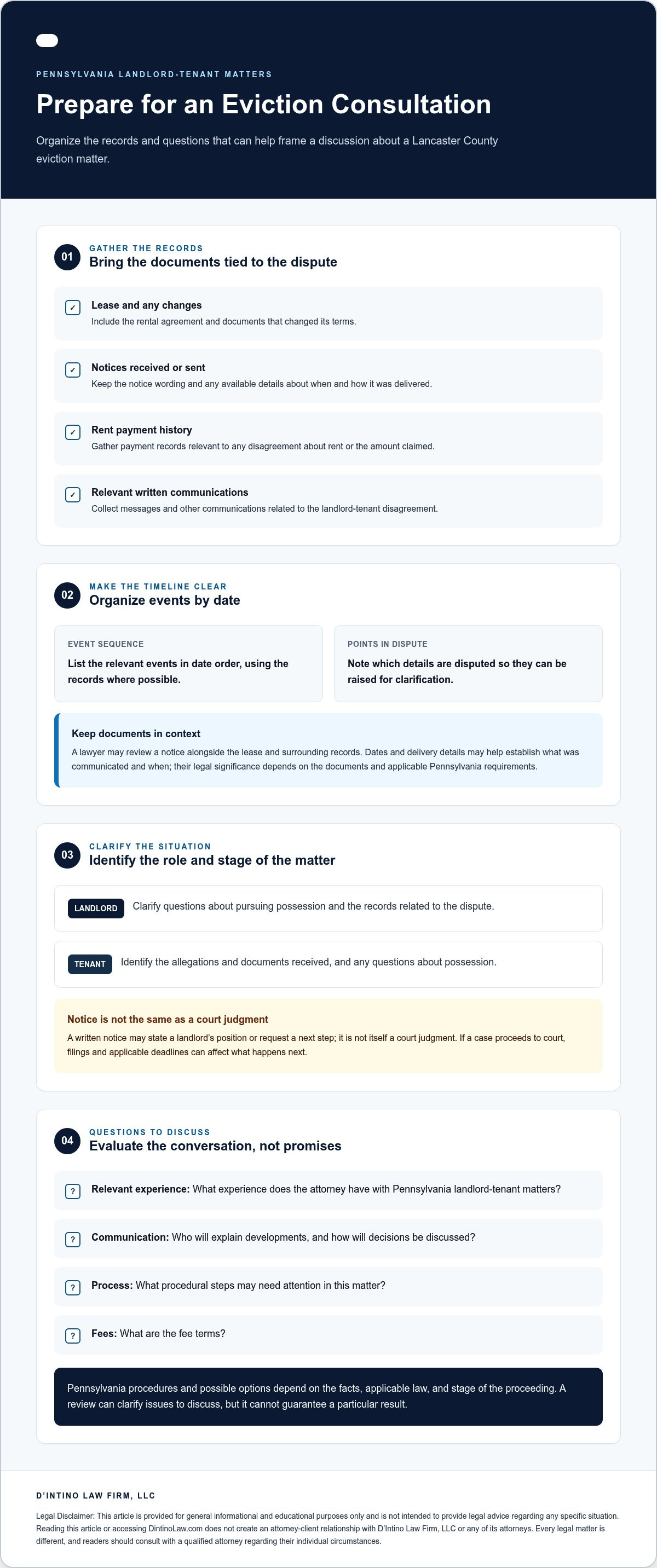
Prepare for an Eviction Consultation in Lancaster County
Organizing your records can make a consultation more focused. The steps below are general guidance for preparing to discuss a matter, not legal advice about what to do in a particular case. You do not need to resolve every issue before meeting with counsel. Bring a clear record of what happened and the questions you want answered.
- 1. Gather the lease. Include amendments, renewals, and other written terms related to the rental arrangement.
- 2. Collect notices and court papers. Keep copies of documents you sent or received, along with any envelope, delivery record, or other information showing when and how they arrived.
- 3. Organize payment records. Gather receipts, account statements, or other records relevant to rent payments or amounts being disputed.
- 4. Save relevant communications. Include messages, letters, and emails about rent, alleged lease issues, repairs, or efforts to resolve the disagreement. Preserve records as they are. Do not alter, delete, or conceal potentially relevant information.
- 5. Write a short timeline. List key events and dates as you understand them, including notices, payments, conversations, and any upcoming dates you know about. Use it as an aid for discussion, not as a substitute for verifying a legal deadline.
- 6. Note your questions and goals. Identify what you most need to understand, such as the status of the matter, possible next steps, or the scope and cost of representation.
Documents and details to organize
Group records by type and arrange them chronologically where practical. A folder for the lease, notices, payment history, communications, and timeline can help an attorney see how the pieces relate. Avoid circulating another person’s confidential details unnecessarily. If you are unsure whether a record matters, note it for discussion rather than changing or discarding it.
What to discuss about procedure and fees
Ask which Pennsylvania rules and Lancaster County court details may apply to your circumstances, what procedural questions need further review, and what work the proposed representation would cover. Discuss how fees are structured and what payment options are available. D’Intino Law Firm, LLC offers free consultations and flexible payment options. A consultation is an opportunity to discuss the circumstances and potential legal options, not a guarantee of possession, payment, dismissal, or another outcome.
For a conversation with an eviction attorney Lancaster County PA, bring your organized records and questions, then schedule a consultation about your eviction matter. Contacting the firm does not by itself create an attorney-client relationship.
Discuss Your Lancaster County Eviction Matter With D’Intino Law Firm
A practical next step is to clarify the issue, organize the lease and other relevant records, and consider how you want an attorney to communicate with you. You can also ask about the proposed scope of representation and fees. These points can make a discussion focused, whether you’re a landlord or tenant, and give counsel a starting point for identifying matters that may need closer review.
D’Intino Law Firm, LLC handles Pennsylvania landlord-tenant and eviction matters, including matters in Lancaster County. Attorney John D’Intino Jr. has more than two decades of experience, and clients work directly with him from the initial consultation through resolution. The firm offers free consultations and flexible payment options. These details explain the consultation and representation model, but do not predict or guarantee an outcome.
What to expect when discussing your matter
A consultation can help identify questions about your lease, notices, payment records, communications, or the stage of a court matter. An attorney may need to review specific documents and facts before discussing how Pennsylvania law could apply or what options may be available. You can also ask about communication, the anticipated scope of representation, and fee arrangements.
Information on a website provides general education, not individualized legal advice. Reading this guide or contacting D’Intino Law Firm, LLC does not automatically create an attorney-client relationship. Whether such a relationship exists depends on the circumstances and applicable professional rules.
A measured next step for Lancaster County readers
If you’re considering an eviction attorney Lancaster County PA, you may contact D’Intino Law Firm, LLC to discuss your Pennsylvania landlord-tenant concerns and potential legal options. A conversation can help you understand what information may matter and what questions deserve further attention. Focus on clear explanations and a discussion grounded in your circumstances, rather than promises about the result.
The firm handles Pennsylvania landlord-tenant matters for clients in Lancaster County and across its local service area, including Philadelphia, Media, West Chester, Conshohocken, Lower Merion, Upper Darby, Gladwyne, Drexel Hill, Ardmore, Blue Bell, Montgomery County, Bucks County, Delaware County, and Lehigh.
Legal Disclaimer: This article is provided for general informational and educational purposes only and is not intended to provide legal advice regarding any specific situation. Reading this article or accessing dintinolaw.com/ does not create an attorney-client relationship with D’Intino Law Firm, LLC or any of its attorneys. Every legal matter is different, and readers should consult with a qualified attorney regarding their individual circumstances.
Take a Clear Next Step With Your Eviction Matter
Choosing an eviction attorney Lancaster County PA starts with understanding the issue and organizing the lease, notices, payment records, and communications. Compare how counsel explains the process, communication, and fees. Pennsylvania procedures and options depend on the facts and stage of the matter, so a focused discussion can help identify what needs closer review.
D’Intino Law Firm, LLC handles Pennsylvania landlord-tenant matters. Attorney John D’Intino Jr. has more than two decades of experience, and clients work directly with him. The firm offers free consultations and flexible payment options. To discuss your concerns and potential legal options, contact D’Intino Law Firm. A conversation can help you understand the questions ahead without promising a particular outcome.
Bring your records and questions to the consultation to discuss your Lancaster County eviction matter.
Please note: The information provided above is for general informational purposes only and should not be construed as formal legal advice. Reaching out through this website or reviewing these materials does not establish an attorney-client relationship. Because each landlord-tenant situation involves unique facts, property owners should seek personalized guidance from a licensed Pennsylvania attorney.
Frequently Asked Questions
How do I choose an eviction attorney in Lancaster County, PA?
Discuss relevant Pennsylvania landlord-tenant experience, communication, procedure, and fees. Ask how the attorney would review your lease, notices, payment records, and other documents, and what questions still need answers. Clarify who will communicate with you and what work the representation covers. An eviction attorney Lancaster County PA can explain potential options, but outcomes depend on the facts and applicable law. Be cautious of promises of a guaranteed result.
Can a landlord evict a tenant without going to court in Pennsylvania?
Generally, a landlord must use Pennsylvania’s legal process to obtain possession and cannot simply remove a tenant or change the locks to force them out. A notice to quit may be a step before a court case, but it is not itself a court order authorizing physical removal. The proper procedure depends on the circumstances and lease. A landlord or tenant can discuss how the process may apply with an attorney.
What documents should I bring to an eviction attorney consultation?
Bring the lease and written changes, notices, payment records, relevant communications, and any court papers. Organize documents by type and, where practical, by date. A short timeline can help identify questions about when a notice was sent or received, what payments were made, and what was discussed. Preserve records in their original form and do not alter or conceal potentially relevant information.
How does the eviction process work in Pennsylvania?
A Pennsylvania eviction matter may begin with a notice to quit, followed by a landlord-tenant complaint filed in court if the dispute continues. A hearing and decision may follow. The notice period can depend on the reason for the eviction, lease terms, and other circumstances. In Lancaster County, landlord-tenant cases are handled in Magisterial District Court. Procedural details and deadlines depend on the case and should be assessed in light of its documents and circumstances.
Can a tenant challenge an eviction notice in Pennsylvania?
A tenant may have questions about a notice’s wording, delivery, timing, lease terms, or the basis for the landlord’s position. Whether a particular issue affects the case depends on the documents, facts, and applicable Pennsylvania requirements. A notice alone is not a court judgment. A tenant who receives one can gather the notice, lease, payment records, and related communications to discuss the available options with counsel.
How much does an eviction attorney cost in Lancaster County?
There is no single fee that applies to every eviction matter. Cost can depend on the work involved and the agreed scope of representation. Ask how fees are structured, what services are included, and whether additional work may involve different terms. D’Intino Law Firm, LLC offers free consultations and flexible payment options. A consultation is an opportunity to discuss your circumstances and fees, not a promise of a particular result.
What happens if a tenant does not leave after an eviction case?
A possession judgment does not authorize a landlord to remove a tenant personally. The landlord generally must follow the court’s process for recovering possession. In Pennsylvania, an appeal concerning possession is generally due within 10 days of the Magisterial District Judge’s decision; a monetary-only appeal has a different deadline. In a nonpayment case, paying the full judgment, including court costs, before physical removal may stop the eviction. Details depend on the case.
Disclaimer
Legal Disclaimer: The information provided on dintinolaw.com/, including articles, blog posts, testimonials, case results, and other content, is for general informational and educational purposes only and does not constitute legal advice or create an attorney-client relationship with D’Intino Law Firm, LLC or any of its attorneys. Visiting this website, submitting a contact form, sending an email, calling, texting, or otherwise communicating with the firm does not establish an attorney-client relationship or obligate the firm to represent you. Do not submit confidential, privileged, or time-sensitive information through this website or electronic communications unless and until the firm has expressly agreed to represent you. Legal rights, procedures, statutes of limitation, filing deadlines, and other requirements vary based on the facts and jurisdiction and may change over time; nothing on this website should be relied upon to determine whether a legal deadline applies to your matter. If you have an urgent legal matter or a potential filing deadline, consult a qualified attorney promptly. Testimonials and statements regarding client experiences are individual opinions and experiences and are not a guarantee of future results. Prior results, verdicts, settlements, or case examples do not guarantee or predict the outcome of any future case, and every matter is different. This website may constitute attorney advertising under applicable Pennsylvania rules. D’Intino Law Firm, LLC makes no representation that the information on this website is complete, current, or applicable to your particular circumstances. For legal advice concerning your specific situation, consult directly with a qualified Pennsylvania attorney. D’Intino Law Firm, LLC | Philadelphia, Pennsylvania | dintinolaw.com/
