


Attorney
After a construction-site injury, a key question is who may have been responsible. A Philadelphia worksite can involve several contractors, subcontractors, property owners, and equipment providers. When choosing a construction accident lawyer Philadelphia workers can speak with, look beyond broad promises and ask how the attorney will investigate the facts, evaluate the parties’ roles, and keep you informed.
It’s understandable to be concerned about medical bills, missed work, and whether important records will be preserved. In Pennsylvania, the issues in a construction accident claim can depend on how the injury happened, the parties involved, and the available evidence. No single detail automatically determines responsibility.
This guide explains how a Pennsylvania construction injury claim may involve different parties, what to consider when evaluating a lawyer, and what information may help you prepare for a consultation. You’ll also learn why it can matter to ask who will handle your case and how the attorney will communicate with you. The goal is to help you approach a conversation about possible next steps with clearer expectations, not to predict the outcome of any individual claim.
Key Takeaways
- A construction-site injury doesn’t automatically establish a personal injury claim; the circumstances and relationships among the parties matter.
- Keep relevant information about the incident, your injuries, and the worksite organized, without accessing restricted records or interfering with an investigation.
- When comparing counsel, look for a construction accident lawyer Philadelphia workers can speak with directly who has relevant Pennsylvania plaintiff-side experience.
- Prepare for a consultation by gathering useful records and questions, but prioritize appropriate medical care over paperwork.
- D’Intino Law Firm represents injured plaintiffs in Pennsylvania construction accident matters and can discuss the circumstances and possible legal options.
When a Philadelphia Construction Accident May Raise a Personal Injury Claim
A construction-site injury can leave someone facing medical needs, time away from work, and uncertainty about what happened. A personal injury claim is a civil matter that may examine whether another party’s conduct contributed to the harm. An accident alone doesn’t establish a right to recover. The facts, evidence, and applicable Pennsylvania law all matter.
This section concerns injuries at construction sites in Philadelphia and nearby Pennsylvania communities. It may be relevant to injured workers, delivery workers, visitors, and others hurt at a site. The legal issues can differ based on a person’s role, their relationship to the worksite, and the circumstances of the injury. Rules in other states may differ.
Who may be involved in a construction-site injury
A site may include a property owner, general contractor, multiple subcontractors, suppliers, and other businesses or individuals. The injured person might be an employee of one company, a subcontractor’s worker, a delivery worker, or a visitor. Those roles don’t necessarily lead to the same legal options, so it’s important not to assume one set of rules applies to everyone.
An assessment may consider what each party was doing and how that role relates to the incident. For example, a visitor injured by a site condition raises different factual questions from a worker hurt while using equipment. These examples don’t establish fault. They show why identifying the people and entities involved can help clarify what needs investigation.
Why construction accident claims can involve more than one issue
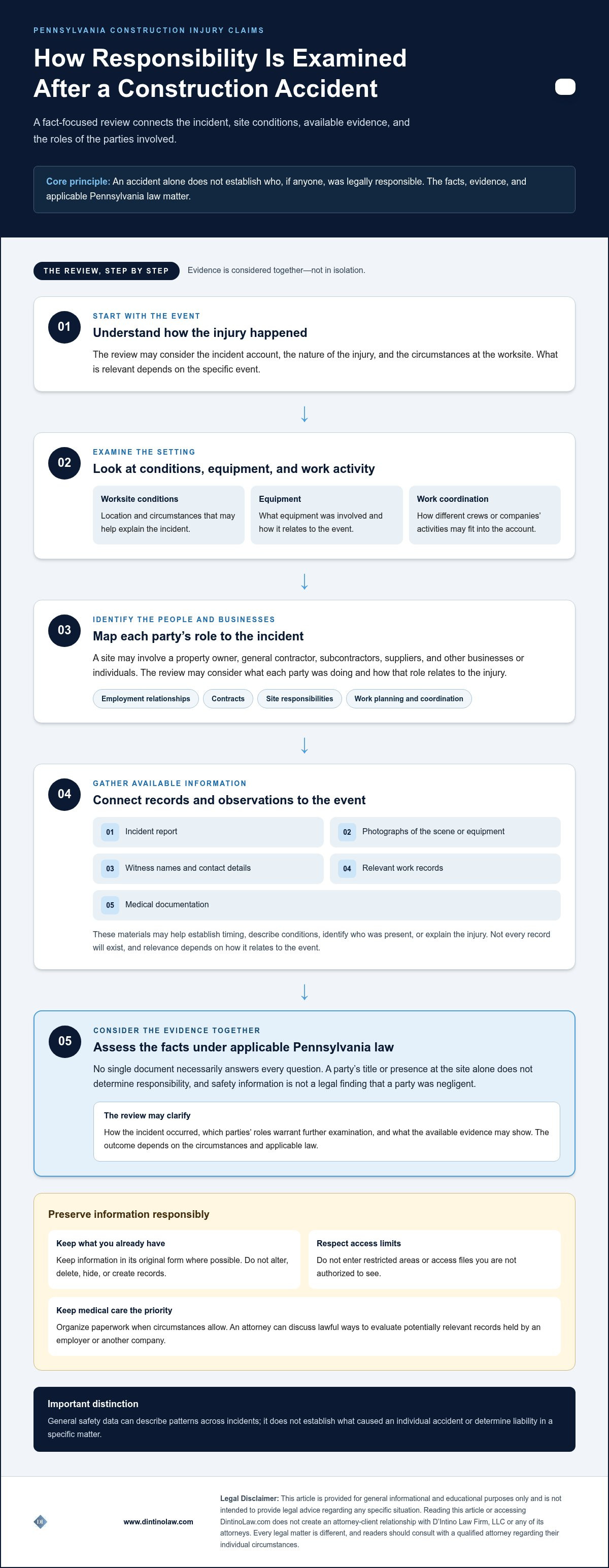
Investigators may need to understand how the injury happened, what conditions existed at the site, whether equipment was involved, and how work was coordinated among different parties. A clear account of the incident may matter, as may records, photographs, witness information, and the responsibilities each party had. Which evidence is available and relevant depends on the circumstances.
A workplace injury alone doesn’t establish which party, if any, was legally responsible. A careful review considers evidence and applicable law rather than relying on assumptions about who controlled the site or employed the injured person. A construction accident lawyer Philadelphia workers consider should be able to explain how those questions may be evaluated without treating an injury as proof of liability.
- Worksite conditions: The location and circumstances of the incident may help explain how the injury occurred.
- Equipment: The equipment involved and its connection to the incident may be relevant.
- Work coordination: Multiple crews or companies may have had different roles on the site.
- Party relationships: Employment, contracts, and site responsibilities may affect the legal analysis.
These issues are a starting point, not a conclusion about any particular claim. A closer review of the available evidence may help clarify how the incident occurred and which parties’ roles warrant further examination.
How Evidence and Responsibility Are Examined After a Construction Accident
A closer review may look at how the incident happened, the nature of the injury, conditions at the site, and the relationships among the people and companies involved. No single document necessarily answers every question. Evidence is considered together, and what matters can depend on the specific facts and applicable Pennsylvania law.
Safety information can help explain hazards and prevention practices, but it isn’t a legal finding that a particular party was negligent or responsible for an injury. For broader context on fatal work incidents, the Bureau of Labor Statistics publishes Construction Fatality Statistics. That data describes patterns across incidents; it doesn’t establish what caused an individual accident or determine liability.
What information may help clarify how the incident happened
Depending on the circumstances, useful information may include an incident report, photographs of the scene or equipment, witness names and contact details, relevant work records, and medical documentation. These materials may help establish timing, describe site conditions, identify who was present, or explain the injury. Not every record will exist, and its significance depends on how it relates to the particular event.
Keep information already in your possession in its original form where possible. Don’t alter, delete, hide, or create records, and don’t enter restricted areas or access files you aren’t authorized to see. If a document or photograph is held by an employer or another company, an attorney can discuss lawful ways to evaluate whether it may be relevant. Appropriate medical care should remain the priority. Organize paperwork when circumstances allow.
How multiple companies or site conditions can affect the review
A Philadelphia construction site may involve a property owner, general contractor, subcontractors, and companies connected to equipment or materials. A reviewer may examine each entity’s role, the conditions surrounding the injury, and any available records that help explain how work was planned or carried out. A company’s title or presence at the site, by itself, doesn’t establish responsibility.
Identifying potentially responsible parties takes evidence and legal analysis, not assumptions based on who was present. Safety guidance may help frame questions about a hazard, but whether it supports a legal claim depends on the relevant facts and law.
A construction accident lawyer Philadelphia residents consult can review available information and explain what questions may matter. D’Intino Law Firm represents injured plaintiffs in Pennsylvania construction accident matters. Discussing a construction injury with counsel can provide an opportunity to understand possible legal options without assuming what the evidence will show.
Choosing a Construction Accident Lawyer in Philadelphia
Choosing counsel is about more than comparing advertisements. Look for an attorney who can discuss Pennsylvania plaintiff-side construction injury matters, explain how a case may be evaluated, and make clear who will handle your questions. A construction accident lawyer Philadelphia residents consider should be willing to discuss relevant experience and communication without suggesting that any particular result is assured.
Use an initial conversation to understand the working relationship. Ask how the attorney approaches issues such as site conditions, equipment, and the roles of multiple companies. OSHA’s Construction Regulations can provide safety context, but a safety rule or potential violation isn’t, by itself, a finding of civil liability. An attorney can explain how such information may relate to the facts and applicable law.
Questions that can make an initial consultation more useful
Consider asking who will handle the matter, how the attorney assesses construction-site issues, how updates are usually shared, what steps may follow, and how fees and case-related costs are explained. These questions help you understand the proposed working relationship. The answers don’t guarantee success or determine whether a claim can proceed.
Relevant experience: Ask about work involving Pennsylvania plaintiff-side construction injury matters, including investigations where several companies or site conditions may be relevant.
Attorney access: Find out whether you’ll speak directly with the attorney handling the matter or primarily with other staff, and how questions are routed.
Communication: Ask how the firm provides updates, who your point of contact will be, and how you can raise concerns if something is unclear.
Fees and costs: Request a plain-language explanation of the fee arrangement, any case-related costs, and how those terms will be documented.
Why personal attention and clear communication matter
Construction injury matters can raise detailed questions about the incident, records, and the roles of different parties. Clear communication helps you follow what the attorney is evaluating, understand what information may be useful, and know whom to contact with questions. It also gives you a chance to see whether explanations are direct and understandable.
At D’Intino Law Firm, clients work directly with Attorney John D’Intino Jr. rather than being handed off to associates or case managers. He has more than two decades of experience. Those facts may help readers assess the kind of attorney access and background they value, but they don’t predict the outcome of any matter.
Use each consultation to compare relevant experience, attorney involvement, communication, and fee explanations. No lawyer can promise a particular outcome, and a confident advertisement is not a substitute for a clear discussion of the facts and possible legal options. A consultation is an opportunity to ask questions and consider whether the proposed approach and working relationship fit your needs. It doesn’t, by itself, create an attorney-client relationship.
Practical Steps to Prepare for a Pennsylvania Construction Accident Consultation
A consultation can be more focused if you have a simple account of what happened and the information already available to you. You don’t need a complete file or a polished timeline. This general preparation guide isn’t individualized legal advice, and gathering paperwork should never delay appropriate medical care.
Organize a clear account and relevant records
Start with what you remember, even if some details are uncertain. Keep your notes factual, and distinguish what you saw from what someone else told you. Records can help an attorney understand the situation, but missing documents don’t automatically determine whether a matter can be reviewed.
- Prioritize your health. Seek appropriate medical attention for your needs. Don’t postpone care to collect records, take photographs, or prepare for a legal discussion.
- Write down the basic sequence. Note the date and location, what you were doing, how the incident unfolded, and what happened afterward. Add names or roles you know, such as a supervisor, coworker, delivery worker, or contractor, without guessing about anyone’s responsibilities.
- Gather information already available to you. You might organize photographs, correspondence, work-related information, and medical records. Keep original files when possible and label copies clearly so the dates and context aren’t lost.
- List questions and unknowns. Note details you’re unsure about, records you don’t have, and questions about the process. You don’t need to resolve those gaps before speaking with an attorney.
Don’t enter restricted areas, access files you aren’t authorized to see, or alter, delete, or conceal information. Avoid confronting people involved in the incident or making public statements about it. If you’re uncertain how to handle a record or communication, raise that question during a legal consultation.
Understand deadlines and parallel workplace processes
A civil injury claim and workplace benefit processes are separate issues. Different rules and procedures may apply, so information about one process shouldn’t be treated as a complete answer about another.
In Pennsylvania, the limitation period for most personal injury claims is generally two years from the injury date under 42 Pa. C.S. § 5524. The rule may involve exceptions or different considerations depending on the circumstances, and claims involving a government entity can raise separate notice questions. Don’t rely on a general summary to calculate a deadline. An attorney should verify current Pennsylvania law and evaluate how it may apply to the particular facts.
Bring any notices, forms, or correspondence you already have about workplace or insurance processes, if available. A consultation with D’Intino Law Firm can provide an opportunity to discuss a Pennsylvania construction injury, organize the questions that matter, and learn about possible legal options. This general information doesn’t establish an attorney-client relationship.
Discuss Your Philadelphia Construction Accident With D’Intino Law Firm
Understanding the general issues in a construction injury matter can help you prepare questions, but it can’t determine how Pennsylvania law applies to your circumstances. D’Intino Law Firm represents injured plaintiffs in Pennsylvania construction accident matters. A conversation with counsel can give you a chance to explain what happened and ask about possible legal options without assuming responsibility or predicting an outcome.
What a first conversation can cover
You can describe the incident, the injuries you know about, and any information you have already gathered. It’s also reasonable to bring questions about who may have been involved, what facts may need further review, and how the legal process could work. You don’t need to have every answer before raising those questions.
An attorney can discuss the circumstances and explain potential legal options based on the information available. The conversation may also address what remains uncertain and what additional details could matter. D’Intino Law Firm is prepared to take cases to trial when necessary, but that doesn’t predict whether a particular matter will go to trial or how it may resolve. No lawyer can promise a specific result.
A direct, respectful next step
If you’re in the Philadelphia area and would like to discuss a construction accident, you can contact the firm to talk about your concerns and ask questions about the process. You may start with the information you have; a complete file isn’t necessary for an initial conversation. The firm also offers flexible payment options, which you can discuss as part of understanding the terms of representation.
Contact D’Intino Law Firm to discuss your construction accident concerns. Contacting the firm or having a conversation doesn’t, by itself, create an attorney-client relationship. Representation begins only if you and the firm enter into a separate attorney-client agreement.
Legal Disclaimer: This article is provided for general informational and educational purposes only and is not intended to provide legal advice regarding any specific situation. Reading this article or accessing DintinoLaw.com does not create an attorney-client relationship with D’Intino Law Firm, LLC or any of its attorneys. Every legal matter is different, and readers should consult with a qualified attorney regarding their individual circumstances.
Move Forward With a Clearer Conversation
After a construction injury, uncertainty about responsibility or next steps can make it difficult to know where to begin. You don’t need to predict the outcome or have every answer before discussing your concerns. A careful conversation can help clarify which questions depend on the facts and what legal options may warrant further review under Pennsylvania law.
Choosing a construction accident lawyer Philadelphia workers can speak with is an opportunity to look for clear explanations, relevant guidance, and a respectful working relationship. Any evaluation will depend on the specific circumstances, and no attorney can promise a particular result. You can decide what feels right after learning more about the process.
D’Intino Law Firm serves clients in Philadelphia, Media, West Chester, Conshohocken, Lower Merion, Upper Darby, Gladwyne, Drexel Hill, Ardmore, and Blue Bell, as well as Montgomery, Bucks, Delaware, Lancaster, and Lehigh counties. If you’d like to discuss your Pennsylvania construction accident concerns, request a free consultation with D’Intino Law Firm. Taking time to ask questions can be a constructive next step toward greater clarity.
Frequently Asked Questions
Can I bring a construction accident claim in Pennsylvania if I was partly responsible?
Possibly. Under Pennsylvania’s comparative negligence law, a person’s share of fault may affect whether damages can be recovered and may reduce a recovery. The legal analysis depends on the evidence and applicable law, including how responsibility is assessed. For example, accounts of how an incident occurred may differ. A construction accident lawyer Philadelphia residents consult can review the circumstances and explain potential legal issues without promising a result.
How long do I have to file a construction accident lawsuit in Pennsylvania?
Filing deadlines depend on the claim, the parties, and the circumstances. Some situations may involve exceptions or separate notice requirements, so a general timeline may not answer the question for a particular injury. Missing an applicable deadline may affect legal options. Rather than calculating a personal deadline from an article, discuss the incident and parties involved with a Pennsylvania attorney who can assess which rules may apply.
Can a visitor injured at a Philadelphia construction site have a claim?
A visitor may have legal issues to explore, but an injury alone doesn’t establish liability. Relevant details may include why the visitor was at the site, where the incident occurred, what condition caused harm, and which parties had a role in the area. For instance, a delivery person’s circumstances may differ from those of someone attending an authorized site visit. Pennsylvania law and the available evidence guide the assessment.
Does a construction accident claim automatically include workers’ compensation?
No. A civil personal injury claim and a workplace benefits process are distinct matters; one doesn’t automatically establish the other. A worker’s employment circumstances and the identity of potentially responsible parties may affect which legal questions arise. A possible claim involving a party other than an employer is assessed separately under the facts and applicable law. This information doesn’t determine eligibility for workplace benefits.
How long does a construction accident case take in Philadelphia?
There’s no single timeline that applies to every Philadelphia construction accident case. The time needed to understand injuries, gather information from multiple parties, address disputed facts, and follow applicable court procedures can vary. Settlement discussions, if any, may also affect the process. An attorney can explain factors that may matter in a specific situation, but a timetable or outcome can’t be promised based on a brief description.
What if a contractor or insurer denies responsibility after a construction accident?
A denial doesn’t, by itself, decide legal responsibility. The incident may still require a review of relevant communications, available records, witness accounts, and the parties’ roles. Keep correspondence you already have and note when it arrived, so it can be discussed with counsel. Avoid treating a denial as either proof that no options exist or a guarantee that a claim will succeed.
Can I discuss a construction accident with a lawyer before I have every document?
Yes. You can describe what you currently know, including the approximate sequence of events, known injuries, and questions that remain. A missing work record or medical document doesn’t automatically prevent an initial discussion. An attorney can explain whether additional information may be relevant and discuss possible next steps. Contacting a lawyer or having a consultation alone doesn’t create an attorney-client relationship; representation requires a separate agreement.
Disclaimer
Legal Disclaimer: The information provided on DintinoLaw.com, including articles, blog posts, testimonials, case results, and other content, is for general informational and educational purposes only and does not constitute legal advice or create an attorney-client relationship with D’Intino Law Firm, LLC or any of its attorneys. Visiting this website, submitting a contact form, sending an email, calling, texting, or otherwise communicating with the firm does not establish an attorney-client relationship or obligate the firm to represent you. Do not submit confidential, privileged, or time-sensitive information through this website or electronic communications unless and until the firm has expressly agreed to represent you. Legal rights, procedures, statutes of limitation, filing deadlines, and other requirements vary based on the facts and jurisdiction and may change over time; nothing on this website should be relied upon to determine whether a legal deadline applies to your matter. If you have an urgent legal matter or a potential filing deadline, consult a qualified attorney promptly. Testimonials and statements regarding client experiences are individual opinions and experiences and are not a guarantee of future results. Prior results, verdicts, settlements, or case examples do not guarantee or predict the outcome of any future case, and every matter is different. This website may constitute attorney advertising under applicable Pennsylvania rules. D’Intino Law Firm, LLC makes no representation that the information on this website is complete, current, or applicable to your particular circumstances. For legal advice concerning your specific situation, consult directly with a qualified Pennsylvania attorney. D’Intino Law Firm, LLC | Philadelphia, Pennsylvania | DintinoLaw.com
