


Attorney
What if that “standard” triple-net lease you’re about to sign actually contains hidden maintenance costs that could wipe out your first year’s profit margin? It’s a valid concern for many business owners across the Lehigh Valley. You’ve likely spent years building your company’s reputation, and the prospect of an unfavorable termination clause or an unexpected eviction filing is incredibly stressful. You want a space that allows your business to grow, not a contract that limits your potential through ambiguous repair responsibilities or lopsided financial terms.
Partnering with a dedicated commercial lease lawyer Lehigh County provides the strategic protection you need to negotiate from a position of strength. This guide explains how Pennsylvania law applies to your specific agreement, ensuring you gain clarity on complex NNN expenses and maintenance obligations before you sign. We’ll also preview the procedural realities of the Lehigh County Court of Common Pleas, giving you a clear roadmap for resolving landlord-tenant disputes while keeping your business interests at the forefront of every legal decision.
Key Takeaways
- Understand why Pennsylvania law treats commercial agreements differently than residential ones, placing the burden of due diligence squarely on the business owner.
- Learn to identify and cap Common Area Maintenance (CAM) charges to prevent unexpected costs from undermining your company’s financial stability.
- Discover how a dedicated commercial lease lawyer Lehigh County reviews complex contracts to uncover hidden liabilities and negotiate essential contingencies.
- Gain clarity on the formal notice requirements and local court procedures necessary to resolve landlord-tenant disputes in Allentown and surrounding areas.
- Explore the advantages of hands-on legal representation that prioritizes your business continuity and protects your interests during high-stakes negotiations.
Understanding Commercial Leases in Lehigh County
In Pennsylvania, the law views a commercial lease as a contract between two sophisticated business entities. This is a sharp departure from residential leases, where tenants enjoy significant statutory protections regarding security deposits and habitability. When you enter into commercial lease agreements, the court assumes you’ve read, understood, and negotiated every word. There is no safety net if the terms turn out to be predatory. This legal reality makes hiring a commercial lease lawyer Lehigh County a necessity rather than a luxury for any business owner.
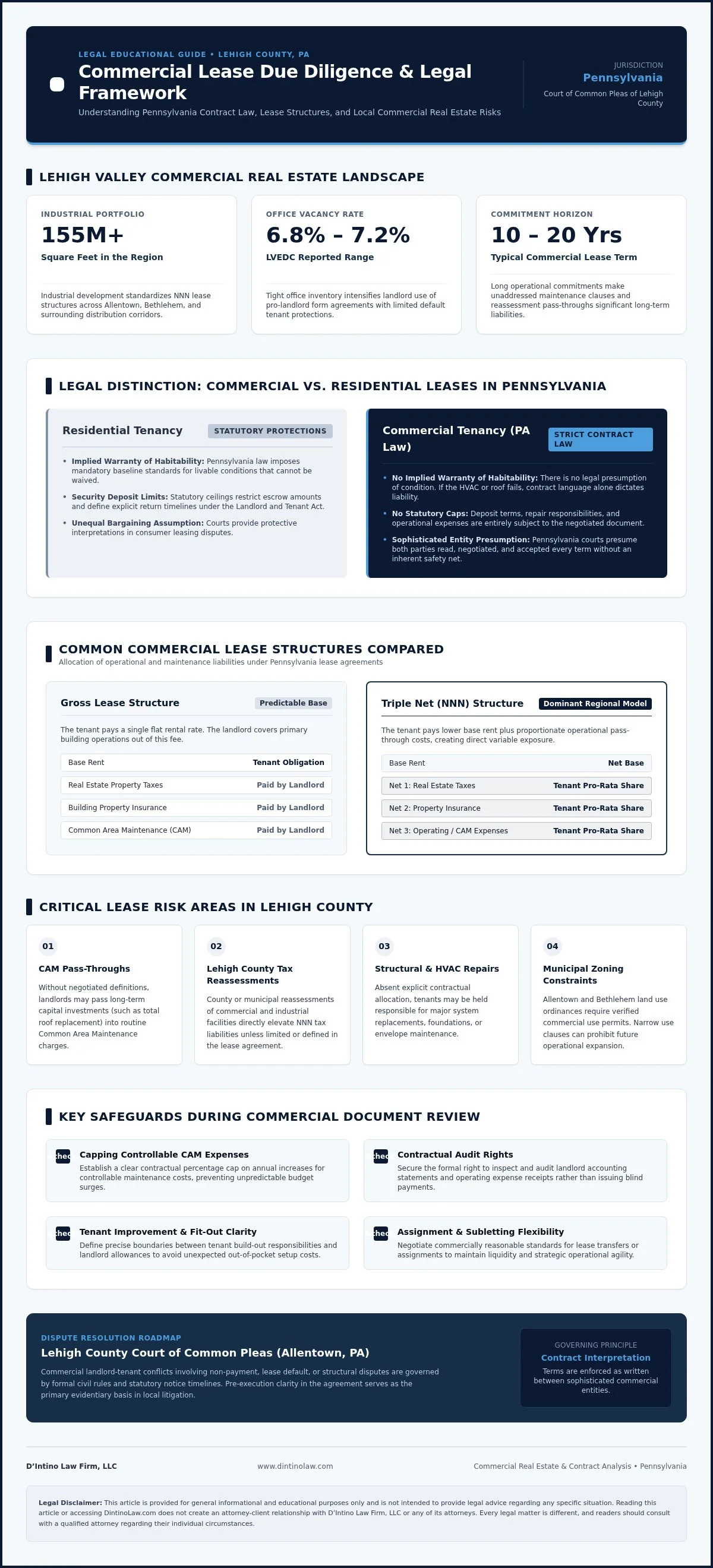
The Lehigh Valley market is currently seeing massive shifts. With an industrial portfolio exceeding 155 million square feet and office vacancy rates hovering between 6.8% and 7.2% according to the Lehigh Valley Economic Development Corporation, competition for prime space in Allentown and Bethlehem is fierce. Landlords often push “standard” forms to speed up the process. However, these boilerplate documents are almost always drafted to shield the property owner from liability while shifting maximum cost to the tenant. You should never sign these documents without a thorough professional review.
Why Commercial Leases Carry Higher Risks
Unlike residential tenancies, commercial agreements in Pennsylvania often involve commitments spanning 10 or 20 years. You aren’t just renting a space; you’re anchoring your business’s financial future to a specific location. If the lease lacks clear language regarding tenant improvement allowances or “fit-out” responsibilities, you could face massive out-of-pocket expenses before you even open your doors. A commercial lease lawyer Lehigh County acts as a shield, ensuring that “standard” clauses don’t become long-term anchors that sink your cash flow. Without statutory caps on security deposits or maintenance obligations, your contract is your only protection.
Lehigh County Market Considerations
Zoning and land use regulations in municipalities like Allentown and Bethlehem can be surprisingly complex. You can’t assume your business type is permitted just because a space is vacant. Additionally, Lehigh County’s property tax landscape directly impacts Triple Net (NNN) lease calculations. If a building is reassessed, your portion of the tax bill could skyrocket unexpectedly. Understanding these local variables is critical for accurate budgeting. For those already facing conflicts, Pennsylvania Real Estate Lawyers: A Guide to Litigation and Dispute Resolution provides deeper insight into how these issues are handled in court. Professional document review balances the power dynamic, giving you the leverage needed to protect your bottom line.
Essential Clauses in a Pennsylvania Commercial Lease
A commercial lease is often the largest financial commitment a business makes. In the Lehigh Valley, where industrial and retail sectors are expanding rapidly, understanding the difference between a Gross lease and a Triple Net (NNN) lease is vital. A Gross lease typically includes most operating costs in the base rent, but NNN leases require the tenant to pay for real estate taxes, insurance, and maintenance. Because NNN structures are the standard for the 155 million square feet of industrial space in our region, you need a commercial lease lawyer Lehigh County to ensure your total financial obligation is transparent from day one.
Financial and Maintenance Provisions
Common Area Maintenance (CAM) charges are a frequent source of friction. Landlords sometimes try to pass through capital improvements, such as a complete roof replacement, as an operating expense. Your lease should explicitly exclude these costs or place a cap on controllable expenses. Including audit rights is another critical protection. It gives you the power to verify the landlord’s expense claims rather than just cutting a check. Maintenance responsibilities also vary wildly. Under Pennsylvania law, there’s no implied warranty of habitability for commercial spaces. If the HVAC system fails or the roof leaks, the lease determines who pays. Without specific language, a tenant might be responsible for structural repairs that should belong to the landlord.
Use clauses and assignment rights are equally important. You must ensure your commercial location and zoning requirements align with your business operations. A narrow use clause could prevent you from expanding your service offerings later. Similarly, assignment and subletting rights protect your exit strategy. If you’re planning to sell your business or need to relocate, you don’t want the landlord to unreasonably withhold consent for a new tenant.
Termination and Default Clauses
Every commercial tenant needs a cure period. This provision ensures that if you’re late on a payment or accidentally breach a minor term, you receive formal notice and an opportunity to fix the issue before facing eviction. Post-pandemic, Force Majeure clauses have also gained new scrutiny. Pennsylvania courts interpret these acts of god strictly. Your lease needs to clearly define what qualifies as an uncontrollable event to prevent a sudden business closure from triggering an immediate default. If you’re concerned about the fine print in your current agreement, having a legal professional review your lease documents can identify these liabilities before they become expensive disputes.
The Critical Role of Attorney Document Review
You shouldn’t mistake a landlord’s “standard” document for a neutral one. In the Lehigh Valley, these agreements are often drafted by sophisticated legal teams to protect the property owner’s equity at your expense. While the Pennsylvania Landlord and Tenant Act of 1951 provides some framework, commercial parties have broad latitude to waive statutory rights. A seasoned commercial lease lawyer Lehigh County looks past the surface to find clauses that could handicap your growth. We focus on customizing terms to fit your specific operation, ensuring that commercial landlord-tenant law principles work for you rather than against you.
The Review Process: Beyond the Fine Print
Comprehensive document review identifies toxic contract language early, stopping expensive court battles before they have a chance to begin.
Why ‘Standard’ Forms Are Often Pro-Landlord
The myth of the “standard” Pennsylvania commercial lease is a tool landlords use to discourage negotiation. These forms frequently include a “Confession of Judgment” clause, which is one of the most aggressive legal mechanisms in the state. This provision allows a landlord to bypass a traditional trial and enter a judgment against your business for money or possession almost instantly. Under Pa. R. Civ. P. 2959, a tenant typically has only 30 days from the notice of entry to file a petition to open or strike that judgment. Failure to act within this window generally waives all defenses. Whether you are operating in the Lehigh Valley or working with a Real Estate Lawyer Philadelphia: Protecting Your Property and Interests, understanding that these clauses are strictly for commercial transactions is vital for your protection.
By identifying these “hidden” liabilities, we balance the power dynamic. We ensure your lease isn’t just a monthly bill, but a strategic asset that supports your business continuity. Every word in that contract carries a price tag; our job is to make sure you aren’t paying more than you bargained for.
Resolving Commercial Landlord-Tenant Disputes in Lehigh County
Disputes in the Lehigh Valley commercial market often arise when business expectations don’t align with the legal fine print. Whether you’re managing a logistics hub near the I-78 corridor or a retail storefront in Bethlehem, the financial stakes of a breach are immense. While non-payment is the most common trigger, violations regarding property use or maintenance can be just as damaging. A commercial lease lawyer Lehigh County can help you determine if mediation is a viable alternative to the courtroom, or if aggressive litigation is required to protect your bottom line. Professional representation ensures that formal notice requirements are met, preventing procedural errors that could derail your case.
The Eviction Process for Commercial Properties
Commercial evictions in Pennsylvania move quickly. Under the Landlord and Tenant Act of 1951, a standard notice to quit is 10 to 30 days depending on the breach. However, commercial parties can legally waive these notice requirements entirely within the written lease agreement. If the dispute involves more than $12,000, the complaint must be filed in the Lehigh County Court of Common Pleas at 455 West Hamilton Street, Allentown. After a hearing and a favorable judgment, the landlord must obtain a writ of possession. Only the Lehigh County Sheriff has the legal authority to physically remove a tenant and their property. This methodical approach is necessary to avoid liability for wrongful eviction.
Defenses and Counterclaims
Tenants facing eviction aren’t without recourse. A common defense is a breach of the covenant of quiet enjoyment, which occurs when a landlord’s actions substantially interfere with the tenant’s use of the space. In extreme cases, this may escalate to constructive eviction. This happens when property conditions, like a collapsed roof or lack of essential utilities, make business operations impossible. Landlords must be cautious; “self-help” measures like changing locks or cutting off power are generally illegal in Pennsylvania. These actions often lead to expensive counterclaims that can dwarf the original unpaid rent. If you’re currently facing a high-stakes dispute, contact D’Intino Law Firm, LLC to discuss your legal options and protect your business continuity.
Strategic Advocacy for Your Lehigh County Real Estate Matters
When you’re managing commercial real estate in the Lehigh Valley, you need more than just a signature on a page. You need a commercial lease lawyer Lehigh County who understands that your physical space is the foundation of your daily operations. Large, faceless corporate entities in Allentown often prioritize volume over value; we prioritize you. At D’Intino Law Firm, LLC, we take a different approach to legal representation. Attorney John D’Intino Jr. works directly with every client, ensuring that your business interests receive the focus, tenacity, and strategic thinking they deserve.
A Hands-On Approach to Real Estate Law
We intentionally limit our caseload to maintain a high standard of personalized service. This means your lease isn’t just another file in a stack; it’s a strategic document that we analyze with a “fighter” mentality. You won’t deal with hand-offs to junior associates who lack the experience to spot high-stakes liabilities. Instead, you get direct access to an attorney with over two decades of experience in both negotiation and courtroom litigation across Pennsylvania. Whether we’re negotiating tenant improvement allowances for a new office in Bethlehem or litigating a complex dispute in the Lehigh County Court of Common Pleas, we prioritize practical, business-minded outcomes.
Our experience has shown how a single poorly defined clause can lead to years of financial strain. We’ve seen landlords attempt to pass through unreasonable capital expenses or use aggressive confession of judgment clauses to bypass your rights. We don’t back down from these challenges. Our goal is to provide elite, tailored advocacy that balances the power dynamic between you and your landlord, protecting your bottom line from the start.
Contact D’Intino Law Firm, LLC
Navigating the complexities of Pennsylvania real estate law doesn’t have to be a solo journey. We provide transparent communication and steady guidance for business owners in Allentown, Bethlehem, and throughout the surrounding Lehigh Valley communities. If you’re facing a lease violation, an unfair eviction notice, or simply want a professional to review an agreement before you sign, we’re here to help. We offer flexible options and a commitment to professional advocacy that centers on your long-term success. Contact D’Intino Law Firm, LLC today to schedule a consultation and discuss your Lehigh County real estate needs.
Legal Disclaimer: This article is provided for general informational and educational purposes only and is not intended to provide legal advice regarding any specific situation. Reading this article or accessing DintinoLaw.com does not create an attorney-client relationship with D’Intino Law Firm, LLC or any of its attorneys. Every legal matter is different, and readers should consult with a qualified attorney regarding their individual circumstances.
Secure Your Business Foundation in the Lehigh Valley
Your commercial lease is more than just a monthly expense; it’s a strategic document that can either support your growth or anchor your business with hidden liabilities. From understanding the nuances of NNN expenses to neutralizing aggressive confession of judgment clauses, every detail requires professional scrutiny. Pennsylvania law treats these agreements as high-stakes contracts where your only protection is the language you negotiate today.
By working with a dedicated commercial lease lawyer Lehigh County, you gain the advantage of over 20 years of legal experience and direct access to Attorney John D’Intino Jr. Our hands-on approach ensures your documents are reviewed with a fighter’s mentality, focusing on practical outcomes and business continuity. Whether you’re entering a new space in Allentown or Bethlehem or facing a landlord-tenant dispute, you don’t have to face these legal hurdles alone.
Schedule a Consultation with a Lehigh County Commercial Lease Lawyer today. Protect your investment and move forward with the confidence that your business interests are fully secured.
Legal Disclaimer: This article is provided for general informational and educational purposes only and is not intended to provide legal advice regarding any specific situation. Reading this article or accessing DintinoLaw.com does not create an attorney-client relationship with D’Intino Law Firm, LLC or any of its attorneys. Every legal matter is different, and readers should consult with a qualified attorney regarding their individual circumstances.
Frequently Asked Questions
Do I really need a lawyer to review a commercial lease in Pennsylvania?
Yes, because Pennsylvania law assumes that commercial tenants are sophisticated business entities who don’t require the same consumer protections as residential renters. Courts generally enforce the lease exactly as it’s written, even if the terms seem one sided. A commercial lease lawyer Lehigh County identifies hidden liabilities in these complex contracts. Professional review ensures you aren’t unknowingly waiving your rights or accepting unreasonable financial burdens before you sign.
What is a ‘confession of judgment’ clause in a PA commercial lease?
A confession of judgment is a powerful legal tool that allows a landlord to enter a judgment against you without a trial. This clause is strictly for commercial transactions in Pennsylvania and can apply to money damages or possession of the property. Under Pa. R. Civ. P. 2959, you typically have only 30 days to challenge this judgment after receiving notice. Missing this deadline often waives your defenses entirely.
How long does a commercial eviction take in Lehigh County?
The timeline varies based on your specific lease terms and the nature of the breach. While the Landlord and Tenant Act of 1951 outlines notice periods of 10 to 30 days, many commercial leases legally waive these requirements. If the claim exceeds $12,000, the landlord must file a complaint in the Lehigh County Court of Common Pleas. An attorney can evaluate the circumstances to help you understand the likely procedural schedule for your case.
Can a commercial landlord lock out a tenant in Pennsylvania?
Generally, no. Self-help evictions like changing locks or cutting off utilities are considered illegal and highly risky for Pennsylvania landlords. Property owners must follow the formal legal process, which includes filing a complaint and obtaining a judgment for possession. Only the Lehigh County Sheriff has the legal authority to physically remove a tenant. Landlords who bypass these steps may face significant counterclaims for damages and wrongful eviction.
What are CAM charges, and can I negotiate them?
Common Area Maintenance (CAM) charges cover shared expenses like landscaping, snow removal, and building insurance. You can and should negotiate these terms with the help of a commercial lease lawyer Lehigh County. It’s common to request a cap on “controllable” expenses to prevent sudden spikes in your monthly costs. You should also ensure the lease includes audit rights, giving you the power to verify that the landlord’s expense claims are accurate.
What happens if I need to break my commercial lease early in Allentown?
Pennsylvania law doesn’t provide an automatic right to terminate a lease early. Your options depend entirely on the language in your contract, such as “kick out” clauses or subletting rights. Some leases include liquidated damages provisions that define the cost of an early exit. Depending on the circumstances, an attorney may be able to negotiate a buyout or a surrender agreement that protects your business from a full acceleration of rent.
Is there a difference between a retail lease and an industrial lease in PA?
Retail and industrial leases address very different operational risks. Retail agreements often focus on “exclusive use” clauses to prevent competitors from moving into the same plaza and “co-tenancy” requirements regarding anchor tenants. Industrial leases, common along the Lehigh Valley’s logistics corridors, prioritize environmental indemnification and specific loading dock access. Each requires a tailored approach to document review to ensure the unique needs of your specific industry are fully protected.
How do I know if my Lehigh County property is zoned correctly for my business?
You must verify zoning requirements with the specific municipality where the property is located, such as the City of Allentown or Bethlehem. Don’t rely on a landlord’s verbal assurances that your business use is permitted. An attorney can evaluate the agreement and negotiate contingencies that make the lease commencement dependent on you obtaining the necessary municipal permits. This step prevents you from being locked into a long term lease for a space you cannot legally use.
Disclaimer
Legal Disclaimer: The information provided on DintinoLaw.com, including articles, blog posts, testimonials, case results, and other content, is for general informational and educational purposes only and does not constitute legal advice or create an attorney-client relationship with D’Intino Law Firm, LLC or any of its attorneys. Visiting this website, submitting a contact form, sending an email, calling, texting, or otherwise communicating with the firm does not establish an attorney-client relationship or obligate the firm to represent you. Do not submit confidential, privileged, or time-sensitive information through this website or electronic communications unless and until the firm has expressly agreed to represent you. Legal rights, procedures, statutes of limitation, filing deadlines, and other requirements vary based on the facts and jurisdiction and may change over time; nothing on this website should be relied upon to determine whether a legal deadline applies to your matter. If you have an urgent legal matter or a potential filing deadline, consult a qualified attorney promptly. Testimonials and statements regarding client experiences are individual opinions and experiences and are not a guarantee of future results. Prior results, verdicts, settlements, or case examples do not guarantee or predict the outcome of any future case, and every matter is different. This website may constitute attorney advertising under applicable Pennsylvania rules. D’Intino Law Firm, LLC makes no representation that the information on this website is complete, current, or applicable to your particular circumstances. For legal advice concerning your specific situation, consult directly with a qualified Pennsylvania attorney. D’Intino Law Firm, LLC | Philadelphia, Pennsylvania | DintinoLaw.com
