


Attorney
What if the lease clause that seems to settle the issue doesn’t tell the whole story? In a commercial eviction, the lease, the reason for seeking possession, and the steps already taken can all matter. If you’re searching for a commercial eviction lawyer Montgomery County PA, understanding how those pieces fit together is a useful place to start.
Questions about notice requirements, lease language, and the proper court or process are common. Pennsylvania commercial landlord-tenant disputes turn on the specific agreement and circumstances, so acting on assumptions may complicate rather than resolve a dispute.
This guide explains general considerations in the Pennsylvania commercial eviction process, highlights lease terms and records that may be relevant, and outlines practical preparation steps. It also explains how a Pennsylvania real estate attorney can review the lease and dispute history and discuss possible options. This is general information, not legal advice for a particular situation.
Key Takeaways
- Review the full commercial lease, including default, notice, cure, termination, and dispute-resolution terms, before deciding how to proceed.
- Consider possession separately from unpaid rent or other lease-related claims, since each may raise distinct legal issues.
- Identify which court, procedures, and potential claims may apply to the particular dispute under Pennsylvania law.
- Organize the lease, amendments, account records, and communications in chronological order to clarify the history of the dispute.
- A commercial eviction lawyer Montgomery County PA can review the lease and available records and explain legal and procedural considerations tied to the circumstances.
Commercial Evictions in Montgomery County, PA: What Landlords Need to Know
A commercial eviction is a formal legal process for seeking possession of business property, not an informal removal of a tenant. A lease disagreement or unpaid balance may be part of the same conflict, but it is not automatically the same as recovering possession. A landlord may need to consider possession and financial claims separately, based on the lease, the facts, and Pennsylvania law.
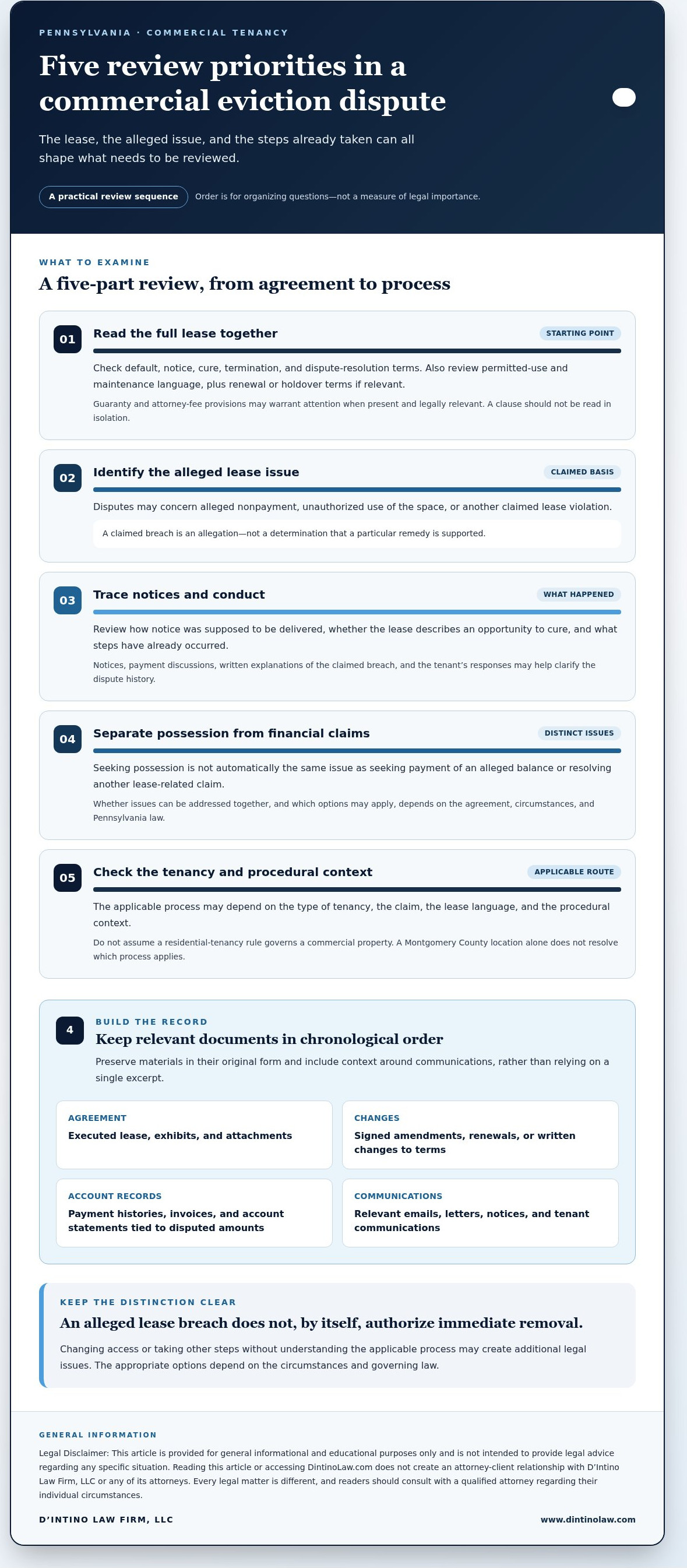
This distinction matters when a tenant allegedly stops paying rent, uses the premises in a way the lease restricts, or fails to meet another contractual obligation. An alleged breach does not, by itself, authorize immediate removal. Changing access or taking other steps without understanding the applicable process may create additional legal issues. The appropriate options depend on the circumstances and the governing law.
When a commercial landlord may consider legal action
Disputes may involve alleged nonpayment, unauthorized use of the space, or another claimed lease violation. The agreement can affect what counts as a default, whether the tenant has an opportunity to address it, and what remedies may be available. Notices, payment discussions, and written explanations of the alleged breach may also be relevant.
Before deciding how to proceed, identify the goals involved. A landlord may be seeking possession, payment of an alleged balance, or resolution of another lease dispute. Whether these issues can be addressed together, and which steps may be available, depends on the agreement, facts, and Pennsylvania law. A commercial eviction lawyer Montgomery County PA can review those details and explain the issues that may need attention.
Commercial tenancy is not the same as residential tenancy
Commercial leases often address the property’s business use and may contain detailed terms about permitted activities, maintenance, default, notice, and dispute resolution. Understanding Commercial Leases provides general background on lease relationships, but it does not explain how Pennsylvania law applies to a particular commercial dispute.
Do not assume that a rule or procedure associated with residential tenancies also governs a commercial property. The applicable law may depend on the type of tenancy, lease language, and facts. Review the statutory distinctions and procedural requirements relevant to the specific matter rather than inferring them from a general description of eviction law.
For a Montgomery County property, location alone does not resolve which legal process applies. Pennsylvania law governs the issues discussed here, while the proper route for a particular dispute may depend on the claim and procedural context. Reviewing the agreement and tenancy history can clarify which questions need answers before choosing a next step.
How Pennsylvania Lease Terms Shape a Montgomery County Commercial Eviction
The signed lease is a key starting point in a Pennsylvania commercial tenancy dispute. It may define default, specify how notice must be delivered, describe an opportunity to cure a problem, and explain how the agreement can be terminated. Read these provisions together. They should not be treated as stand-alone permission to remove a tenant. Their meaning and enforceability depend on the full agreement, the facts, and applicable Pennsylvania law.
Lease wording and documented conduct can shape which issues need legal review in a commercial eviction dispute. A clause may appear clear in isolation, but another section, an amendment, or the parties’ communications may affect how it applies.
Which lease provisions deserve careful review?
Review the definitions of default, notice requirements, cure provisions, and termination language. Check whether the lease specifies a delivery method or explains how the tenant may address an alleged violation. Renewal and holdover terms may matter if the lease term has ended or a renewal is disputed. Guaranty and attorney-fee provisions may also warrant attention when present and legally relevant. Do not assume a clause authorizes eviction without considering its wording and applicable law.
How a lease breach differs from a proven legal basis
A landlord’s claim that a tenant breached the lease is an allegation, not a determination that the agreement or Pennsylvania law supports a particular remedy. The tenant may dispute the facts, the interpretation of a clause, or whether required steps were followed. The full record and governing law affect the analysis. A commercial eviction lawyer Montgomery County PA can review the agreement and circumstances and identify questions that may need to be resolved.
Keep relevant records together and preserve them in their original form. Materials that may help clarify the timeline include:
- The fully executed lease and any exhibits or attachments.
- Signed amendments, renewal documents, or written agreements that changed the terms.
- Payment histories, invoices, and account statements related to disputed amounts.
- Relevant emails, letters, notices, and other communications with the tenant.
Organize communications chronologically, including messages that provide context or reflect a response to the dispute. Avoid relying on a single excerpt when the surrounding exchange may affect its meaning. For general county information, landlords can consult Montgomery County Official Resources. Local government information does not replace review of the lease or the law governing a specific dispute.
D’Intino Law Firm, LLC represents clients in Pennsylvania landlord-tenant matters, including commercial lease and eviction disputes. Landlords can learn about commercial lease and eviction legal guidance from the firm.
Commercial Eviction in Montgomery County: Process Questions and Common Misconceptions
A commercial landlord-tenant dispute does not follow one guaranteed path. The process generally calls for reviewing the lease and relevant facts, considering any applicable notice, and identifying the proper forum and procedure before seeking a legal remedy. Steps depend on the type of claim and circumstances, so a general outline is not a case-specific roadmap.
What happens after a landlord identifies a possible default?
An initial review may cover the agreement, the alleged default, the tenant’s response, and relevant communications. The lease and Pennsylvania law may affect whether notice is appropriate and what it should address. Before taking a formal step, identify which court or process applies and whether related claims raise separate issues.
For a Montgomery County dispute, assess the forum and procedure based on the particular claim rather than assuming they follow from the property’s location alone. The Pennsylvania Judicial System provides official court-system information, but a general website overview cannot determine the proper venue or requirements for an individual matter. Review notice terms and applicable legal requirements for the specific case. Do not rely on an assumed deadline or filing sequence without verifying it.
Can a landlord remove a commercial tenant without a court process?
Changing locks, removing property, or otherwise taking control of the premises without a court process may raise serious legal issues. Whether particular conduct is permitted depends on the facts, the lease, and current Pennsylvania law. Do not treat an alleged breach as automatic authority to take possession. Get legal review of a proposed action before taking it.
Several assumptions can sound straightforward but leave important questions unanswered:
Assumption: A lease violation means the tenant can be removed immediately. Question for review: What does the full agreement say, and what steps may apply under Pennsylvania law?
Assumption: A notice used in another dispute will fit this one. Question for review: Is the notice appropriate for this lease, alleged default, and circumstances?
Assumption: Every landlord-tenant claim follows the same court route. Question for review: Which forum and procedural rules apply to this particular claim?
Assumption: Lock changes or property removal are simply practical steps. Question for review: Could the proposed action create additional legal issues under current Pennsylvania law?
These distinctions help keep a dispute from being reduced to a single question, such as whether rent is overdue or a lease term was breached. A commercial eviction lawyer Montgomery County PA can assess the agreement, facts, possible claims, and procedural questions together. The available options depend on the particular matter; general information cannot determine what is appropriate for a specific landlord or property.
Preparing for a Commercial Eviction Dispute in Montgomery County, PA
Organized records can help an attorney understand what happened, what the lease says, and which questions need legal analysis. Preparation does not determine the outcome, but a complete and accurate file can make it easier to assess the dispute under Pennsylvania law. Keep documents in their original form and record events as they occurred. Do not edit, discard, or selectively preserve material because it seems unhelpful.
Documents and information to organize
Use this checklist to assemble the core information. If a record is missing, note that rather than trying to recreate it as though it were original.
- Gather the agreement. Include the signed lease, attachments, amendments, renewal documents, and any written changes to the arrangement.
- Collect notices and communications. Save notices exchanged with the tenant, along with relevant emails, letters, and messages. Keep full conversations and available dates, not selected excerpts.
- Organize account records. Assemble payment histories, invoices, account statements, and records that explain how disputed amounts were calculated or recorded.
- Include property-management records. Collect relevant inspection notes, maintenance records, and other documents related to the claimed lease issue or use of the premises.
- Draft a factual timeline. List significant events in date order, such as payments, communications, notices, and responses. Separate what you observed directly from what someone else reported.
- Confirm the tenancy details. Note the property involved, the tenant named in the lease, the space covered, and whether the records identify other occupants or business entities connected to the arrangement.
Questions that help clarify the legal issues
Alongside the documents, write down the specific concern in neutral terms. Which lease provision do you believe applies? What conduct or missed obligation is at issue, and when did it occur? Did the tenant dispute the account, explain the conduct, or propose a way to resolve the disagreement? Include communications that complicate your account, too. A balanced timeline is more useful than a conclusion unsupported by the records.
Property details can matter to the review. The premises’ address and description, the area covered by the lease, and the identity of the parties can help clarify which agreement and dispute are being evaluated. Do not assume that the business name on a sign is the same entity named in the lease. An attorney can assess these details alongside the agreement and communications; the relevant issues depend on the circumstances.
A practical preparation checklist is simple: gather original records, organize them by date, identify the lease term and conduct at issue, and note what remains uncertain. Keep confidential business and tenant information private. Share relevant materials directly with counsel rather than publishing them online.
D’Intino Law Firm, LLC handles Pennsylvania commercial landlord-tenant matters. To discuss a commercial lease dispute, contact the firm about your Montgomery County matter. An attorney can review the documents and circumstances and explain potential legal options without predicting the result.
How a Montgomery County Commercial Eviction Lawyer Can Help
A commercial landlord-tenant dispute can involve more than rent or lease compliance. A lawyer can examine how the contract, the parties’ conduct, and Pennsylvania law fit together, then explain which issues may need attention. The review depends on the circumstances. It can clarify potential legal options, but it cannot guarantee a particular result or timeline.
What legal counsel may assess
Counsel may review the executed lease and amendments, the events behind the dispute, and the records that document them. That review can include how default, notice, cure, termination, and dispute-resolution terms interact, and whether related claims or responses raise additional questions. No single clause or document should be viewed in isolation; the full agreement and surrounding facts can affect its interpretation.
Procedural questions also call for current, case-specific review. The appropriate forum, applicable rules, and any local requirements may depend on the claim and procedural posture. A lawyer can assess those issues under Pennsylvania law rather than assume every commercial landlord-tenant matter follows the same route. The goal is to identify relevant considerations and explain possible paths, not promise possession, payment, or a particular resolution.
For broader context on Pennsylvania real estate disputes, the firm’s Pennsylvania real estate law overview discusses related legal issues. A commercial lease matter still requires focused review of its own terms, records, and circumstances.
Discussing a commercial landlord-tenant concern
For help with a Pennsylvania commercial landlord-tenant issue, landlords can contact D’Intino Law Firm, LLC. Attorney John D’Intino Jr. works directly with clients and has more than two decades of experience. The firm offers free consultations. A conversation can help identify the concerns to examine and the information that may be useful for a fuller review. Contacting the firm or discussing a concern does not, by itself, create an attorney-client relationship.
D’Intino Law Firm, LLC serves clients in Montgomery County and surrounding Pennsylvania communities, including Philadelphia, Media, West Chester, Conshohocken, Lower Merion, Upper Darby, Gladwyne, Drexel Hill, Ardmore, Blue Bell, Bucks County, Delaware County, Lancaster County, and Lehigh County. For a Montgomery County commercial eviction concern, the central questions remain the specific lease, documented events, and applicable Pennsylvania law. A commercial eviction lawyer Montgomery County PA can review those details and discuss potential legal options without making assumptions about the outcome.
Consider Your Priorities Before Taking the Next Step
A commercial tenancy dispute can put business plans and property decisions in tension. Before choosing a path, consider what needs to be resolved, how the lease relationship affects your plans, and whether possession, unpaid amounts, or both are part of the concern. These priorities can help frame a focused legal discussion, but they do not determine which options Pennsylvania law may allow.
A commercial eviction lawyer Montgomery County PA can review the circumstances and identify questions that remain before you act. The analysis depends on the lease, records, and dispute, and no attorney can promise a particular result. Understanding the legal issues can help you make informed decisions without relying on assumptions about process or outcome.
To discuss a Pennsylvania commercial landlord-tenant concern, contact D’Intino Law Firm, LLC. The firm handles commercial lease and eviction matters in Pennsylvania. A free consultation can help clarify which issues may benefit from legal review and whether representation fits your needs. A conversation can begin with a clear discussion of the facts and the options available for evaluation.
Frequently Asked Questions
Does Pennsylvania law treat commercial and residential evictions the same way?
No. Commercial and residential tenancies can involve different lease terms and legal considerations, so a residential rule should not automatically be applied to a business property. For example, a commercial lease may be negotiated around a particular business use or contain detailed provisions on default and notice. The applicable analysis depends on the tenancy, agreement, facts, and Pennsylvania law. A lawyer can review which rules govern the specific property and dispute.
Can a commercial landlord change the locks after a tenant violates the lease?
A landlord should not assume a lease violation makes a lock change lawful. Lockouts and other self-help steps may raise serious legal issues under Pennsylvania law, depending on the circumstances and the tenant’s rights to occupy the space. Before restricting access or removing property, seek legal review of the lease, current law, and facts. An alleged breach alone does not establish that a landlord can take possession without following an appropriate legal process.
What documents should a Montgomery County landlord gather for a commercial eviction consultation?
Gather the signed lease and amendments, any relevant guaranty, notices exchanged, payment records, and communications about the dispute. Also note the exact business or legal entity named as tenant, the leased space, and key dates. For electronic records, preserve full messages and attachments rather than screenshots of selected lines alone. A clear, factual timeline can help counsel identify missing information and questions that need closer review.
How does a commercial lease affect an eviction dispute in Pennsylvania?
The lease can define the parties’ obligations and describe what they agreed would happen after a claimed default. For instance, it may address permitted use, how rent is calculated, or how notice must be delivered. The entire agreement matters, including amendments and incorporated attachments. A clause does not automatically settle the legal issue; interpretation may depend on the wording, the parties’ conduct, and governing Pennsylvania law.
Which court handles a commercial eviction case in Montgomery County, Pennsylvania?
Montgomery County commercial landlord-tenant eviction matters are generally heard in Magisterial District Court. The appropriate court and procedure can still depend on the type of relief sought, the location of the property, and related claims. A request for possession may raise different jurisdictional questions from a separate dispute over contract obligations. Confirm the correct forum and current requirements for the particular case rather than relying on a general description.
Can a landlord pursue unpaid rent as well as possession of commercial property?
Possibly. A landlord may have questions about both regaining possession and seeking payment, but whether those requests can be pursued together depends on the claim, amount, lease, and applicable procedure. Account records should distinguish rent from other disputed charges and show how payments were applied. The tenant may contest the balance or raise other issues, so an attorney can assess the available claims and proper forum under Pennsylvania law.
When should a commercial landlord speak with an eviction lawyer in Montgomery County?
Consider consulting counsel when a tenant disputes an alleged default, a lease term or notice requirement is unclear, or you are weighing steps that could affect access to the property. A commercial eviction lawyer Montgomery County PA can review the lease, communications, and procedural questions before you act. Legal review can clarify issues and options, though it cannot promise a particular timeline or result. A consultation alone does not create an attorney-client relationship.
Legal Disclaimer: This article is provided for general informational and educational purposes only and is not intended to provide legal advice regarding any specific situation. Reading this article or accessing DintinoLaw.com does not create an attorney-client relationship with D’Intino Law Firm, LLC or any of its attorneys. Every legal matter is different, and readers should consult with a qualified attorney regarding their individual circumstances.
Disclaimer
Legal Disclaimer: The information provided on DintinoLaw.com, including articles, blog posts, testimonials, case results, and other content, is for general informational and educational purposes only and does not constitute legal advice or create an attorney-client relationship with D’Intino Law Firm, LLC or any of its attorneys. Visiting this website, submitting a contact form, sending an email, calling, texting, or otherwise communicating with the firm does not establish an attorney-client relationship or obligate the firm to represent you. Do not submit confidential, privileged, or time-sensitive information through this website or electronic communications unless and until the firm has expressly agreed to represent you. Legal rights, procedures, statutes of limitation, filing deadlines, and other requirements vary based on the facts and jurisdiction and may change over time; nothing on this website should be relied upon to determine whether a legal deadline applies to your matter. If you have an urgent legal matter or a potential filing deadline, consult a qualified attorney promptly. Testimonials and statements regarding client experiences are individual opinions and experiences and are not a guarantee of future results. Prior results, verdicts, settlements, or case examples do not guarantee or predict the outcome of any future case, and every matter is different. This website may constitute attorney advertising under applicable Pennsylvania rules. D’Intino Law Firm, LLC makes no representation that the information on this website is complete, current, or applicable to your particular circumstances. For legal advice concerning your specific situation, consult directly with a qualified Pennsylvania attorney. D’Intino Law Firm, LLC | Philadelphia, Pennsylvania | DintinoLaw.com
