


Attorney
What should you do immediately after being charged with an offense in Pennsylvania, and how do you choose legal counsel who will actually stand beside you in court? An arrest puts your career, personal freedom, and future at risk within hours. Facing this sudden reality is terrifying, especially when you don’t know whether your case begins in a local Magisterial District Court or proceeds directly to the Bucks County Justice Center in Doylestown. Partnering with a dedicated Bucks County criminal attorney ensures you aren’t treated like a file number passed down to an inexperienced associate.
You already know that the stakes are far too high for a passive, one-size-fits-all approach. This guide clarifies Pennsylvania criminal procedure so you can understand your upcoming court appearances, your constitutional protections, and the defense strategies that may apply to your specific circumstances. We’ll examine how cases move from preliminary hearings to the Court of Common Pleas, outlining the direct advocacy required to safeguard your record and your future at every phase.
Key Takeaways
- Understand the critical difference between local Magisterial District Courts and the Bucks County Justice Center in Doylestown.
- Learn how an arrest or summons triggers strict procedural deadlines under the Pennsylvania Rules of Criminal Procedure.
- Discover how a dedicated Bucks County criminal attorney builds strategic defenses by scrutinizing police procedure and evidentiary elements.
- Identify essential qualities to look for in defense counsel, including direct representation instead of junior associate hand-offs.
- Explore available diversionary programs and local court processes that can significantly impact the resolution of your case.
Facing Criminal Allegations in Bucks County: Immediate Legal Realities
A police stop in Bensalem or a formal summons mailed from a Doylestown address sets statutory machinery into motion immediately. Under Pennsylvania law, criminal investigations and charging decisions trigger stringent procedural deadlines. Township police departments, borough authorities, and Pennsylvania State Troopers must adhere strictly to the Pennsylvania Rules of Criminal Procedure. These rules govern everything from the issuance of a criminal complaint to formal detention standards. Understanding foundational criminal procedure in the United States clarifies that the earliest phases of an investigation often determine the trajectory of your entire defense.
Retaining a qualified Bucks County criminal attorney early provides an active buffer between you and law enforcement. Investigators often attempt to secure voluntary admissions before formal charges appear on a court docket. Once legal counsel enters an appearance, police officers cannot continue custodial interrogation without your attorney present. That intervention stops accidental self-incrimination before initial hearings take place.
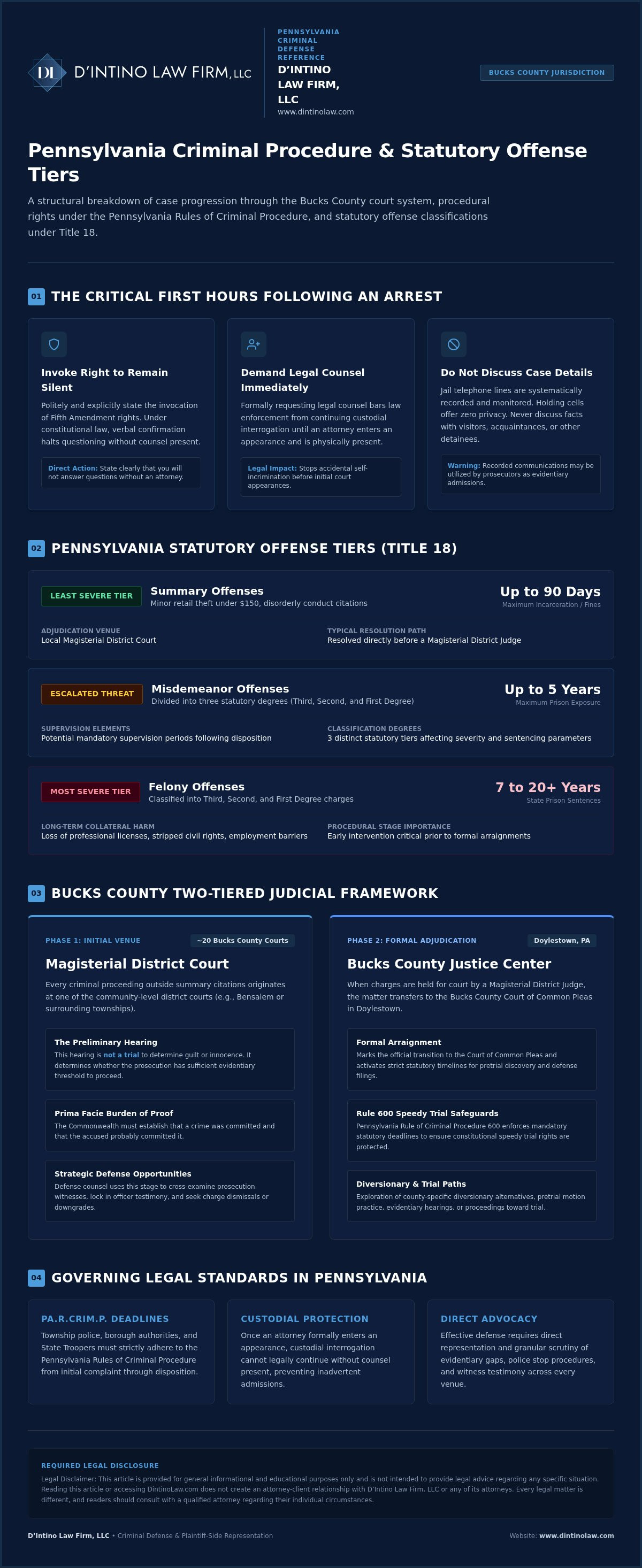
The Critical First Hours Following an Arrest
What you do immediately following an arrest dictates how strong your defense posture remains. Take these proactive steps:
- Politely invoke your right to remain silent: Explicitly state that you are exercising your Fifth Amendment rights and will not answer questions without counsel.
- Request your attorney immediately: Demanding an attorney halts interrogation under established constitutional protections.
- Do not discuss your case with anyone: Jail telephone calls are recorded, and holding cells offer zero privacy. Never discuss facts with visitors, friends, or other detainees.
Understanding Summary Offenses, Misdemeanors, and Felonies
Pennsylvania categorizes offenses into three distinct statutory tiers under Title 18 of the Pennsylvania Consolidated Statutes. Each tier carries starkly different procedural paths and penalties.
Summary offenses represent the least severe tier, often involving minor retail theft under $150 or disorderly conduct. These are typically resolved directly before a Magisterial District Judge through fines or up to 90 days of incarceration. Misdemeanor charges, divided into three degrees, escalate the threat significantly. A misdemeanor conviction can lead to up to five years in prison along with mandatory supervision.
Felonies carry severe consequences under Pennsylvania sentencing guidelines. Classified into third, second, and first degrees, felony convictions can result in maximum terms ranging from seven to twenty or more years in state prison. Beyond incarceration, felony records bring long-term collateral harm, stripping away professional licenses, civil rights, and employment opportunities. Early intervention by an experienced Bucks County criminal attorney helps counter these charges before formal arraignments occur.
Navigating the Bucks County Court System: Step-by-Step Procedure
Criminal prosecutions in Bucks County follow a distinct two-tiered judicial framework. Minor procedural decisions at the outset often shape the ultimate resolution of your charges. Understanding the typical course of a criminal case helps eliminate confusion as your case advances from community district courts to county-level venues. Working closely with an experienced Bucks County criminal attorney ensures strict adherence to procedural milestones, including speedy trial guarantees protected under Pennsylvania Rule of Criminal Procedure 600.
The Magisterial District Court and Preliminary Hearings
Every criminal proceeding outside summary citations begins at one of the roughly twenty Magisterial District Courts across Bucks County. The preliminary hearing is not a trial to determine guilt. Instead, the Commonwealth must present a prima facie case, establishing that a crime occurred and that you likely committed it. Experienced defense counsel uses this hearing to lock in officer testimony, cross-examine prosecution witnesses, and highlight evidentiary gaps to argue for charge dismissals or downgrades before cases advance.
Proceedings at the Bucks County Justice Center in Doylestown
When a district judge holds charges for court, the matter moves to the Bucks County Court of Common Pleas at the Justice Center in Doylestown. This marks the transition to formal adjudication:
- Formal Arraignment: The defendant receives the formal criminal information sheet detailing statutory charges.
- Pre-Trial Conferences: Counsel reviews complete discovery packets, initiates substantive negotiations with county prosecutors, and addresses trial scheduling.
- Omnibus Pre-Trial Motions: Defense filings challenge unconstitutional stops, unlawful searches, or coerced statements through suppression hearings before a Common Pleas judge.
Alternative Resolution Programs in Pennsylvania
Certain defendants may qualify for statutory diversionary programs designed to avoid standard criminal convictions. The Accelerated Rehabilitative Disposition (ARD) program offers eligible first-time, non-violent individuals an alternative path. The Bucks County District Attorney retains discretion over admission, which requires waiving the preliminary hearing and completing mandated conditions like community service or counseling. Recent updates under Pennsylvania Act 58 stipulate that a prior ARD disposition for DUI can be treated as a prior offense if a subsequent charge occurs within ten years.
Bucks County also maintains specialty court tracks, including Veterans Court, Mental Health Court, and drug diversion initiatives like the District Court Diversion Program. If you are facing formal charges, reviewing these pathways with dedicated legal counsel can provide clarity on which statutory options fit your circumstances.
Defense Strategies for Frequent Bucks County Criminal Charges
Every criminal prosecution in the Commonwealth requires the state to prove each statutory element beyond a reasonable doubt. Charges filed across lower Bucks County often stem from patrol stops along Route 1, Interstate 95, or the Pennsylvania Turnpike. Effective defense work does not rely on passive negotiation; it begins with an aggressive audit of the state’s evidence. Local court rules and formal Bucks County criminal case procedures dictate strict filing windows for substantive motions, making prompt case analysis vital to your defense strategy.
A strategic Bucks County criminal attorney targets police conduct from the moment of initial contact. By establishing procedural missteps early, counsel can challenge search validity, witness reliability, and statutory grading before county prosecutors finalize their trial theories.
Pennsylvania DUI Offenses and Chemical Test Challenges
Pennsylvania divides Driving Under the Influence charges into three separate tiers based on Blood Alcohol Content (BAC). Penalties escalate dramatically from Tier 1 (General Impairment, .08% to .099%) to Tier 3 (Highest Rate, .16% and above, or any controlled substance). Challenging these charges involves reviewing traffic stop dashcam footage for reasonable suspicion, verifying field sobriety testing protocols, and inspecting breath testing device calibration logs. Blood draws require strict scrutiny of medical chain-of-custody procedures and laboratory testing timelines.
Firearms Offenses Under the Uniform Firearms Act (VUFA)
Gun allegations under Title 18 Section 6106 (carrying without a license) or Section 6105 (persons not to possess) frequently arise from traffic stops involving shared vehicles. Key defense considerations include:
- Constructive Possession: Proving the state cannot establish both knowledge of the firearm’s presence and exclusive intent to control it.
- Search-and-Seizure Violations: Invoking Article I, Section 8 of the Pennsylvania Constitution to suppress weapons found during warrantless vehicle sweeps that lack probable cause.
- Permit and Reciprocity Verification: Confirming whether valid out-of-state carry authorizations or statutory exceptions apply to the accused.
Drug Charges, Theft, and Assault Allegations
Drug allegations demand a sharp distinction between simple possession and Possession with Intent to Deliver (PWID). The prosecution often relies on packaging materials, multiple cell phones, or cash to infer intent. Defense counsel challenges the warrants authorizing these searches. Theft offenses depend strictly on property valuation thresholds; property under $2,000 remains a misdemeanor, while values exceeding that mark trigger felony grading. In simple or aggravated assault matters, attorneys evaluate eyewitness reliability and establish affirmative self-defense justifications under Title 18 Section 505.
Evaluating Defense Counsel: What to Look for in a Bucks County Attorney
Hiring representation is one of the most consequential decisions you will make after an arrest. Many large firms operate on high file volume, relying on sales consultations to secure retainers before delegating court appearances to junior associates. A serious charge requires direct accountability. When interviewing a potential Bucks County criminal attorney, ask directly who will draft your omnibus motions, negotiate with the prosecutor, and appear beside you in the courtroom.
Guarantees of specific outcomes are an immediate red flag. Ethical Pennsylvania legal counsel provides honest, practical assessments grounded in statutory law and local court precedent rather than unrealistic promises. You need an advocate who evaluates physical evidence methodically and prepares every stage as if the matter will proceed to verdict.
The Value of Direct, Hands-On Legal Advocacy
Working directly with the attorney handling your defense eliminates costly miscommunications. Boutique defense practices that intentionally manage their caseload volume offer distinct advantages:
- Consistent Strategic Vision: The attorney who reviews your police reports is the same person arguing before the judge.
- Direct Communication Channels: You communicate with your actual legal advocate instead of filtering urgent questions through case managers or intake coordinators.
- Deep Case Familiarity: Your counsel knows the fine details of your testimony, timeline, and discovery files before walking into a conference.
Trial Readiness Versus Passive Plea Bargaining
Prosecution teams quickly recognize which defense attorneys prepare for trial and which merely seek quick dispositions. Real trial readiness changes settlement dynamics. When an attorney conducts independent investigations, reviews township bodycam records, and challenges procedural missteps, the prosecution must reevaluate its position.
Persuasive advocacy also relies on understanding local courtroom standards within the Bucks County Court of Common Pleas. Familiarity with local filing deadlines, pre-trial motion requirements, and judicial expectations ensures your statutory rights are asserted effectively. If you want dedicated advocacy tailored directly to your case, take the step to consult with experienced defense counsel about protecting your constitutional rights.
Protecting Your Future: Steps to Take With D’Intino Law Firm, LLC
Facing criminal allegations in southeastern Pennsylvania demands decisive, trial-tested advocacy. Attorney John D’Intino Jr. brings more than two decades of courtroom litigation experience to every defense strategy. Unlike traditional multi-layered practices, D’Intino Law Firm, LLC maintains an intentional caseload limit to ensure every client works directly with lead counsel from the initial case evaluation through final resolution. Your matter will not be handed off to a junior associate or processed by a case manager.
Early intervention preserves vital evidence before memories fade or digital records disappear. Retaining a dedicated Bucks County criminal attorney immediately allows counsel to request township surveillance tapes, secure dispatch audio, and establish non-monetary bail conditions before initial hearings conclude.
Preparing for Your Initial Legal Consultation
Arriving organized for your consultation enables your attorney to evaluate defense avenues without delay. Take time to assemble these essential materials:
- Official Court Paperwork: Bring the criminal complaint, affidavit of probable cause, summons, and any bail sheets issued by the district court.
- Chronological Event Timeline: Write down your recollection of events while details remain fresh, noting precise times, locations, and weather conditions.
- Potential Witness Details: Compile names, telephone numbers, and addresses of anyone present who observed police interactions or the alleged incident.
- Property Documentation: Keep receipts, registration cards, or ownership paperwork relevant to vehicle or property searches.
Strategic Defense Representation Across Southeastern Pennsylvania
Criminal charges frequently cross municipal and county lines throughout the greater Delaware Valley. An investigation initiated in Bensalem or Bristol can intersect with proceedings in neighboring counties, demanding a cohesive defense across jurisdictions. When allegations extend into Philadelphia, partnering with a seasoned Philadelphia criminal defense lawyer ensures your constitutional rights remain protected under consistent strategic leadership.
High-stakes allegations involving complex grading or multi-jurisdictional task forces require an uncompromising defense plan. If your matter involves severe offenses or substantial incarceration risks, working with a qualified felony defense attorney in Philadelphia provides the rigorous motion practice and trial preparation necessary to challenge the Commonwealth’s evidence. D’Intino Law Firm, LLC delivers direct, hands-on representation designed to evaluate the unique facts of your case and guide you through Pennsylvania’s criminal justice system.
Take Strategic Control of Your Pennsylvania Criminal Defense
Facing criminal allegations in Pennsylvania places your reputation, career, and personal liberty on the line. Moving through local Magisterial District Courts to the Bucks County Justice Center requires strict compliance with statutory deadlines and a detailed analysis of the prosecution’s evidence. Choosing the right Bucks County criminal attorney ensures you aren’t treated like a file folder passed down to junior staff.
Attorney John D’Intino Jr. delivers more than two decades of trial-tested advocacy directly to your defense. Every case benefits from hands-on leadership, rigorous motion practice, and legal strategies built around the specific facts of your situation. You don’t have to face county prosecutors or complex courtroom proceedings alone. To review your options and protect your constitutional rights, contact D’Intino Law Firm, LLC to schedule a confidential legal consultation today.
Legal Disclaimer: This article is provided for general informational and educational purposes only and is not intended to provide legal advice regarding any specific situation. Reading this article or accessing DintinoLaw.com does not create an attorney-client relationship with D’Intino Law Firm, LLC or any of its attorneys. Every legal matter is different, and readers should consult with a qualified attorney regarding their individual circumstances.
Frequently Asked Questions
What happens at a preliminary hearing in a Bucks County Magisterial District Court?
The Commonwealth must present sufficient evidence to establish a prima facie case, showing a crime occurred and that you likely committed it. It isn’t a trial to establish guilt. Instead, your attorney can cross-examine prosecution witnesses, uncover inconsistencies in police reports, and argue for charge reductions or dismissals before the case is transferred to county court.
Can criminal charges be dismissed before reaching the Bucks County Justice Center?
Yes, charges can be dismissed or downgraded at the Magisterial District Court level during the preliminary hearing. If the prosecution fails to establish basic legal elements, the district judge may dismiss specific counts. Counsel can also negotiate with police officers and prosecutors before the hearing to drop redundant or unsupported allegations entirely.
How does the ARD program work for first-time offenders in Bucks County?
The Accelerated Rehabilitative Disposition program allows eligible individuals facing non-violent charges, like first-offense DUIs, to complete community service, classes, and supervision instead of facing trial. Admission remains at the discretion of the Bucks County District Attorney. Under Pennsylvania Act 58, a prior ARD for DUI counts as a prior offense if a subsequent DUI occurs within ten years.
Is it possible to challenge evidence obtained during a traffic stop in Pennsylvania?
Yes, your attorney can challenge traffic stops by filing an omnibus pretrial motion to suppress evidence. Under Article I, Section 8 of the Pennsylvania Constitution, police must possess reasonable suspicion or probable cause to initiate a stop. If an officer conducted an unlawful vehicle search or prolonged detention unconstitutionally, the court can suppress physical items and statements.
What is the difference between a misdemeanor and a felony under Pennsylvania law?
Misdemeanors are divided into three degrees, carrying maximum penalties ranging from one to five years in county jail or state prison. Felonies represent far more severe offenses, divided into third, second, and first degrees, with statutory maximums ranging from seven to twenty or more years. Felonies also impose severe civil restrictions, including the permanent loss of firearm ownership rights.
Will my criminal defense attorney handle my case personally or assign an associate?
At D’Intino Law Firm, LLC, Attorney John D’Intino Jr. handles your defense directly from your initial consultation through final resolution. Large volume firms often pass clients to junior associates or paralegals. Retaining a dedicated Bucks County criminal attorney ensures you receive personalized trial advocacy, consistent updates, and direct representation during every court proceeding.
What should I do immediately after receiving a criminal summons in Bucks County?
Review the appearance date, note the specific Magisterial District Court listed, and contact defense counsel immediately. Never contact the police department or the alleged complainant to explain your actions. Early intervention by a Bucks County criminal attorney helps protect your procedural rights and provides ample time to prepare evidence before your preliminary hearing.
Disclaimer
Legal Disclaimer: The information provided on DintinoLaw.com, including articles, blog posts, testimonials, case results, and other content, is for general informational and educational purposes only and does not constitute legal advice or create an attorney-client relationship with D’Intino Law Firm, LLC or any of its attorneys. Visiting this website, submitting a contact form, sending an email, calling, texting, or otherwise communicating with the firm does not establish an attorney-client relationship or obligate the firm to represent you. Do not submit confidential, privileged, or time-sensitive information through this website or electronic communications unless and until the firm has expressly agreed to represent you. Legal rights, procedures, statutes of limitation, filing deadlines, and other requirements vary based on the facts and jurisdiction and may change over time; nothing on this website should be relied upon to determine whether a legal deadline applies to your matter. If you have an urgent legal matter or a potential filing deadline, consult a qualified attorney promptly. Testimonials and statements regarding client experiences are individual opinions and experiences and are not a guarantee of future results. Prior results, verdicts, settlements, or case examples do not guarantee or predict the outcome of any future case, and every matter is different. This website may constitute attorney advertising under applicable Pennsylvania rules. D’Intino Law Firm, LLC makes no representation that the information on this website is complete, current, or applicable to your particular circumstances. For legal advice concerning your specific situation, consult directly with a qualified Pennsylvania attorney. D’Intino Law Firm, LLC | Philadelphia, Pennsylvania | DintinoLaw.com
