


Attorney
Could entering through an unlocked door still lead to a Pennsylvania burglary allegation, even if nothing was taken? It can. Pennsylvania burglary law focuses on more than whether someone forced a door or removed property. If you’re searching for a breaking and entering defense lawyer Bucks County, understanding the alleged intent behind an entry is an important starting point.
It’s reasonable to wonder whether an accusation describes burglary, criminal trespass, or another offense. The legal distinction can depend on the circumstances, including what the prosecution claims a person intended to do inside and what the evidence shows. An allegation alone does not resolve those questions.
This article explains the general elements of burglary under Pennsylvania law, how burglary differs from criminal trespass, and why evidence such as statements, surveillance footage, or the circumstances of entry may matter. It also outlines early stages of a Bucks County criminal case, including a preliminary hearing and possible proceedings in the Court of Common Pleas. These points can help you identify issues to discuss with counsel. The facts and applicable law shape each case.
Key Takeaways
- Pennsylvania burglary law focuses on the alleged intent behind an entry, not simply whether someone forced their way inside or took property.
- Details about permission, identity, entry, and alleged intent may raise questions that a careful review of the evidence can help clarify.
- Burglary and criminal trespass have different legal focuses. The specific charge and circumstances matter when distinguishing them.
- Bucks County criminal cases may move through different court stages. The process depends on the charges and procedural posture.
- For anyone searching “breaking and entering defense lawyer Bucks County,” this article outlines issues to discuss with counsel, including charging documents, evidence, and possible legal options.
What Does ‘Breaking and Entering’ Mean Under Pennsylvania Burglary Law?
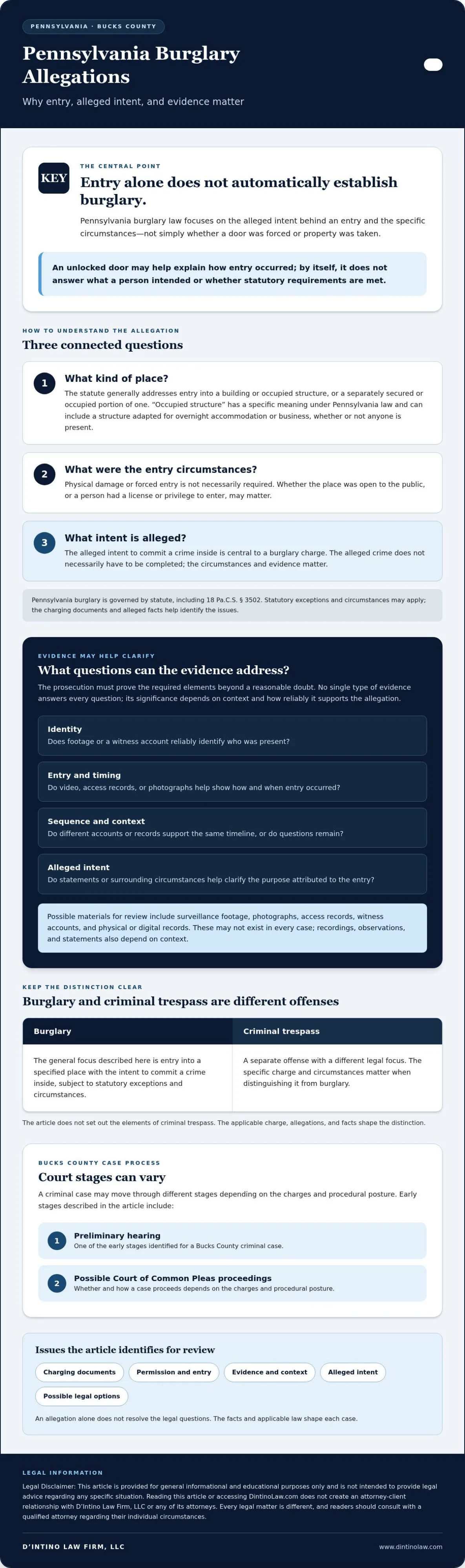
Hearing “burglary” or “breaking and entering” can leave you wondering what the accusation means, especially if no door was forced and nothing was taken. In Pennsylvania, the charge is governed by statute, not by the everyday phrase. Under 18 Pa.C.S. § 3502, the alleged intent and circumstances of entry matter. Entry alone does not automatically establish burglary.
In brief: Pennsylvania burglary generally involves entering a building or occupied structure, or a separately secured or occupied portion of one, with the intent to commit a crime inside, subject to statutory exceptions and circumstances. Whether the law applies depends on the specific allegations and facts.
What Pennsylvania’s burglary statute generally addresses
The statute focuses on the alleged purpose behind the entry. It also accounts for circumstances such as whether the place was open to the public or the person had a license or privilege to enter. “Occupied structure” has a specific meaning under Pennsylvania law. It can include a structure adapted for overnight accommodation or business, whether or not anyone is present at the time.
The general idea of burglary can vary across legal systems, so a broad overview is not a substitute for Pennsylvania’s statutory language. The charging documents and alleged facts help identify which part of the statute may be relevant.
Does burglary always require breaking in or taking property?
No physical damage or forced entry is necessarily required for a burglary allegation. The phrase “breaking and entering” can be misleading because the statute is not limited to breaking a lock or window. The alleged crime inside also does not necessarily have to be completed. The question may be whether the person entered with the required intent, rather than whether the intended act succeeded.
Entry by itself does not automatically amount to burglary. Permission, the nature of the location, and evidence of intent can all matter. For example, an unlocked door may help explain how entry occurred, but it does not, by itself, answer what the person intended or whether the statutory requirements are met.
For someone considering a breaking and entering defense lawyer Bucks County, these distinctions are a starting point, not a conclusion about a particular allegation. An attorney can review how the charge is framed and assess the facts and applicable law. This section provides general information about Pennsylvania law, not an individualized legal assessment.
Which Facts and Evidence May Matter in a Bucks County Burglary Case?
A burglary allegation involves more than the label in a charging document. Under Pennsylvania law, the prosecution must prove the required elements beyond a reasonable doubt. The evidence may raise questions about who entered, whether entry was authorized, and what the person allegedly intended. No single type of evidence answers every question. Its significance depends on context and how reliably it supports the allegation.
Evidence that may help establish the sequence of events
Depending on the case, investigators or attorneys may review surveillance footage, photographs, access records, witness accounts, or physical and digital records. Each source may shed light on a particular issue:
- Identity: Does footage or a witness account reliably identify who was present?
- Entry and timing: Do video, access records, or photographs help show how and when entry occurred?
- Sequence and context: Do different accounts or records support the same timeline, or do questions remain?
- Intent: Do statements or surrounding circumstances help clarify the purpose the prosecution attributes to the entry?
These materials may not exist in every case, and evidence can be incomplete or open to different interpretations. A recording’s quality, a witness’s opportunity to observe, and the context of a statement can affect how much weight the information deserves. Whether particular evidence may be used in court is a separate legal question that depends on the circumstances.
How permission, intent, and property type may become disputed
Under 18 Pa.C.S. § 3502, the alleged intent to commit a crime inside is central to a burglary charge. Intent cannot be assumed from entry alone. It must be evaluated against the evidence and applicable law. The prosecution’s account of a person’s purpose may be considered alongside the surrounding circumstances, including statements and the timeline.
Permission or a claimed right to enter may also be relevant. Messages, access arrangements, or witness accounts could help clarify what authorization existed, if any. The property’s classification matters, too. Pennsylvania’s statute refers to a “building or occupied structure,” a term with a statutory definition that can include certain places used for overnight accommodation or business. The location’s actual use and circumstances may therefore need review.
A breaking and entering defense lawyer Bucks County may assess how the evidence relates to each allegation, including its reliability, context, and potential admissibility. For information about Pennsylvania criminal defense, D’Intino Law Firm, LLC serves clients in Bucks County. A conversation with counsel can help clarify general questions. It does not guarantee a particular outcome or, by itself, create an attorney-client relationship.
Burglary vs. Criminal Trespass in Pennsylvania: What Is the Difference?
In Pennsylvania, burglary and criminal trespass are separate offenses under 18 Pa.C.S. §§ 3502 and 3503. The everyday phrase “breaking and entering” does not determine which charge applies. One alleged event may raise different legal questions depending on the allegations, evidence, and charging decisions.
Burglary, § 3502: The statute generally focuses on entry with intent to commit a crime inside, subject to statutory exceptions.
Criminal trespass, § 3503: The statute generally addresses entering or remaining in a place knowing there is no license or privilege to do so, along with other conduct specified in the law.
For either charge: The specific statutory subsection, evidence, and circumstances require careful legal review.
How Pennsylvania law distinguishes burglary from criminal trespass
The offenses have distinct statutory elements. For burglary, the alleged intent at the time of entry is a central issue. Criminal trespass generally focuses on knowingly entering or remaining without permission or another legal privilege. Section 3503 also separately addresses “breaking into” a building or occupied structure, using statutory criteria about how entry was gained.
Evidence about authorization may be relevant to a trespass allegation, while evidence about the alleged purpose of entry may be central to burglary. Which questions matter depends on the charge and facts. An allegation alone does not establish that either offense occurred.
Why charge grading and potential consequences require verification
Pennsylvania burglary grading can depend on statutory circumstances, including the structure’s use, whether someone was present in certain situations, and whether the alleged intent involved a controlled substance. Criminal trespass has its own categories and grading provisions. The phrase “breaking and entering” alone does not identify the applicable grading or establish potential consequences.
For current statutory language, consult the Pennsylvania General Assembly’s statutes, including §§ 3502 and 3503. Counsel can review the specific charging documents and evidence. Someone seeking a breaking and entering defense lawyer Bucks County can also explore Pennsylvania criminal defense information from D’Intino Law Firm, LLC. General website information does not create an attorney-client relationship.
What Happens After a Burglary Arrest or Charge in Bucks County?
A burglary accusation can bring unfamiliar paperwork and court terms. In Bucks County, criminal cases generally begin in a Magisterial District Court. Felony cases that proceed beyond the early stage may move to the Bucks County Court of Common Pleas in Doylestown. The path and timing depend on the charges, procedural posture, and circumstances.
Early steps and initial court proceedings
After an arrest or filing of charges, an initial court appearance may address the charges and bail. A preliminary hearing in Magisterial District Court generally gives a judge an opportunity to consider whether the prosecution has presented enough evidence for the case to proceed. If charges are held for court, a felony case may continue in the Court of Common Pleas. Later proceedings can include formal arraignment, pretrial matters, and, if the case proceeds, trial. The steps in a particular case can vary.
Court paperwork can identify the allegations and scheduled dates. The specific instructions and next steps depend on the documents and circumstances of the case.
Preparing to discuss the allegation with a defense attorney
For a confidential discussion, available paperwork and a personal timeline may help counsel understand the case’s procedural stage and identify questions to review. An attorney can explain possible procedural options based on the circumstances. Contacting a firm or having an initial conversation does not, by itself, create an attorney-client relationship.
Do not alter or destroy potential evidence, or contact witnesses to discuss or influence their accounts. Raise questions about evidence or communications with counsel.
For broader information about criminal defense in Pennsylvania, see the firm’s Pennsylvania criminal defense overview. If you’re looking for a breaking and entering defense lawyer Bucks County, you may contact D’Intino Law Firm, LLC to discuss your concerns. An attorney can review the circumstances and explain potential next steps without promising a particular result.
How a Breaking and Entering Defense Lawyer in Bucks County Can Review Your Options
A charge labeled “breaking and entering” may leave important questions unanswered. A lawyer can review the charging documents, the specific Pennsylvania statutes cited, and the stage of the case. Counsel may also assess how the available evidence relates to the alleged entry, permission, intent, and property classification. Those issues can inform a discussion of possible legal options, but no particular argument or outcome can be assumed in advance.
D’Intino Law Firm, LLC serves clients in Bucks County. The firm states that Attorney John D’Intino Jr. works directly with clients, giving a person an opportunity to discuss the allegations and process with the attorney handling the matter.
Questions to ask during a consultation
A consultation can help you understand what needs further review. Consider asking which allegations and statutes appear in the paperwork, what evidence or procedural issues counsel would want to examine, and what steps may follow at the current stage. You can also ask how the firm handles communication, fees, and next steps. The answers depend on the matter, and no single approach fits every case.
A measured next step for a Bucks County allegation
An attorney can evaluate the circumstances and explain potential options without predicting a result. If the paperwork identifies a felony charge, the firm’s felony defense overview may provide broader information. D’Intino Law Firm, LLC offers free consultations, according to its materials. You may contact the firm to discuss your concerns. Reaching out does not guarantee representation or create an attorney-client relationship by itself.
Legal Disclaimer: This article is provided for general informational and educational purposes only and is not intended to provide legal advice regarding any specific situation. Reading this article or accessing DintinoLaw.com does not create an attorney-client relationship with D’Intino Law Firm, LLC or any of its attorneys. Every legal matter is different, and readers should consult with a qualified attorney regarding their individual circumstances.
Take a Clear Next Step
Pennsylvania burglary allegations turn on statutory elements and evidence, not just the phrase “breaking and entering.” Questions about intent, permission, the property, and the court process may all need careful review. The distinction between burglary and criminal trespass can also depend on the specific allegations and applicable law.
If you’re searching for a breaking and entering defense lawyer Bucks County, D’Intino Law Firm, LLC serves clients in Bucks County and communities including Philadelphia, Media, West Chester, Conshohocken, Lower Merion, Upper Darby, Gladwyne, Drexel Hill, Ardmore, Blue Bell, Montgomery County, Bucks County, Delaware County, Lancaster County, and Lehigh. Attorney John D’Intino Jr. has more than two decades of experience, according to firm materials, and the firm offers free consultations. A conversation can help you raise questions about your circumstances and learn what further review may involve, without a promise of any particular result.
Contact D’Intino Law Firm, LLC to discuss a Pennsylvania criminal defense concern. Understanding the allegations and process can help you approach the next steps with greater clarity.
Legal Disclaimer: This article is provided for general informational and educational purposes only and is not intended to provide legal advice regarding any specific situation. Reading this article or accessing DintinoLaw.com does not create an attorney-client relationship with D’Intino Law Firm, LLC or any of its attorneys. Every legal matter is different, and readers should consult with a qualified attorney regarding their individual circumstances.
Frequently Asked Questions
Is breaking and entering the same as burglary in Pennsylvania?
Not exactly. “Breaking and entering” is a common phrase, while Pennsylvania law identifies burglary under 18 Pa.C.S. § 3502. The statute generally focuses on entering a building or occupied structure with the intent to commit a crime inside, subject to statutory exceptions. Physical force or damage is not required in every burglary allegation. The specific charge and facts matter, so the phrase alone does not establish which offense applies.
Can you be charged with burglary in Pennsylvania without taking anything?
Yes, an allegation can involve burglary even if nothing was taken. Pennsylvania’s burglary statute focuses in part on the alleged intent to commit a crime inside, not only on whether that crime was completed. That does not mean every entry is burglary. The prosecution must prove the applicable statutory elements, and the circumstances, evidence, and any exceptions in the law may matter when assessing the charge.
What is the difference between burglary and criminal trespass in Pennsylvania?
Burglary under 18 Pa.C.S. § 3502 generally concerns entry with intent to commit a crime inside, subject to statutory exceptions. Criminal trespass under § 3503 generally addresses entering or remaining where a person knows they lack a license or privilege, along with other conduct covered by that statute. The offenses are not interchangeable. The subsection charged, alleged intent, permission, entry circumstances, and evidence all require case-specific legal review.
What happens after a burglary arrest in Bucks County?
A criminal case may begin with proceedings in a Magisterial District Court, including an initial appearance and, where applicable, a preliminary hearing. If a felony case proceeds, it may move to the Bucks County Court of Common Pleas in Doylestown for further proceedings. The sequence and timing depend on the charges and case circumstances. Court paperwork identifies scheduled dates and allegations, but an attorney can explain how they relate to a specific case.
What evidence may matter in a Pennsylvania burglary case?
Potentially relevant evidence may include surveillance footage, photographs, access records, witness accounts, statements, or physical and digital records, if available. These sources may raise questions about identity, permission, timing, entry, or alleged intent. Their reliability, context, and potential admissibility can matter. A recording or account does not automatically resolve a disputed fact. Counsel can assess how the available material relates to the statutory elements and specific allegations.
Can a burglary charge be reduced or dismissed in Bucks County?
A charge’s outcome depends on the facts, evidence, applicable law, and procedural posture. Depending on those circumstances, legal issues may affect how allegations are evaluated, but no reduction or dismissal can be predicted or promised. A lawyer can review the charging documents, statutory elements, and available evidence, then explain potential options. General information cannot determine whether a particular charge should change or what result a court may reach.
Should I speak with a Bucks County burglary defense lawyer?
Speaking with counsel can help clarify what the charging paperwork alleges, which Pennsylvania statutes are cited, and what evidence or court steps may need review. If you’re looking for a breaking and entering defense lawyer Bucks County, D’Intino Law Firm serves Bucks County and offers free consultations, according to its materials. A consultation does not guarantee representation or a particular outcome, and contacting a firm alone does not create an attorney-client relationship.
Disclaimer
Legal Disclaimer: The information provided on DintinoLaw.com, including articles, blog posts, testimonials, case results, and other content, is for general informational and educational purposes only and does not constitute legal advice or create an attorney-client relationship with D’Intino Law Firm, LLC or any of its attorneys. Visiting this website, submitting a contact form, sending an email, calling, texting, or otherwise communicating with the firm does not establish an attorney-client relationship or obligate the firm to represent you. Do not submit confidential, privileged, or time-sensitive information through this website or electronic communications unless and until the firm has expressly agreed to represent you. Legal rights, procedures, statutes of limitation, filing deadlines, and other requirements vary based on the facts and jurisdiction and may change over time; nothing on this website should be relied upon to determine whether a legal deadline applies to your matter. If you have an urgent legal matter or a potential filing deadline, consult a qualified attorney promptly. Testimonials and statements regarding client experiences are individual opinions and experiences and are not a guarantee of future results. Prior results, verdicts, settlements, or case examples do not guarantee or predict the outcome of any future case, and every matter is different. This website may constitute attorney advertising under applicable Pennsylvania rules. D’Intino Law Firm, LLC makes no representation that the information on this website is complete, current, or applicable to your particular circumstances. For legal advice concerning your specific situation, consult directly with a qualified Pennsylvania attorney. D’Intino Law Firm, LLC | Philadelphia, Pennsylvania | DintinoLaw.com
