


Attorney
You walk out to your backyard on a Saturday morning only to find your neighbor’s new fence sitting two feet inside your property line. It’s a frustrating moment that immediately transforms a peaceful home into a source of anxiety and legal confusion. Most homeowners in Pennsylvania view their land as their most significant investment; seeing that investment threatened by an encroachment is deeply unsettling. Consulting a boundary dispute lawyer West Chester residents trust ensures you don’t have to choose between keeping the peace and protecting what you’ve worked hard to build.
This article provides the insights needed to resolve complex property line conflicts in West Chester with strategic legal guidance and professional advocacy. We’ll explain how to address Pennsylvania property laws, the mechanics of the 21-year adverse possession rule, and the steps required to remove encroachments or secure a quiet title. By exploring these trial-ready strategies, you can move toward a clear determination of your property lines and safeguard your investment.
Key Takeaways
- Recognize common conflict triggers, such as new fences or landscaping projects, that often lead to property line disagreements.
- Understand how Pennsylvania legal doctrines, including the “Consentable Line” theory, can change property boundaries over time based on usage.
- Learn why a professional boundary survey is the only reliable way to establish legal facts when old mortgage surveys or plot plans fail.
- Discover how a boundary dispute lawyer Chester County homeowners trust can use formal demand letters to resolve encroachments efficiently.
- Gain a clear roadmap for removing encroachments and protecting your property’s long-term value through trial-ready advocacy.
Common Property Line and Boundary Disputes in Chester County
A boundary dispute occurs when two neighbors cannot agree on where one property ends and the other begins. In Chester County, these conflicts often stem from historical deed descriptions that are vague, outdated, or rely on landmarks that no longer exist. When you realize that your neighbor’s new driveway actually sits on your land, it’s more than a minor annoyance; it’s a direct threat to your property rights. Consulting a boundary dispute lawyer Chester County residents trust ensures you have an advocate to clarify these lines before a minor disagreement turns into a permanent loss of land.
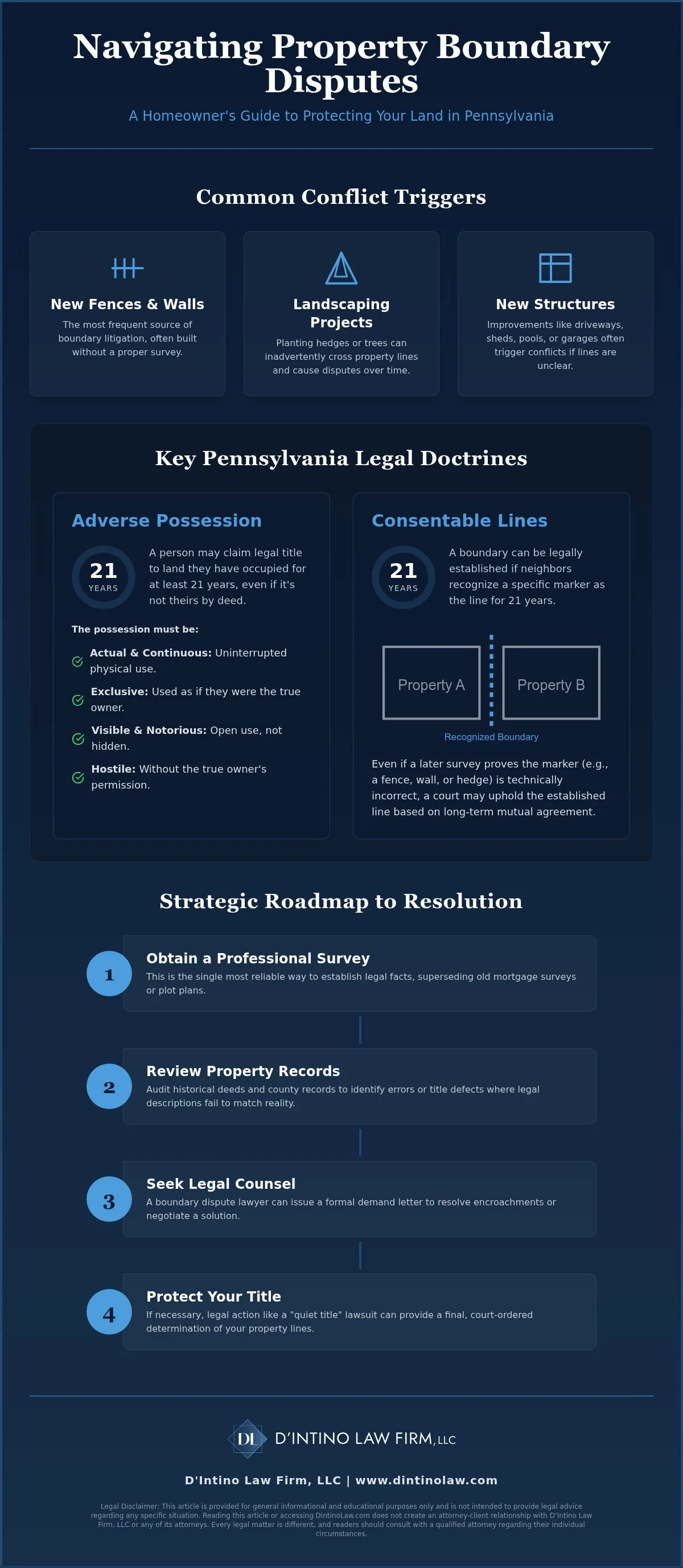
Most disputes are triggered by active improvements or changes to the landscape. A homeowner installs a pool, builds a shed, or plants a line of privacy hedges. Without a fresh survey, these projects often cross invisible lines. These issues don’t just affect your relationship with your neighbor. They can stall a home sale or lower your property’s market value, as title insurance companies and mortgage lenders require clear, unencumbered boundaries before approving a transaction.
Encroachments and Physical Trespass
An encroachment happens when a physical structure or improvement crosses the property line. This includes permanent structures like garages or retaining walls, but it also covers smaller items like sheds or play sets. Pennsylvania law also addresses natural encroachments, such as tree branches or root systems that extend over a line. If a neighbor uses your land openly and continuously for a long period, they might eventually claim ownership through adverse possession. In Pennsylvania, this typically requires 21 years of actual, hostile, and continuous possession. Distinguishing between a temporary encroachment, like a movable wood pile, and a permanent one, like a concrete foundation, is essential for a boundary dispute lawyer Chester County homeowners rely on to determine the right legal strategy.
Fence and Retaining Wall Conflicts
Fences are the most common source of boundary litigation in local townships. Pennsylvania property owners sometimes deal with “spite fences,” which are structures built solely to annoy a neighbor or block their view. Local ordinances in Chester County townships often set specific height restrictions and setback requirements for these structures. Additionally, maintenance of a boundary fence is often a shared responsibility, but disputes arise when one party refuses to pay or builds the fence entirely on the wrong side of the line. If a retaining wall is failing and it sits on a disputed line, the question of who’s responsible for repairs becomes a high-stakes legal battle that requires clear evidence of ownership.
Legal Grounds for Resolving Property Conflicts in Pennsylvania
Resolving a property line conflict in Pennsylvania requires a deep understanding of state statutes and common law doctrines. While your deed is the starting point, it isn’t always the final word on where your ownership ends. Errors in historical surveys or mistakes in the Chester County Property Records can create title defects that haunt homeowners for decades. A boundary dispute lawyer Chester County residents rely on can audit these documents to identify where the legal description fails to match the reality on the ground.
Adverse Possession and Consentable Lines
In Pennsylvania, the law recognizes that long-term use can eventually lead to legal ownership. Under the doctrine of adverse possession, a person may claim title to land if they’ve occupied it for at least 21 years. This possession must be actual, continuous, exclusive, visible, notorious, and hostile. “Hostile” doesn’t mean a physical fight; it simply means using the land without the true owner’s permission. If you’ve been paying taxes on a strip of land that your neighbor has fenced in for over two decades, you may be facing a high-stakes legal challenge to your title.
The doctrine of consentable lines is a related but distinct concept. This theory allows a boundary to be established if both neighbors have recognized a specific marker, like a stone wall or a hedge, as the dividing line for 21 years. Even if a professional survey later proves the line is technically incorrect, the court may uphold the established boundary based on this long-term mutual acquiescence. Understanding these timelines is critical when you consult with a real estate attorney about your specific situation.
Easements and Rights of Way
An easement gives someone the legal right to use a portion of your land for a specific purpose without owning it. Express easements are typically recorded in your deed and are easy to identify. However, prescriptive easements are more complex. These are created through continuous use over 21 years, similar to adverse possession, but they only grant a right to use the land rather than full ownership. Utility easements are also common across Chester County, allowing companies to maintain power lines or pipes. If a neighbor claims they have a right to drive across your lawn because “it’s always been done that way,” you need a boundary dispute lawyer Chester County homeowners trust to verify if that right actually exists in the eyes of the law.
The Importance of Surveys and Chester County Property Records
Many homeowners rely on a “mortgage survey” or a basic plot plan received during their home closing. These documents are often insufficient for resolving a real conflict. A mortgage survey is designed to protect the lender’s interest, not to establish precise boundaries for legal disputes. When you face an encroachment, you need a professional boundary survey that stands up in court. A boundary dispute lawyer Chester County residents trust will often begin by recommending a licensed surveyor to locate physical markers, such as iron pins or concrete monuments, that define your land.
Title insurance is another critical factor that homeowners often misunderstand. Most standard policies contain “survey exceptions,” which means they won’t cover boundary issues that a current survey would have revealed. However, if an error exists within the recorded public record itself, you might have a claim. Understanding these technical nuances ensures you aren’t fighting a legal battle with incomplete information or false expectations about your insurance coverage.
Commissioning a Professional Boundary Survey
A professional survey involves more than just looking at a map. The surveyor researches historical records and then physically locates markers on the property. They look for “metes and bounds,” which are descriptions that use directions and distances to outline the perimeter. If those markers are missing, they use neighboring properties and historical evidence to reset them. This data is vital for compliance with Pennsylvania property line and fence laws. A stake survey, where markers are physically placed in the ground, provides the visual evidence needed to show a neighbor exactly where they’ve crossed the line.
Reviewing Local Deeds and Historical Records
Property records in Chester County are managed by the Recorder of Deeds. The county updated its fee schedule on December 1, 2025, reflecting the ongoing administrative importance of accurate land documentation. If your deed contains a clerical error or an ambiguous description, it creates a title defect that must be corrected. A boundary dispute lawyer Chester County homeowners hire can perform a deep dive into the county index. This search identifies discrepancies between your current deed and historical “parent” tracts. By tracing the chain of title, an attorney can pinpoint exactly when a boundary description became skewed, providing the leverage needed for a resolution.
Strategic Steps to Resolve a Boundary Dispute
Resolving a property line conflict requires a methodical approach that balances firm advocacy with practical solutions. While an informal chat over the fence is often the logical first step, these “neighborly” discussions frequently fail when emotions run high or property values are at stake. If a neighbor dismisses your survey results or continues to build on your land, you must shift from casual conversation to a structured legal strategy. A boundary dispute lawyer Chester County residents trust can help you regain control of the situation by moving the conflict from your backyard into a formal legal framework.
Mediation is another effective tool in Pennsylvania for homeowners who want to avoid the high costs of a full trial. This process involves a neutral third party who helps both neighbors reach a voluntary agreement. It’s often faster than litigation and allows for creative solutions, such as land swaps or shared maintenance agreements, that a judge might not have the authority to grant. However, mediation only works if both parties are willing to act in good faith. If your neighbor remains combative, you need a strategy that prepares for the courtroom while pursuing every available path to a settlement.
Negotiation and Demand Letters
A formal demand letter drafted by an attorney is often the catalyst for a resolution. This document serves as a professional notice that you’re prepared to defend your property rights. It outlines the specific legal grounds for your claim, references the relevant survey data, and sets a clear deadline for the removal of any encroachments. In many cases, this letter prompts the other party’s insurance company or attorney to take the matter seriously. We often use this stage to propose boundary line agreements or license agreements. These recorded documents can resolve the dispute by clearly defining the line in the public record, ensuring that future buyers don’t inherit the same conflict.
Filing a Quiet Title or Ejectment Action
When negotiations stall, litigation in the Chester County Court of Common Pleas becomes the necessary path forward. In Pennsylvania, homeowners typically pursue a Quiet Title action or an Ejectment action. A Quiet Title action asks a judge to “quiet” any competing claims and legally confirm your ownership of the disputed strip of land. This is vital for maintaining a clean title and ensuring your property remains sellable. An Ejectment action is the specific legal vehicle used to force the physical removal of a structure, such as a fence, driveway, or shed, that sits on your land. These proceedings require precise evidence and a “fighter” mentality to protect your investment. If you’re facing a neighbor who refuses to budge, you should consult with a trial-ready real estate attorney to discuss your litigation options.
How D’Intino Law Firm Advocates for Chester County Homeowners
When property lines become battlegrounds, the right legal partner makes the difference between a resolved issue and a permanent loss of land value. You need a boundary dispute lawyer Chester County residents can trust for aggressive, trial-ready representation. D’Intino Law Firm, LLC brings a “fighter” mentality to every case, ensuring that your largest investment is protected from encroachments and title defects. Our experience extends beyond local townships to our work as a real estate lawyer Philadelphia residents rely on, providing a broad perspective on Pennsylvania property litigation and the nuances of regional land records.
A Hands-On Approach to Real Estate Litigation
Large law firms often hand off complex property files to junior associates who lack the experience to handle high-stakes conflicts. We operate differently. Attorney John D’Intino Jr. handles every case personally, offering over 20 years of legal experience to every client. This boutique experience ensures that you are a priority, not just another case number. We understand the unique landscape of Pennsylvania real estate law, from the rolling hills of Chester County to the dense urban parcels of surrounding counties. Our firm prioritizes strategic planning that accounts for specific township zoning updates and the localized procedures of the Chester County Court of Common Pleas.
By maintaining a focused caseload, we provide the personalized attention necessary for complex boundary issues. We dig deep into historical “metes and bounds” descriptions and audit title reports to find the leverage your case needs. This hands-on advocacy is designed to resolve disputes efficiently while remaining ready to defend your rights in a courtroom if a neighbor refuses to act in good faith.
Consult with a Chester County Real Estate Attorney
Facing a boundary conflict is stressful, but you don’t have to navigate it alone. A professional case evaluation helps you understand the strength of your position and the potential risks of your specific situation. Whether you’re dealing with a residential encroachment or a complex easement issue, we offer a guiding presence to help you regain control. We focus on practical outcomes, such as the clear determination of property lines or the removal of unauthorized structures, while keeping you informed at every stage of the legal journey.
If you’re ready to protect your property and your peace of mind, we invite you to contact D’Intino Law Firm, LLC regarding your legal concerns. Our team is dedicated to providing the elite, tailored service you deserve during this challenging time.
Legal Disclaimer: This article is provided for general informational and educational purposes only and is not intended to provide legal advice regarding any specific situation. Reading this article or accessing DintinoLaw.com does not create an attorney-client relationship with D’Intino Law Firm, LLC or any of its attorneys. Every legal matter is different, and readers should consult with a qualified attorney regarding their individual circumstances.
Secure Your Property’s Future Today
Protecting your land in Pennsylvania requires a proactive approach and a clear understanding of your legal standing. Resolving these conflicts involves analyzing historical deeds, commissioning precise surveys, and applying strategic pressure through formal demand letters. If you’re facing a property line conflict, hiring a boundary dispute lawyer Chester County homeowners trust is the most effective way to safeguard your investment and ensure your title remains clear for future resale.
Attorney John D’Intino Jr. brings over 20 years of legal experience to every case, providing the direct attorney-client interaction you need during high-stakes situations. We personally handle every matter across Chester, Montgomery, and Philadelphia Counties with a fighter mentality and a focus on practical results. You don’t have to face neighbor disputes alone. If you’re ready to resolve your property concerns, contact D’Intino Law Firm, LLC today for a professional consultation. We’re here to help you protect what you’ve built.
Legal Disclaimer: This article is provided for general informational and educational purposes only and is not intended to provide legal advice regarding any specific situation. Reading this article or accessing DintinoLaw.com does not create an attorney-client relationship with D’Intino Law Firm, LLC or any of its attorneys. Every legal matter is different, and readers should consult with a qualified attorney regarding their individual circumstances.
Frequently Asked Questions
How long do I have to file a boundary dispute claim in Pennsylvania?
In Pennsylvania, the timeframe depends on the nature of your legal claim. If you’re defending against a neighbor’s attempt to take your land, the critical period is 21 years under adverse possession or consentable line doctrines. However, for claims involving physical damage or trespass, the statute of limitations is typically two years. You should act quickly to prevent a temporary encroachment from becoming a permanent legal right.
Can my neighbor claim my land if they have used it for years?
Yes, a neighbor can potentially claim ownership of your land through a doctrine known as adverse possession. In Pennsylvania, they must prove they’ve used the property openly, notoriously, exclusively, and continuously for at least 21 years. This use must also be hostile, meaning it occurred without your permission. Consulting a boundary dispute lawyer Chester County property owners trust can help you interrupt this timeline before the legal 21-year requirement is met.
Does title insurance cover property line disputes in Chester County?
Standard title insurance policies in Pennsylvania often exclude boundary disputes through what’s called a survey exception. This means the insurance company won’t cover issues that a current, accurate survey would’ve revealed. However, if the dispute arises from a clerical error in the official county records or if you purchased an enhanced policy, you might have coverage. It’s vital to have an attorney review your specific policy to determine your rights.
Is a fence considered a legal property boundary in PA?
A fence is not automatically a legal boundary in Pennsylvania just because it exists. However, if both neighbors treat a fence as the dividing line for at least 21 years, it can become the legal boundary under the doctrine of consentable lines. This applies even if a professional survey later shows the fence is in the wrong place. If the fence is new, it doesn’t establish a legal boundary without a corresponding agreement.
What is a Quiet Title action and when is it necessary?
A Quiet Title action is a specific type of lawsuit used to establish a party’s title to real property against anyone else who might claim an interest. It’s necessary when there are conflicting deed descriptions or when a neighbor claims ownership through adverse possession. By obtaining a court order, you quiet all other claims, ensuring your title is clear for future sales or refinances within the Pennsylvania court system.
Do I need a new survey if I already have one from when I bought the house?
You likely need a new survey if your existing one is a mortgage survey or a basic plot plan. These older documents are often not precise enough to resolve a physical encroachment or a legal dispute in court. A fresh boundary survey performed by a licensed professional will locate current markers and iron pins. This provides the trial-ready evidence a boundary dispute lawyer Chester County residents hire needs to build a strong case.
How much does it cost to hire a boundary dispute lawyer?
Legal fees for property disputes in Pennsylvania vary based on the complexity of the case and whether it requires litigation. Some matters can be resolved through a simple demand letter or a boundary agreement, while others require a full trial. We offer free consultations and flexible payment options to ensure you receive personalized attention. Our firm focuses on trial-ready representation to protect your property rights and your investment efficiently.
What happens if my deed description is different from my neighbor’s deed?
When deed descriptions conflict, it creates a legal overlap or a gap that must be resolved through a chain of title search. This often happens in older parts of Pennsylvania where deeds rely on outdated landmarks. An attorney will trace both properties back to their original parent tracts to see which deed contains the error. If neighbors can’t agree on a correction, a judge may have to decide based on historical evidence.
If you are facing a property line conflict, we invite you to contact D’Intino Law Firm, LLC regarding your legal concerns. Our team is ready to provide the dedicated advocacy and professional guidance you need to protect your property rights.
Legal Disclaimer: This article is provided for general informational and educational purposes only and is not intended to provide legal advice regarding any specific situation.
Disclaimer
Legal Disclaimer: The information provided on DintinoLaw.com, including articles, blog posts, testimonials, case results, and other content, is for general informational and educational purposes only and does not constitute legal advice or create an attorney-client relationship with D’Intino Law Firm, LLC or any of its attorneys. Visiting this website, submitting a contact form, sending an email, calling, texting, or otherwise communicating with the firm does not establish an attorney-client relationship or obligate the firm to represent you. Do not submit confidential, privileged, or time-sensitive information through this website or electronic communications unless and until the firm has expressly agreed to represent you. Legal rights, procedures, statutes of limitation, filing deadlines, and other requirements vary based on the facts and jurisdiction and may change over time; nothing on this website should be relied upon to determine whether a legal deadline applies to your matter. If you have an urgent legal matter or a potential filing deadline, consult a qualified attorney promptly. Testimonials and statements regarding client experiences are individual opinions and experiences and are not a guarantee of future results. Prior results, verdicts, settlements, or case examples do not guarantee or predict the outcome of any future case, and every matter is different. This website may constitute attorney advertising under applicable Pennsylvania rules. D’Intino Law Firm, LLC makes no representation that the information on this website is complete, current, or applicable to your particular circumstances. For legal advice concerning your specific situation, consult directly with a qualified Pennsylvania attorney. D’Intino Law Firm, LLC | Philadelphia, Pennsylvania | DintinoLaw.com
