


Attorney
Can bail be reconsidered while a criminal case is still pending? If someone remains in custody because they can’t meet bail, that uncertainty can weigh heavily on them and their family. A bail reduction hearing lawyer Montgomery County defendants consult can explain how a request may proceed under Pennsylvania law. A court may consider a supported request, but no particular outcome is assured.
It’s reasonable to wonder what a judge may want to know and whether the process changes as a case moves forward. Pennsylvania Rule of Criminal Procedure 529 addresses who may modify bail at different stages of a case. The circumstances behind the current bail order, the person’s situation, and information supporting a proposed change may all matter, depending on the case.
This article explains the general bail-modification process in Montgomery County, the kinds of information that may be relevant at a hearing, and how counsel can help prepare a case-specific request. Attorney John D’Intino Jr. works directly with clients to discuss their circumstances and explain the legal issues involved, without promising a reduction or release.
Key Takeaways
- A bail reduction hearing asks the court to reconsider existing bail terms; it doesn’t guarantee a reduction or release.
- Who may consider a bail modification request can depend on where the case stands in Pennsylvania’s criminal process.
- Accurate information about residence, support, and other circumstances may help counsel assess what could be relevant to a request.
- A bail reduction hearing lawyer Montgomery County residents consult can review the bail order, procedural posture, and potential legal options.
- Understanding the hearing process can help you prepare questions for counsel without assuming what the court will decide.
What a Montgomery County bail reduction hearing can, and cannot, decide
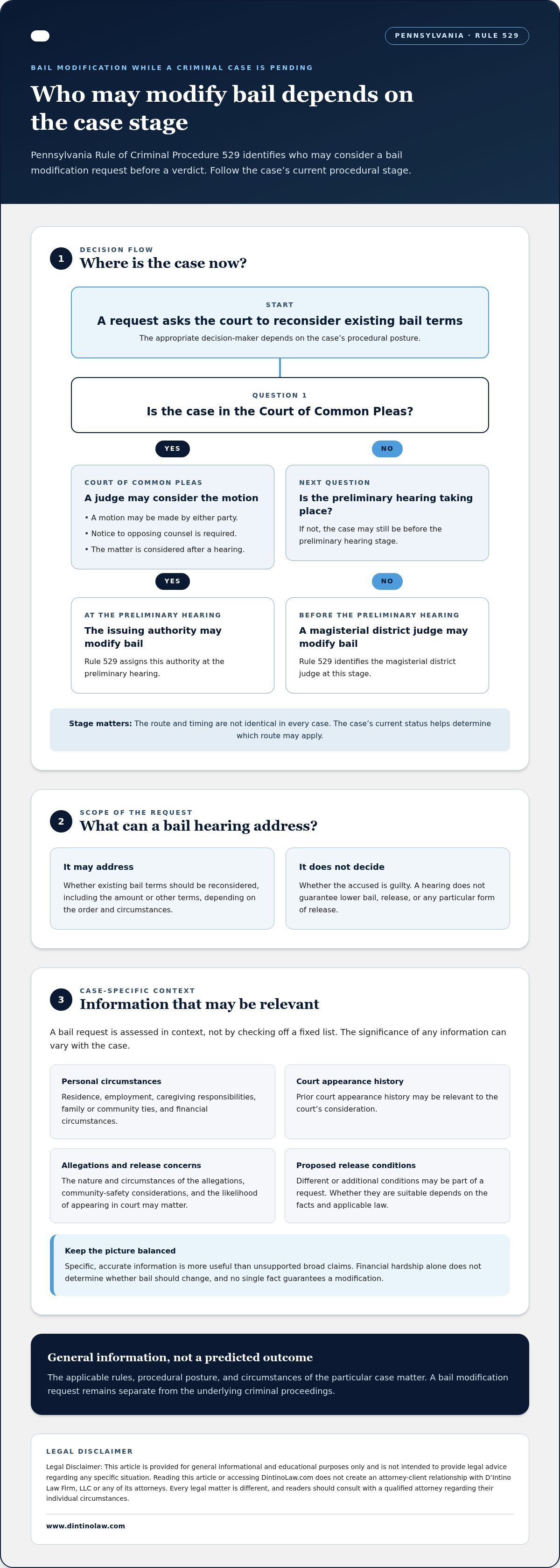
Can a court reconsider bail while a criminal case is pending? Pennsylvania law provides a process for seeking a change to an existing bail order, but whether a request is available and what happens next depend on the case’s procedural stage, facts, and applicable rules. A hearing can address bail terms. It does not decide whether the accused is guilty or guarantee lower bail, release, or any particular form of release.
In practical terms, a bail reduction hearing is a proceeding to ask the appropriate judicial officer to reconsider existing bail conditions. Depending on the order and circumstances, the request may concern the amount or other terms. A general overview of how bail systems operate appears in Bail in the United States, but Pennsylvania’s rules govern a Pennsylvania criminal case.
How a bail modification request differs from an initial bail decision
An initial bail decision sets terms earlier in the case. A modification request asks the authorized court or judicial officer to revisit an order already in place. Pennsylvania Rule of Criminal Procedure 529 addresses who may modify bail before a verdict. Before the preliminary hearing, a magisterial district judge may modify bail; at the preliminary hearing, the issuing authority may do so. After the case is in the Court of Common Pleas, a judge may modify bail on a motion by either party, with notice to opposing counsel and after a hearing.
These stages matter. The route and timing aren’t identical for every person, and the case’s current status can affect where a request belongs. A bail modification request also remains separate from the underlying criminal proceedings. It doesn’t resolve the charges or determine the eventual outcome.
Why Montgomery County court context matters
For a case pending in Montgomery County, the proper decision-maker depends on its procedural posture. Before the case reaches the Court of Common Pleas, the authority described in Rule 529 may rest with a magisterial district judge or the issuing authority. Once the case is in the Court of Common Pleas, the rule provides for a judge of that court to consider a modification motion under its stated conditions. The case’s current status determines which route may apply.
A bail reduction hearing lawyer Montgomery County residents consult can review the existing order and procedural posture, then explain the legal options that may apply. This is general information about Pennsylvania procedure, not advice for an individual case. The court’s decision depends on the circumstances and applicable law, and no hearing guarantees a change in bail or release.
Which facts may matter in a Pennsylvania bail reduction request?
A bail request is assessed in context, not by checking off a fixed list. Pennsylvania law and court rules identify considerations that may inform bail decisions, but no single fact guarantees a change. The Pennsylvania General Rules for Bail provide statutory context; the applicable rules and the particular case matter too. Courts assess case-specific information about the accused, the allegations, and concerns relevant to release.
Personal circumstances and history that may be relevant
Information about a person’s residence, employment, caregiving responsibilities, family or community ties, and financial circumstances may help provide context. Prior court appearance history may also be relevant. These points aren’t a formula, and their significance can vary based on the case. Specific, accurate details are more useful than broad claims that aren’t supported by information.
Ability to pay may be part of the picture, but financial hardship alone doesn’t determine whether bail should change. A request can describe the person’s financial circumstances alongside other relevant considerations. There is no universal document checklist or guaranteed evidentiary formula for every request, so counsel can help identify what information is appropriate to present in the particular procedural setting.
The allegations, safety concerns, and proposed release terms
The nature and circumstances of the allegations may matter, along with considerations related to community safety and the likelihood that the person will appear in court. Those issues require careful, case-specific treatment. An allegation isn’t proof of guilt, and a bail proceeding doesn’t decide the criminal charges.
Pennsylvania’s rules allow courts to consider conditions of release as part of bail decisions. A proposal involving different or additional conditions may be relevant to a request, but whether any condition is suitable depends on the facts and applicable law. Suggesting terms doesn’t require the court to modify bail or release someone.
For a clear presentation, distinguish verified details from assumptions. For example, information about a stable residence or work can explain a person’s circumstances, while court appearance history provides a separate part of the picture. Neither point should be presented as decisive on its own.
A bail reduction hearing lawyer Montgomery County residents consult can review the bail order and assess which information may be relevant without treating any factor as a guaranteed path to a result. To discuss the circumstances with counsel, visit D’Intino Law Firm, LLC.
What happens at a Montgomery County bail reduction hearing?
The process depends first on where the criminal case stands. Pennsylvania Rule of Criminal Procedure 529 assigns authority to modify bail according to procedural stage. A case before a preliminary hearing, one being addressed at that hearing, and one already in the Court of Common Pleas may follow different routes. Filing and scheduling details depend on the specific case and applicable procedure.
Before the hearing: identify the court and procedural posture
A useful starting point is to review the current bail order and identify the case’s status. Before the preliminary hearing, a magisterial district judge may modify bail; at the preliminary hearing, the issuing authority may do so. After the case is in the Court of Common Pleas, Rule 529 provides for a judge of that court to consider a motion by either party, with notice to opposing counsel and after a hearing.
Those rule-based stages help identify the appropriate decision-maker, but they don’t establish every Montgomery County filing step or hearing date. The route and timing depend on procedural posture and the applicable process. Avoid relying on a generic filing deadline or assuming the same procedure applies to every case.
During and after the hearing: arguments and decision
At a hearing under Rule 529, the parties can address the request and the court considers the arguments under applicable law. Counsel may organize supportable information, explain why the existing terms are being challenged, and respond to concerns raised by the prosecution or the court. The prosecution may have an opportunity to respond under the applicable procedure, and hearing arrangements depend on the case.
Montgomery County-specific research offers helpful background on local bail practices. The Vera Institute of Justice’s report on Bail-Setting Practices in Montgomery County examines the county context, but a research report is not a substitute for the current order or rules governing an individual matter.
After considering the request, the court decides whether to leave the existing terms in place or modify them. If terms change, the court’s actual order controls what those terms are and what steps follow. The decision depends on the circumstances and applicable law, so no particular result can be predicted in advance.
A bail reduction hearing lawyer Montgomery County residents consult can help clarify the procedural stage and prepare for a case-specific discussion. Attorney John D’Intino Jr. works directly with clients on Pennsylvania criminal matters, helping them understand the issues without promising a particular decision.
How to prepare for a bail reduction hearing without risking your case
Careful preparation starts with accurate information and sound judgment about what to share. A bail request may involve personal circumstances and details connected to an active criminal case, so online checklists shouldn’t be treated as instructions for what to file or say. Counsel can help assess what information may be relevant and how to address it appropriately.
Information to organize for a conversation with counsel
If safely available, gather the current bail order and related case paperwork. You can also prepare a clear, factual summary of circumstances counsel may need to understand, such as residence, work, caregiving responsibilities, family or community support, and prior court appearances. These details may help counsel evaluate the situation, but they don’t guarantee a change in bail.
Share sensitive facts and documents privately with counsel rather than posting them online or circulating them broadly. A document that seems helpful may raise other legal or evidentiary questions. Don’t assume every record can be submitted or used at a hearing. Counsel can review the material in context.
What families can do while avoiding harmful assumptions
Family members may help by gathering accurate information about housing, practical support, or caregiving arrangements and sharing it with counsel. Their support can provide context, but it doesn’t control the court’s decision. Avoid making promises about what the judge will do or suggesting that any single fact assures release.
Protect the case. Don’t alter, hide, destroy, or withhold evidence. Family or friends also shouldn’t contact witnesses about what to say, pressure anyone, or try to coordinate accounts. Questions about communications or case-related information are best discussed privately with an attorney.
For broader context about Pennsylvania criminal defense, see Philadelphia criminal defense representation. A bail reduction hearing lawyer Montgomery County residents consult can review the order and circumstances directly with them. D’Intino Law Firm, LLC represents clients in Pennsylvania criminal matters, and Attorney John D’Intino Jr. works directly with clients. Readers can discuss a bail concern with the firm to learn about potential legal options. Reaching out does not itself create an attorney-client relationship.
How a Montgomery County bail reduction hearing lawyer can guide next steps
A bail order can leave important questions unanswered: which procedure applies, what information is relevant, and what options may be available at this stage of the case. A lawyer can review those issues in context, explain the process under Pennsylvania law, and help you understand what a request may involve. No attorney can promise how a court will decide.
What a case-specific legal review can address
A review may start with the existing bail order and the case’s procedural posture. Counsel can assess which court or judicial officer may have authority to consider a modification, what current rules apply, and whether the circumstances support discussing a request. That review can also help identify relevant information and potential concerns, rather than relying on a generic checklist.
An attorney can explain available legal options and the issues each may raise. The purpose is to help the client make informed decisions about the case, not to predict the court’s response. General information in this article can provide background, but it isn’t a substitute for legal advice based on the actual order, case status, and individual facts.
Discussing your Montgomery County matter with D’Intino Law Firm
D’Intino Law Firm, LLC represents clients in Pennsylvania criminal matters, including cases involving bail. Attorney John D’Intino Jr. has more than two decades of experience and works directly with clients from consultation through resolution. Direct attorney involvement gives clients an opportunity to discuss the order, relevant circumstances, and questions about the process with the attorney handling their matter.
The firm offers free consultations and flexible payment options. During a consultation, an attorney can listen to the circumstances and discuss potential Pennsylvania legal options without suggesting that a bail change or release is assured. Sharing information or speaking with the firm doesn’t, by itself, create an attorney-client relationship.
If you’re considering speaking with a bail reduction hearing lawyer Montgomery County residents can consult about Pennsylvania criminal proceedings, D’Intino Law Firm, LLC invites you to discuss your concerns in a free consultation. The firm serves clients in Montgomery County and nearby communities, including Blue Bell, Conshohocken, Lower Merion, Ardmore, Gladwyne, Philadelphia, Media, West Chester, Upper Darby, and Drexel Hill, as well as Bucks, Delaware, Berks, Lancaster, Chester, and Lehigh counties. A conversation can help clarify questions and legal options related to the specific circumstances.
Take a Clear Next Step on Your Bail Questions
A bail modification request depends on the case’s procedural stage, the information presented, and applicable Pennsylvania law. Stable housing, community support, financial circumstances, and other facts may help provide context, but no factor or hearing guarantees lower bail or release. Careful preparation can help keep the request focused while protecting the broader criminal case.
Speaking with a bail reduction hearing lawyer Montgomery County residents can consult may help clarify which court process applies, what information could be relevant, and what options may be available. Attorney John D’Intino Jr. has more than two decades of experience and works directly with clients from the initial consultation through resolution. D’Intino Law Firm, LLC offers free consultations and flexible payment options.
If you’d like to discuss your Pennsylvania criminal matter, contact D’Intino Law Firm for a free consultation. A conversation can help you understand the questions and options specific to your circumstances, without pressure or promises about what a court will decide.
Frequently Asked Questions
Can bail be reduced after it has been set in Montgomery County?
Yes, Pennsylvania procedure may allow a request to modify bail after it has been set, but the available process depends on the case’s stage and the existing order. Pennsylvania Rule of Criminal Procedure 529 addresses who may modify bail at different stages. The court may leave the existing terms in place, and a request doesn’t guarantee a reduction or release. A defense attorney can review the order and explain options that may apply.
What does a judge consider at a Pennsylvania bail reduction hearing?
A judge considers the circumstances of the case and the applicable Pennsylvania rules, rather than relying on one fact as a guarantee of reduced bail. The parties may raise information relevant to the request and concerns about the proposed terms. The weight of any particular information depends on the matter. An attorney can identify the current authority and explain how it relates to the case.
How do I request a bail reduction in Montgomery County?
The appropriate process depends on the current bail order, the court handling the case, and its procedural stage. Pennsylvania Rule of Criminal Procedure 529 describes modification procedures at different stages, including a motion and hearing after a case reaches the Court of Common Pleas. A bail reduction hearing lawyer Montgomery County residents consult can assess which process may apply. Don’t treat general online information as filing instructions; local procedures and facts matter.
How long does it take to get a bail reduction hearing in Montgomery County?
There isn’t one timeline that applies to every bail modification request in Montgomery County. Scheduling can depend on the procedural posture, court calendars, and circumstances of the case. An estimated timeframe without case-specific court information could be misleading. Counsel familiar with the matter may be able to explain what is known about the process and any scheduled hearing, but cannot promise when a hearing will occur.
Can family members provide information for a bail reduction request?
Yes, family members can share accurate information with defense counsel about support, residence, caregiving, or other circumstances that may help counsel assess the request. Counsel can determine whether and how information may be presented. Family involvement doesn’t control the court’s decision. Relatives should avoid contacting witnesses in ways that could affect the case and should not alter, conceal, or withhold evidence.
Does hiring a bail reduction hearing lawyer guarantee release?
No. Hiring an attorney cannot guarantee a bail reduction, release, or any other court decision. Counsel can review the existing order, explain the procedure, assess potentially relevant facts, and present arguments under applicable Pennsylvania law. The court makes its decision based on the case and governing rules. A consultation can help clarify possible options, but it doesn’t promise a particular result or automatically create an attorney-client relationship.
What should I bring to a consultation about bail in Montgomery County?
If safely available, bring the current bail order and relevant case paperwork, along with accurate information about residence, work, family support, or other circumstances that may be relevant. Don’t alter documents or share sensitive case details publicly. An attorney can explain what additional information may be useful after reviewing the case. This is a general preparation suggestion, not a legal requirement, and the circumstances may call for different materials.
Legal Disclaimer: This article is provided for general informational and educational purposes only and is not intended to provide legal advice regarding any specific situation. Reading this article or accessing dintinolaw.com/ does not create an attorney-client relationship with D’Intino Law Firm, LLC or any of its attorneys. Every legal matter is different, and readers should consult with a qualified attorney regarding their individual circumstances.
Disclaimer
Legal Disclaimer: The information provided on dintinolaw.com/, including articles, blog posts, testimonials, case results, and other content, is for general informational and educational purposes only and does not constitute legal advice or create an attorney-client relationship with D’Intino Law Firm, LLC or any of its attorneys. Visiting this website, submitting a contact form, sending an email, calling, texting, or otherwise communicating with the firm does not establish an attorney-client relationship or obligate the firm to represent you. Do not submit confidential, privileged, or time-sensitive information through this website or electronic communications unless and until the firm has expressly agreed to represent you. Legal rights, procedures, statutes of limitation, filing deadlines, and other requirements vary based on the facts and jurisdiction and may change over time; nothing on this website should be relied upon to determine whether a legal deadline applies to your matter. If you have an urgent legal matter or a potential filing deadline, consult a qualified attorney promptly. Testimonials and statements regarding client experiences are individual opinions and experiences and are not a guarantee of future results. Prior results, verdicts, settlements, or case examples do not guarantee or predict the outcome of any future case, and every matter is different. This website may constitute attorney advertising under applicable Pennsylvania rules. D’Intino Law Firm, LLC makes no representation that the information on this website is complete, current, or applicable to your particular circumstances. For legal advice concerning your specific situation, consult directly with a qualified Pennsylvania attorney. D’Intino Law Firm, LLC | Philadelphia, Pennsylvania | dintinolaw.com/
