


Attorney
The object involved doesn’t tell the whole story. In Pennsylvania, whether an item counts as a deadly weapon can depend on how it was used or intended to be used, as well as the surrounding facts. A careful assault with a deadly weapon defense West Chester review starts with the actual charge and the conduct alleged.
It’s understandable to have questions about what the allegation means, which evidence may matter, and what happens next in Chester County. Pennsylvania’s aggravated-assault law includes attempting to cause, or intentionally or knowingly causing, bodily injury to another person with a deadly weapon. The specific circumstances can affect how the allegation is evaluated.
This article explains relevant Pennsylvania terminology, why the object and alleged conduct may be examined together, and what evidence could be important. It also outlines preliminary proceedings and the path a felony case may take through Chester County’s courts. These are general legal concepts, not conclusions about any individual case. An attorney can review the specific facts and explain the issues that may apply.
Key Takeaways
- Review the Pennsylvania charging documents to identify the specific offense being alleged.
- The object, its alleged use, and other available evidence may all matter to the case analysis.
- The charge, evidence, and procedural stage help shape an individualized assault with a deadly weapon defense West Chester review.
- Chester County criminal cases may pass through several stages. The path depends on the charge and circumstances.
- A defense attorney can review the allegation, available evidence, and procedural posture together to explain potential legal issues.
What Does an Assault With a Deadly Weapon Allegation Mean in Pennsylvania?
A weapon-related allegation can be unsettling, especially when the language used by police, witnesses, or others differs from the formal charge. This section addresses Pennsylvania law. The charging documents identify the specific offense alleged; everyday descriptions may not match the charge listed in court papers.
“Assault with a deadly weapon” is commonly used to describe conduct that may fall under Pennsylvania’s aggravated-assault law, but it isn’t necessarily the title of the offense in the court documents. Under 18 Pa.C.S. § 2702(a)(4), aggravated assault includes attempting to cause, or intentionally or knowingly causing, bodily injury to another person with a deadly weapon. The charge and its application depend on the allegations and circumstances. Not every assault involving an object is charged under this provision.
How Pennsylvania charge terminology may differ from the search phrase
Official documents may identify an offense by its statutory name and section rather than by a familiar phrase such as “assault with a deadly weapon.” To understand the allegation, compare the wording in those documents with the applicable statute. A general overview of the legal definition of assault can provide context, but it doesn’t determine which Pennsylvania charge applies. Pennsylvania law and the facts alleged are central to that question.
What may make an object legally significant
Pennsylvania’s Crimes Code defines “deadly weapon” in 18 Pa.C.S. § 2301. The definition includes firearms, certain devices designed as weapons and capable of causing death or serious bodily injury, and other devices or instruments that, based on how they’re used or intended to be used, are calculated or likely to cause death or serious bodily injury.
An object’s legal significance may depend on more than what it is. Its characteristics and the alleged circumstances of its use or intended use may need to be considered together. A brief description alone isn’t enough to determine whether an item meets the statutory definition.
For someone considering an assault with a deadly weapon defense West Chester, distinguishing the familiar label from the actual Pennsylvania charge is important. Reviewing the charging documents alongside the statute can clarify the allegation without assuming how a court will resolve it.
Which Evidence and Facts May Matter in a West Chester Weapon-Assault Case?
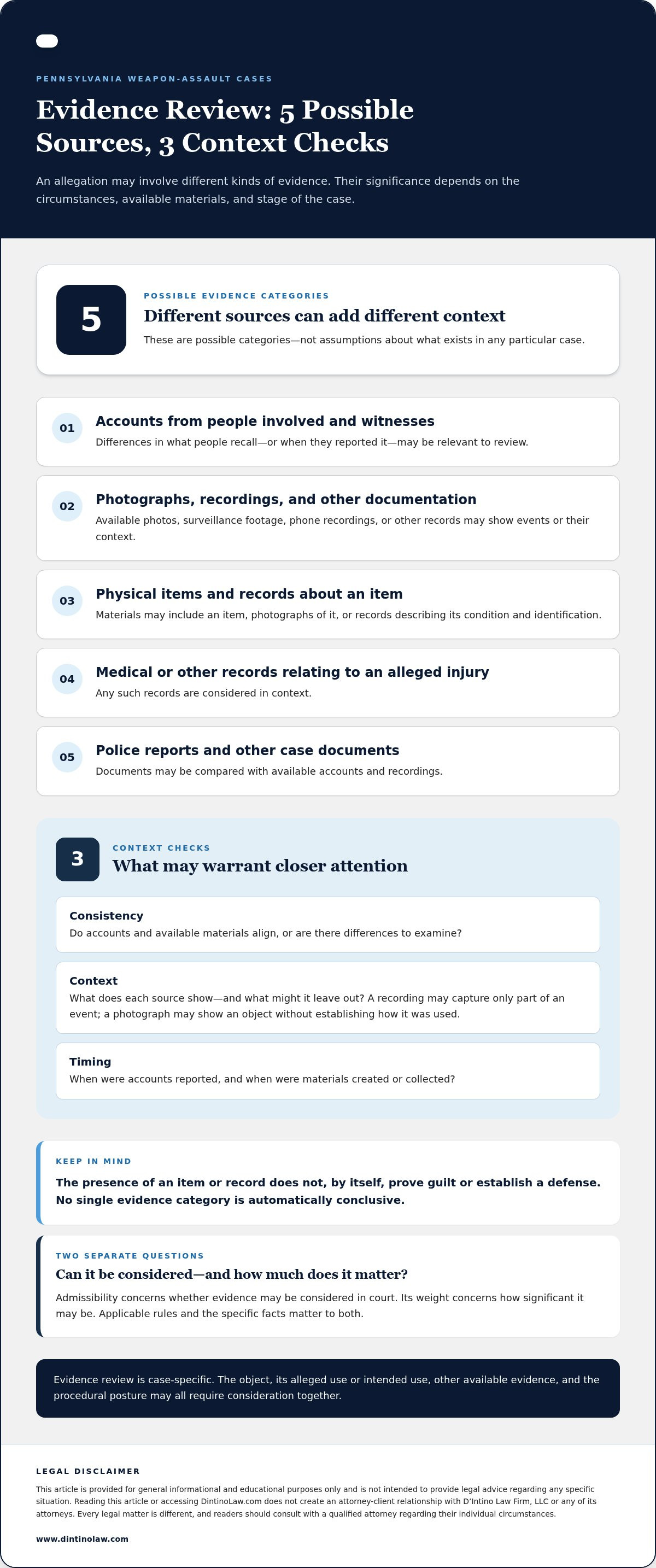
Evidence review depends on the allegations, the materials available, and the stage of the case. A lawyer may compare different sources to see what each establishes and whether questions about timing, context, or reliability need closer attention. The presence of a particular record or object does not, by itself, prove guilt or establish a defense.
Depending on the circumstances, relevant materials may include:
- Accounts from the people involved and any witnesses, including differences in what they recall or when they reported it.
- Available photographs, surveillance footage, phone recordings, or other documentation that may show the events or their context.
- Physical items, photographs of an item, or records describing its condition and identification.
- Medical or other records that may relate to an alleged injury, considered in context.
- Police reports and other case-related documents, which may be compared with available accounts and recordings.
These are possible categories, not assumptions about what exists in a particular case. Whether they may be considered in court, and what significance they may have, depends on the circumstances and applicable law.
How accounts, recordings, and physical evidence may be reviewed
Consistency, context, and timing can raise questions for legal review. A recording, for example, may capture only part of an event, while different accounts may reflect different vantage points or recollections. A photograph may show an object’s appearance without establishing how it was used. An attorney can assess available materials together rather than treating any one item as conclusive.
Whether evidence is admissible, meaning it may be considered in court, is a separate question from how much weight it may carry. The applicable rules and facts matter. No category of evidence guarantees a particular defense or predicts how a case will be resolved.
Why the alleged object and its use require context
Questions may include whether the item has been correctly identified, what condition it was in, and what the evidence indicates about its alleged use or intended use. Possessing an object alone doesn’t establish that an assault occurred or settle how the law applies. Its characteristics and the surrounding circumstances require a fact-specific assessment under Pennsylvania law.
Evidence review also depends on the case’s procedural posture. The official Chester County Court of Common Pleas page provides information about the county court. For an individualized assault with a deadly weapon defense West Chester review, a person can discuss the actual allegations and available materials with an attorney at D’Intino Law Firm, LLC. A review can identify legal questions to consider, but it cannot promise a result.
What Pennsylvania Legal Issues Could Shape a Deadly-Weapon Assault Defense?
The legal analysis depends on more than the label attached to an allegation. The exact charge, the prosecution’s theory, the available evidence, and the case’s procedural stage can all affect which questions deserve attention. A disagreement about what happened is different from a question about how Pennsylvania law applies to the alleged conduct.
For example, witnesses may disagree about who held an object. That is a factual dispute. Whether the alleged conduct fits the offense identified in the charging documents raises a legal question. Neither kind of dispute, by itself, establishes that a defense applies. Counsel must assess the issues in the context of the whole case.
Questions for case-specific review
These categories identify topics an attorney may examine, not predictions about the strength or outcome of a case:
| Potential issue | Questions for attorney review |
|---|---|
| Identity or account of events | Do witness accounts, available recordings, or other materials raise questions about who was involved or what occurred? |
| Intent and alleged conduct | What conduct does the prosecution allege, and what evidence may bear on the required mental state for the specific charge? |
| Object and alleged use | How was the object identified, and what evidence relates to its condition or alleged use? |
| Evidence and procedure | Are there questions about how evidence was collected, preserved, or presented at this stage of the case? |
| Possible justification | If the circumstances raise self-defense or another justification, what Pennsylvania law and evidence would need to be considered? |
Possible defense issues require case-specific review
A potential issue is not automatically a viable defense. An identity concern, for example, may depend on the quality and consistency of the available evidence. An intent question must be considered in relation to the actual charge, not in isolation. If the circumstances raise self-defense, its legal requirements and supporting evidence need careful review under Pennsylvania law. Describing an encounter as defensive does not, by itself, resolve that analysis.
Witness accounts, recordings, physical evidence, and procedural developments may affect which questions are relevant as a case progresses. An individualized assault with a deadly weapon defense West Chester assessment begins with the charging documents and considers them alongside the evidence and procedural posture. This general overview cannot determine whether a particular issue applies or what result a court may reach.
What Should You Expect After a Weapon-Assault Arrest in Chester County?
An arrest begins a legal process, but the next steps depend on the charge, the court, and the circumstances. For a case arising in West Chester, Pennsylvania procedures and Chester County court practices provide the framework. The sequence below is a general overview, not a prediction of what will happen in a particular case.
From initial proceedings to later court appearances
Depending on the charge and procedural posture, a case may involve several stages:
- Preliminary arraignment: After an arrest, a person may appear before a magisterial district judge for an initial proceeding. Issues such as the charges and bail may be addressed.
- Preliminary hearing: A hearing may take place in the appropriate Magisterial District Court. The proceeding generally concerns whether the case should move forward on the charges presented.
- Proceedings in the Court of Common Pleas: If a felony case is held for court, it may proceed in the Chester County Court of Common Pleas. Later steps may include formal arraignment and pretrial proceedings.
- Resolution: A case may conclude through a plea or proceed to trial, depending on the circumstances and decisions made during the case.
This sequence is not identical in every matter, and stages may vary with the charge and case developments. The official Chester County Court of Common Pleas website provides court information, but it does not replace case-specific guidance about a particular notice or appearance. Don’t assume a timeline based on a general description.
Questions to discuss with a Pennsylvania defense attorney
A focused review can start with the precise charge in the court documents, the next scheduled appearance, and the evidence or records currently known. It can also clarify which court is handling the matter and what procedural steps have already occurred. These details help place the allegation in its procedural context.
Share relevant information truthfully with counsel, including documents or communications related to the case. Keep potentially relevant information in its existing form, and don’t alter or delete it. An attorney can explain how it may relate to the issues under review. This article can’t evaluate the facts or provide advice for an individual case.
For an individualized review of a Chester County matter, discuss the charge and court process with D’Intino Law Firm, LLC. Attorney John D’Intino Jr. works directly with clients on Pennsylvania criminal-defense matters, including cases in Chester County.
How Can a West Chester Defense Attorney Review a Deadly-Weapon Allegation?
A useful review considers the charge, available evidence, and procedural posture together. The charging documents state what the prosecution alleges; records and other evidence provide context; and the stage of the case helps clarify which issues may need attention. Looking at these pieces together can help an attorney explain the legal questions and options that may apply without assuming a particular result.
What an initial case discussion can cover
An initial discussion may cover what the charging documents say, the alleged events, evidence known to the person facing the charge, and upcoming court proceedings. Sharing relevant information truthfully can help the attorney understand the circumstances and identify questions for further review. The discussion can clarify potential legal options, but it doesn’t determine how the case will be resolved.
Direct attorney involvement and next steps
At D’Intino Law Firm, LLC, Attorney John D’Intino Jr. works directly with clients from consultation through resolution, rather than handing their matters off to associates or case managers. The firm represents people facing Pennsylvania criminal charges in Chester County, including West Chester. Attorney D’Intino Jr. has more than two decades of experience.
Direct communication gives clients an opportunity to discuss the facts and procedural posture with the attorney handling the matter. The review remains specific to the charge, evidence, and circumstances; it cannot promise a dismissal, acquittal, or any other outcome. An attorney can explain which questions merit closer attention and discuss possible next steps.
If you’re looking for an assault with a deadly weapon defense West Chester review, you can request a free consultation with D’Intino Law Firm, LLC to discuss your concerns. The firm serves clients in West Chester and surrounding Pennsylvania communities, including Philadelphia, Media, Conshohocken, Lower Merion, Upper Darby, Gladwyne, Drexel Hill, Ardmore, Blue Bell, Montgomery County, Bucks County, Delaware County, Lancaster County, and Lehigh County. Contacting the firm or attending a consultation does not, by itself, create an attorney-client relationship.
Take the Next Step Toward a Clearer Understanding
A deadly-weapon allegation requires careful review of the Pennsylvania charge, evidence, and procedural posture. The specific facts matter, and no single detail determines the outcome.
For an assault with a deadly weapon defense West Chester review, Attorney John D’Intino Jr. works directly with clients and has more than two decades of experience. D’Intino Law Firm, LLC offers free consultations to discuss Pennsylvania criminal-defense concerns.
Request a free consultation to discuss your Pennsylvania criminal-defense concerns. Contacting the firm does not by itself create an attorney-client relationship.
Legal Disclaimer: This article is provided for general informational and educational purposes only and is not intended to provide legal advice regarding any specific situation. Reading this article or accessing dintinolaw.com/ does not create an attorney-client relationship with D'Intino Law Firm, LLC or any of its attorneys. Every legal matter is different, and readers should consult with a qualified attorney regarding their individual circumstances.
Frequently Asked Questions
Is assault with a deadly weapon a specific charge in Pennsylvania?
“Assault with a deadly weapon” is commonly used wording, but the formal Pennsylvania charge may be aggravated assault under 18 Pa.C.S. § 2702(a)(4). That provision addresses attempting to cause, or intentionally or knowingly causing, bodily injury to another person with a deadly weapon. The charging documents identify the offense alleged. The applicable subsection and legal analysis depend on the specific allegations and circumstances.
What counts as a deadly weapon in Pennsylvania?
Pennsylvania’s Crimes Code, 18 Pa.C.S. § 2301, includes firearms, devices designed as weapons and capable of causing death or serious bodily injury, and other items that, based on how they’re used or intended to be used, are calculated or likely to cause death or serious bodily injury. An everyday object isn’t automatically a deadly weapon. Its characteristics and alleged use must be considered in context.
Can an assault charge involve a weapon even if no one was injured?
Yes. An allegation under Pennsylvania’s aggravated-assault provision involving a deadly weapon may concern an alleged attempt to cause bodily injury, even if no injury occurred. The statute also covers certain conduct that allegedly causes bodily injury. Whether a particular charge applies depends on what the prosecution alleges and the evidence. The absence of an injury alone doesn’t resolve the legal question or determine the case’s outcome.
What evidence may matter in a Pennsylvania deadly-weapon assault case?
Potentially relevant evidence may include witness accounts, photographs, available recordings, physical items, medical records, and police reports. An attorney may compare accounts, review what a recording captures, and consider whether records provide context about an alleged injury or object. These materials aren’t automatically proof of guilt or innocence. Their admissibility and significance depend on applicable law, the facts, and the case’s procedural stage.
What happens after an assault arrest in Chester County, Pennsylvania?
A case may involve an initial proceeding, a preliminary hearing in a Magisterial District Court, and, if a felony charge is held for court, later proceedings in the Chester County Court of Common Pleas. Formal arraignment and pretrial proceedings may follow. A case may resolve through a plea or proceed to trial. The actual sequence depends on the charge and circumstances, so court notices and case-specific guidance matter.
Can self-defense apply to a deadly-weapon assault allegation in Pennsylvania?
Self-defense may be a legal issue to assess if the facts raise it, but whether it applies depends on Pennsylvania law and the specific circumstances. Relevant questions may include what happened, what evidence is available, and how the prosecution describes the alleged conduct. Describing an encounter as self-defense does not, by itself, settle the issue. An attorney can evaluate whether the law and evidence make it relevant.
Should I speak with a lawyer about a weapon-related assault charge in West Chester?
A Pennsylvania defense attorney can review the exact charge, available evidence, and current court proceedings to identify questions that may matter. For an assault with a deadly weapon defense West Chester review, D’Intino Law Firm serves clients in Chester County, and Attorney John D’Intino Jr. works directly with clients. The firm offers free consultations. Contacting the firm or requesting a consultation doesn’t by itself create an attorney-client relationship.
Disclaimer
Legal Disclaimer: The information provided on dintinolaw.com/, including articles, blog posts, testimonials, case results, and other content, is for general informational and educational purposes only and does not constitute legal advice or create an attorney-client relationship with D’Intino Law Firm, LLC or any of its attorneys. Visiting this website, submitting a contact form, sending an email, calling, texting, or otherwise communicating with the firm does not establish an attorney-client relationship or obligate the firm to represent you. Do not submit confidential, privileged, or time-sensitive information through this website or electronic communications unless and until the firm has expressly agreed to represent you. Legal rights, procedures, statutes of limitation, filing deadlines, and other requirements vary based on the facts and jurisdiction and may change over time; nothing on this website should be relied upon to determine whether a legal deadline applies to your matter. If you have an urgent legal matter or a potential filing deadline, consult a qualified attorney promptly. Testimonials and statements regarding client experiences are individual opinions and experiences and are not a guarantee of future results. Prior results, verdicts, settlements, or case examples do not guarantee or predict the outcome of any future case, and every matter is different. This website may constitute attorney advertising under applicable Pennsylvania rules. D’Intino Law Firm, LLC makes no representation that the information on this website is complete, current, or applicable to your particular circumstances. For legal advice concerning your specific situation, consult directly with a qualified Pennsylvania attorney. D’Intino Law Firm, LLC | Philadelphia, Pennsylvania | dintinolaw.com/
