


Attorney
What if a government inquiry is serious, but no criminal charges have been filed? That uncertainty can make every call, document, and conversation feel consequential. Choosing a government investigation defense lawyer PA residents can turn to for clear guidance means looking beyond broad claims and asking about Pennsylvania criminal-defense experience, attorney involvement, and communication.
An investigation and a filed criminal case are different stages, and an inquiry does not mean charges are inevitable. Still, early decisions may affect how a situation develops. Before responding to investigators or making decisions, it can help to understand what is known, what remains unclear, and how a lawyer can explain the process.
This article outlines how a Pennsylvania criminal investigation may progress, what to consider when comparing lawyers, and what information to organize before a consultation. It also offers practical questions about relevant experience, who will handle your matter, and how the lawyer explains next steps. Attorney John D’Intino Jr. has more than two decades of experience and works directly with clients from consultation through resolution. A consultation can help you discuss the circumstances and potential legal options without assuming an outcome.
Key Takeaways
- An inquiry is not the same as a filed criminal charge. By itself, it does not establish guilt or show whether charges will follow.
- Pennsylvania investigations may involve evidence gathering and a charging decision, but the steps and timing vary.
- When comparing a government investigation defense lawyer in PA, consider Pennsylvania criminal-defense focus, relevant experience, clear communication, and direct attorney access.
- For a consultation, organize notices, contact details, and a simple chronology. Do not alter, destroy, conceal, or withhold potential evidence.
- D’Intino Law Firm handles Pennsylvania criminal-defense matters from its Philadelphia base. Attorney John D’Intino Jr. has more than two decades of experience.
What a Pennsylvania Government Investigation Means Before Charges Are Filed
A government criminal investigation is an effort by a public agency to gather and assess information about conduct that may violate criminal law. It can involve questions, records, digital information, or other evidence. An investigation is fact-gathering; a criminal prosecution is a formal court process concerning alleged offenses. The two may be related, but they are not the same stage.
This distinction matters if an investigator contacts you, you receive a document, or you learn that a search has taken place. You may have questions about what the government is examining and whether you are a witness, a subject, or otherwise connected to the matter. The answer depends on the circumstances. The existence of an inquiry alone does not establish guilt or reveal what will happen next.
How an inquiry can differ from a criminal case
Investigative activity may take place before any charge is filed. A formal criminal case involves proceedings in court, while an inquiry may still be developing outside that process. Not every investigation results in an arrest, charge, or prosecution. The facts, agency, and procedural posture all affect what may happen. For general background on the stages of criminal procedure, see Criminal procedure in the United States. Questions about a matter in Pennsylvania require attention to Pennsylvania law and the specific circumstances.
Different types of contact can have different meanings. A request to speak may be an effort to gather information. A document may seek records or require a response, depending on what it is and how it was issued. A search may involve legal authorization, and the document or circumstances can matter. None of these examples, by itself, shows whether a person will be charged. A lawyer can review the details and explain the questions they raise.
Why Pennsylvania location and jurisdiction matter
This article addresses criminal investigations connected to Pennsylvania. The agency involved and the applicable law may depend on the conduct being examined, where it allegedly occurred, and other facts. A matter involving more than one location or type of agency may raise questions about which authorities are involved. Do not assume that where you live, or the office that first contacts you, answers every jurisdictional question.
D’Intino Law Firm, LLC is based in Philadelphia and handles Pennsylvania criminal-defense matters. For someone searching for a government investigation defense lawyer PA, a useful discussion should distinguish known facts from assumptions and explain which Pennsylvania-specific considerations may affect the matter. An inquiry is not proof of guilt, and no attorney can predict an outcome based on that fact alone.
How Pennsylvania Criminal Investigations May Progress
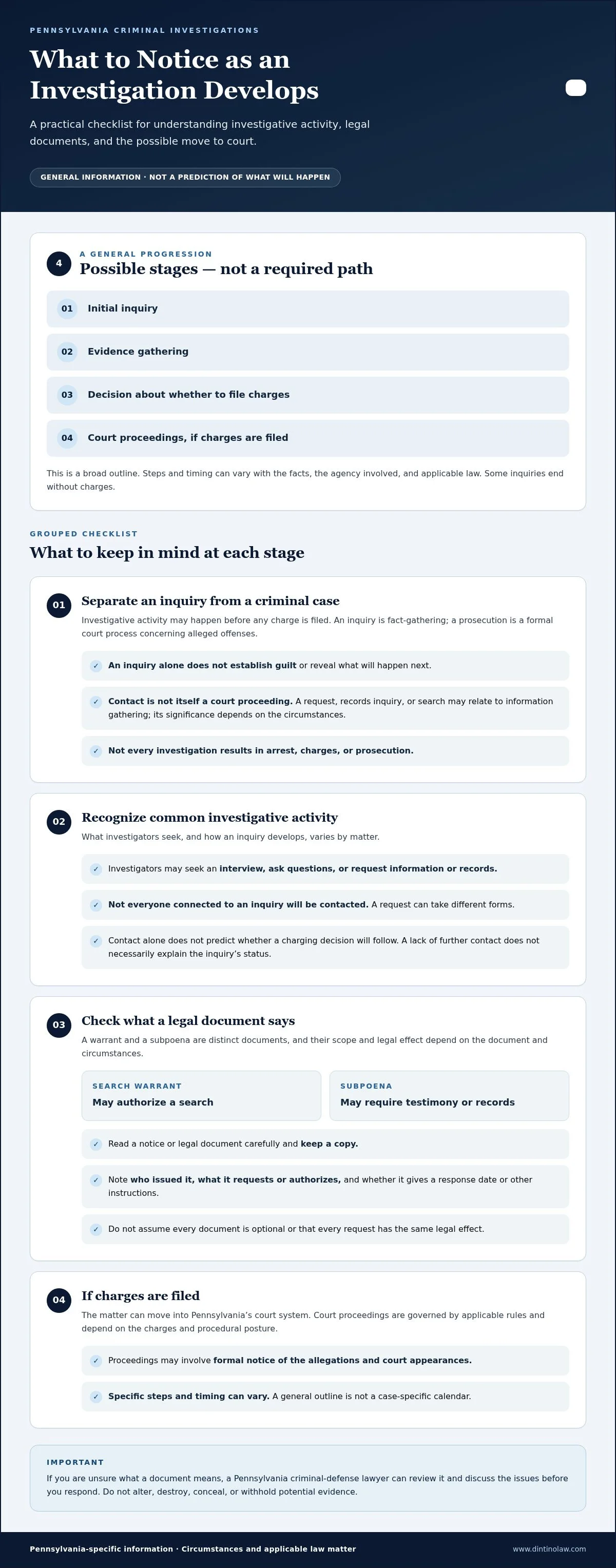
A Pennsylvania criminal investigation may involve an initial inquiry, evidence gathering, a decision about whether to file charges, and court proceedings if charges are filed. This is a general outline, not a required path or prediction. Some inquiries end without charges. Others may take a different course depending on the facts, the agency involved, and applicable law.
Investigative activity is not itself a court proceeding. Contact from an investigator, a request for records, or a search may indicate that authorities are gathering information, but it does not establish that a criminal case has begun. The significance of any step depends on its circumstances.
What investigators may do during an inquiry
Depending on the matter, investigators may seek an interview, ask questions, or request information or records. Not everyone connected to an inquiry will be contacted, and a request can take different forms. A search warrant and a subpoena are distinct legal documents. Broadly, a warrant may authorize a search, while a subpoena may require a person to provide testimony or records. The scope and legal effect depend on the document and circumstances.
Read any notice or legal document carefully and keep a copy. Note who issued it, what it requests or authorizes, and whether it gives a response date or other instructions. Do not assume every document is optional or that every request has the same legal effect. If you are unsure what a document means, a Pennsylvania criminal-defense lawyer can review it and discuss the issues before you respond. Do not alter, destroy, conceal, or withhold potential evidence.
Investigators may also seek information from records or people with relevant knowledge. What they request, and whether an inquiry expands or narrows, varies by case. A lack of further contact does not necessarily explain the status of an inquiry. Contact alone does not predict a charging decision either.
What may happen if criminal charges are filed
If prosecutors file criminal charges, the matter can move into Pennsylvania’s court system. Court proceedings are governed by applicable rules and depend on the charges and procedural posture. The process may involve formal notice of the allegations and court appearances. The specific steps, timing, and issues that require attention can vary, so a general outline should not be treated as a case-specific calendar.
Keep investigative communications distinct from court papers. A court notice may contain instructions that require attention, and the consequences of missing or misunderstanding them depend on the circumstances. An attorney can review the papers and explain the process that may apply. The meaning of a notice depends on its terms and the stage of the matter, so a general description is no substitute for reviewing the actual document.
If you are considering a government investigation defense lawyer PA, a consultation can help clarify what stage the matter appears to be in, what documents are available, and which questions remain open. No general overview can predict whether an inquiry will lead to charges.
How to Compare a Government Investigation Defense Lawyer in Pennsylvania
Choosing counsel during an inquiry can be difficult when you do not know whether charges may follow. No single credential, firm size, or marketing claim tells you how an individual matter will turn out. Compare the lawyer’s Pennsylvania criminal-defense focus, relevant experience, communication practices, and proposed role in your matter.
Use a consultation to see whether the lawyer separates known facts from assumptions and explains what remains uncertain. Ask how the lawyer would assess the information currently available, what additional details could matter, and how you would be kept informed if circumstances change. A government investigation defense lawyer in Pennsylvania should discuss possible next steps without presenting them as certain or promising a result.
| What to compare | What to explore |
|---|---|
| Pennsylvania criminal-defense focus | Ask how experience with Pennsylvania criminal matters informs the lawyer’s analysis of your questions and circumstances. |
| Relevant experience | Discuss experience with issues similar to those you describe. Look for an explanation of how that background may apply, rather than relying on a broad list of practice areas. |
| Communication | Clarify how you can raise questions, how updates are handled, and how the lawyer explains uncertainty and possible developments. |
| Attorney involvement | Ask who would be responsible for your matter, who else may assist, and how you would communicate with the attorney overseeing the work. |
Questions that reveal communication and case handling
Ask practical questions such as: “How would you explain a complicated issue in plain language?” “What can you assess from what I know now, and what would require more information?” “Who should I contact with questions about the matter?” The answers can help you assess whether the lawyer communicates clearly and recognizes the limits of what can be known at this stage.
Ask how fees and payment arrangements are discussed, including what work the proposed arrangement covers. This can clarify the scope of representation and help you understand the working relationship. If the lawyer uses unfamiliar legal terms, ask for an explanation.
Why Pennsylvania criminal-defense focus matters
Criminal law and procedure depend on jurisdiction, and relevant issues can also vary with the facts and stage of an inquiry. Ask how the lawyer approaches Pennsylvania criminal-defense matters and whether the lawyer can explain the applicable process in terms you understand. If a particular charge is a concern, discuss that context directly rather than relying on general claims about criminal experience.
Is hiring counsel before charges are filed necessary? There is no universal answer. Whether a consultation would be useful depends on the inquiry, the communications or documents involved, and the questions you have. A conversation can help you understand possible options without assuming charges will follow. You can contact D’Intino Law Firm to discuss your circumstances and potential legal options. Contacting the firm alone does not create an attorney-client relationship.
What to Prepare Before Speaking With a Pennsylvania Defense Lawyer
You do not need to solve the investigation before seeking legal information. A clear, factual record of what you know can make an initial conversation more focused and help a Pennsylvania lawyer identify questions that remain. Keep preparation simple. The goal is to organize information, not draw conclusions or build a case on your own.
Organize information without changing potential evidence
Gather relevant notices, letters, business cards, contact details, and other documents you already have. Preserve communications in their existing form. Do not delete messages, edit files, hide documents, or destroy or alter anything that could relate to the matter. Do not withhold potential evidence. If you are unsure whether something matters, note the question for counsel rather than changing or discarding it.
A brief chronology can also help. Use your own words and distinguish what you personally observed from what someone else told you. If possible, note:
- Dates and approximate times of calls, visits, interviews, searches, or other events.
- The names, titles, agencies, or contact details of people who reached out, if known.
- What documents you received and any stated instructions or response dates.
- Questions or details you are unsure about, without guessing to fill gaps.
Keep the notes factual and private. Avoid posting about the matter, naming people involved, or sharing documents in public comments, on social media, or in online forums. Public posts may be copied or shared beyond their intended audience. A private consultation is a more appropriate setting for discussing sensitive details.
Use an initial consultation to understand the process
Ask questions that help you understand the discussion rather than assume a particular outcome. For example: “How might Pennsylvania jurisdiction affect the issues?” “What does the current procedural posture tell us, and what remains uncertain?” “Who would communicate with me about developments?” You can also ask how the attorney would stay involved and how fees and payment arrangements are explained.
If you have been arrested, that is different from an inquiry in which no arrest has occurred. Arrest-related concerns may involve separate questions about the applicable process. The information you prepare can help an attorney understand the context, but it does not substitute for an individual legal assessment.
An initial discussion lets you share circumstances and learn about potential legal options. Contacting a firm or speaking with a lawyer does not, by itself, create an attorney-client relationship. Before sharing sensitive information, clarify whether the lawyer can discuss the matter and what steps are needed to establish representation.
If you are preparing to speak with a government investigation defense lawyer PA, you can contact D’Intino Law Firm to discuss your circumstances and learn about the consultation process.
Discussing a Pennsylvania Investigation With D’Intino Law Firm
An inquiry can raise questions that are difficult to sort through alone. A consultation gives you space to describe what prompted your concern, ask what information may matter, and discuss potential legal options. D’Intino Law Firm, LLC handles Pennsylvania criminal-defense matters from its Philadelphia base. The firm serves clients in Philadelphia and surrounding Pennsylvania communities, including Media, West Chester, Conshohocken, Lower Merion, Upper Darby, Gladwyne, Drexel Hill, Ardmore, Blue Bell, Montgomery County, Bucks County, Delaware County, Lancaster County, and Lehigh County.
What direct attorney involvement means
Clear communication can help you understand what is known, what remains uncertain, and which issues may need further review. In a discussion with the firm, you can ask how the Pennsylvania context affects your questions and how the attorney would explain developments if the matter changes. The conversation can clarify the process, but it cannot predict or guarantee an outcome.
You can also ask how the firm handles communication and what information would help the attorney understand your concerns. If you have notices or correspondence, describe what you received and ask what questions those materials raise. The attorney’s evaluation will depend on the specific circumstances and applicable law.
How to take the next step
D’Intino Law Firm offers free consultations and flexible payment options. A consultation is an opportunity to discuss the circumstances, potential legal options, and how fees are addressed. You can prepare a brief chronology or bring relevant documents, preserving them in their existing form. Avoid sharing sensitive information in public posts or comments.
If you would like to discuss a Pennsylvania criminal-defense concern, contact D’Intino Law Firm about your circumstances. An attorney can review the information you provide and discuss potential legal options. Reaching out or having an initial conversation does not by itself create an attorney-client relationship. Representation begins only after the appropriate arrangements are made.
Take a Clear Next Step
Uncertainty does not have to be resolved all at once. A useful next step is to turn what you know into focused questions: What does this contact or document mean? What details still need clarification? Which Pennsylvania-specific issues could affect the matter? A thoughtful conversation can help you understand what is known and what remains uncertain, without assuming that an inquiry will lead to charges or a particular result.
Choosing a government investigation defense lawyer PA is a personal decision. Look for counsel who addresses your questions plainly, explains what remains unknown, and discusses potential legal options based on the circumstances. A useful consultation should provide information, not pressure or promises.
D’Intino Law Firm, LLC welcomes the opportunity to hear about your Pennsylvania criminal-defense concerns and discuss whether the firm may be able to assist. Arrange a free consultation about your concerns to discuss your questions with the firm.
Frequently Asked Questions
What does it mean if I am under a government investigation in Pennsylvania?
It generally means a government agency is examining facts that may relate to a legal matter. The inquiry itself is not a criminal charge and does not establish guilt. The agency, subject, and stage of the matter can vary. For example, a person may learn of an inquiry through an interview request or a document. A Pennsylvania criminal-defense attorney can discuss general options after learning the relevant details.
Should I speak with investigators without a lawyer in Pennsylvania?
The legal and practical considerations depend on the nature of the contact and the circumstances. This general information cannot determine what is appropriate in a particular interaction. If you are concerned about questions from investigators, you may seek legal guidance before discussing substantive facts. Be truthful, and do not destroy records or try to influence an investigation. An attorney can help you understand the request and discuss the issues it raises.
Can a Pennsylvania defense lawyer help before charges are filed?
A lawyer may be able to explain the investigative process and discuss the significance of known facts before charges are filed. The appropriate assistance depends on the matter and the lawyer’s review. This may be relevant to inquiries in Philadelphia or nearby counties such as Montgomery, Bucks, Delaware, Chester, and Lancaster. Representation cannot guarantee that charges will be avoided or that an investigation will end in a particular way.
How long does a government criminal investigation take in Pennsylvania?
There is no single timeline for every Pennsylvania investigation. Duration may depend on the allegations, evidence, number of people involved, agency activity, and other procedural circumstances. An inquiry may develop over time, and a lack of updates does not establish whether it has ended or what decision may follow. An attorney can discuss known circumstances without promising a timeline.
What should I do if investigators ask to interview me in Pennsylvania?
The legal and practical considerations depend on the request and circumstances. You may want to understand who is seeking the interview, its general subject, and whether the request is written or verbal before discussing substantive facts. Do not make false statements or try to influence witnesses. A Pennsylvania attorney can review the situation and explain general options. This information is not individualized legal advice and cannot determine how you should handle a specific interview.
Can a government investigation lead to charges in Pennsylvania?
Yes, an investigation can lead to criminal charges, but some inquiries do not result in charges. Whether charges are filed depends on the facts, evidence, applicable law, and decisions made through the relevant process. No lawyer can guarantee what will happen. A Pennsylvania criminal-defense attorney can explain the general process and discuss potential legal options based on the circumstances, without treating an inquiry as proof that charges are certain.
What documents should I bring to a consultation about an investigation?
If available, gather relevant notices, correspondence, and contact details, along with a basic chronology of events. For example, note when a call or visit occurred and who contacted you, while marking anything you are unsure about rather than guessing. Keep records and communications in their existing form. Do not delete, edit, conceal, or destroy potential evidence, and avoid posting sensitive details publicly. Counsel can help identify what is relevant to the discussion.
Legal Disclaimer: This article is provided for general informational and educational purposes only and is not intended to provide legal advice regarding any specific situation. Reading this article or accessing DintinoLaw.com does not create an attorney-client relationship with D’Intino Law Firm, LLC or any of its attorneys. Every legal matter is different, and readers should consult with a qualified attorney regarding their individual circumstances.
Disclaimer
Legal Disclaimer: The information provided on DintinoLaw.com, including articles, blog posts, testimonials, case results, and other content, is for general informational and educational purposes only and does not constitute legal advice or create an attorney-client relationship with D’Intino Law Firm, LLC or any of its attorneys. Visiting this website, submitting a contact form, sending an email, calling, texting, or otherwise communicating with the firm does not establish an attorney-client relationship or obligate the firm to represent you. Do not submit confidential, privileged, or time-sensitive information through this website or electronic communications unless and until the firm has expressly agreed to represent you. Legal rights, procedures, statutes of limitation, filing deadlines, and other requirements vary based on the facts and jurisdiction and may change over time; nothing on this website should be relied upon to determine whether a legal deadline applies to your matter. If you have an urgent legal matter or a potential filing deadline, consult a qualified attorney promptly. Testimonials and statements regarding client experiences are individual opinions and experiences and are not a guarantee of future results. Prior results, verdicts, settlements, or case examples do not guarantee or predict the outcome of any future case, and every matter is different. This website may constitute attorney advertising under applicable Pennsylvania rules. D’Intino Law Firm, LLC makes no representation that the information on this website is complete, current, or applicable to your particular circumstances. For legal advice concerning your specific situation, consult directly with a qualified Pennsylvania attorney. D’Intino Law Firm, LLC | Philadelphia, Pennsylvania | DintinoLaw.com
