


Attorney
After an accident, clear communication can matter as much as understanding Pennsylvania injury claims. You may be unsure what to say to an insurer, which records to keep, or how the claims process works. A Chester County personal injury lawyer can explain the issues to consider and help you understand possible next steps.
This article covers general Pennsylvania claim considerations and practical ways to organize information after an injury. It also explains what to look for when evaluating legal representation, including who will handle your matter and how updates will be communicated. At D’Intino Law Firm, LLC, clients work directly with Attorney John D’Intino Jr., who has more than two decades of experience. Medical and expense records, accident details, and insurance communications may all be relevant, depending on the circumstances. Every claim is different, but an organized account of what happened can make it easier to discuss the issues.
Key Takeaways
- A lawyer can review the circumstances of an injury and explain possible legal options, but no claim outcome is guaranteed.
- Pennsylvania negligence and comparative-fault rules may affect an injury claim, so understanding how responsibility is evaluated matters.
- When choosing a Chester County personal injury lawyer, look for clear explanations, relevant experience, and direct communication about who will handle your matter.
- After an injury, prioritize safety and appropriate medical care. Then keep useful photos, contact details, correspondence, and expense records when available.
- D’Intino Law Firm, LLC represents injured people in Pennsylvania, including Chester County, with clients working directly with Attorney John D’Intino Jr.
When Should You Contact a Chester County Personal Injury Lawyer?
An injury can bring medical appointments, missed work, insurance questions, and legal concerns all at once. You may be trying to recover while determining what happened, who may be responsible, and what information to preserve. A Chester County personal injury lawyer can help identify questions to consider, but a consultation does not establish that you have a claim or guarantee a particular result.
Whether a legal discussion may be useful depends on the incident, available evidence, whether responsibility is disputed, and how the injury affects daily life. If you are in West Chester or elsewhere in Chester County, an attorney can review the circumstances and explain possible options under Pennsylvania law.
Which injuries and incidents may raise a Pennsylvania claim?
Injured people and surviving family members may have questions after a car, truck, or motorcycle crash; an injury on someone else’s property; a construction incident; suspected medical malpractice; or a death allegedly caused by another party’s conduct. Each situation involves different facts and legal issues. A general personal injury overview can introduce common concepts, but it cannot determine how Pennsylvania law applies to a particular incident.
Useful questions include what happened, what evidence is available, how the injury developed, and whether the law may provide a basis for holding someone responsible. An injury or accident alone does not establish legal fault or prove that a claim can proceed.
When can a lawyer help clarify next steps?
A lawyer can help organize questions about responsibility, insurer communications, records, and losses connected with an injury. If the parties disagree about how a crash occurred, for example, details such as photographs, witness accounts, and records may help clarify the competing descriptions. If symptoms continue after an initial evaluation, the timeline of symptoms and related medical records may also be relevant. Any assessment depends on the evidence and applicable Pennsylvania law.
Before a conversation, consider noting the basic timeline, names of people involved, insurance correspondence, treatment information, and expenses related to the incident, if available. You can also ask who will handle the matter and how the lawyer will explain developments or uncertainty. These discussions provide information, but contacting a lawyer does not guarantee representation, a successful claim, or compensation.
How Pennsylvania Law Shapes a Chester County Personal Injury Claim
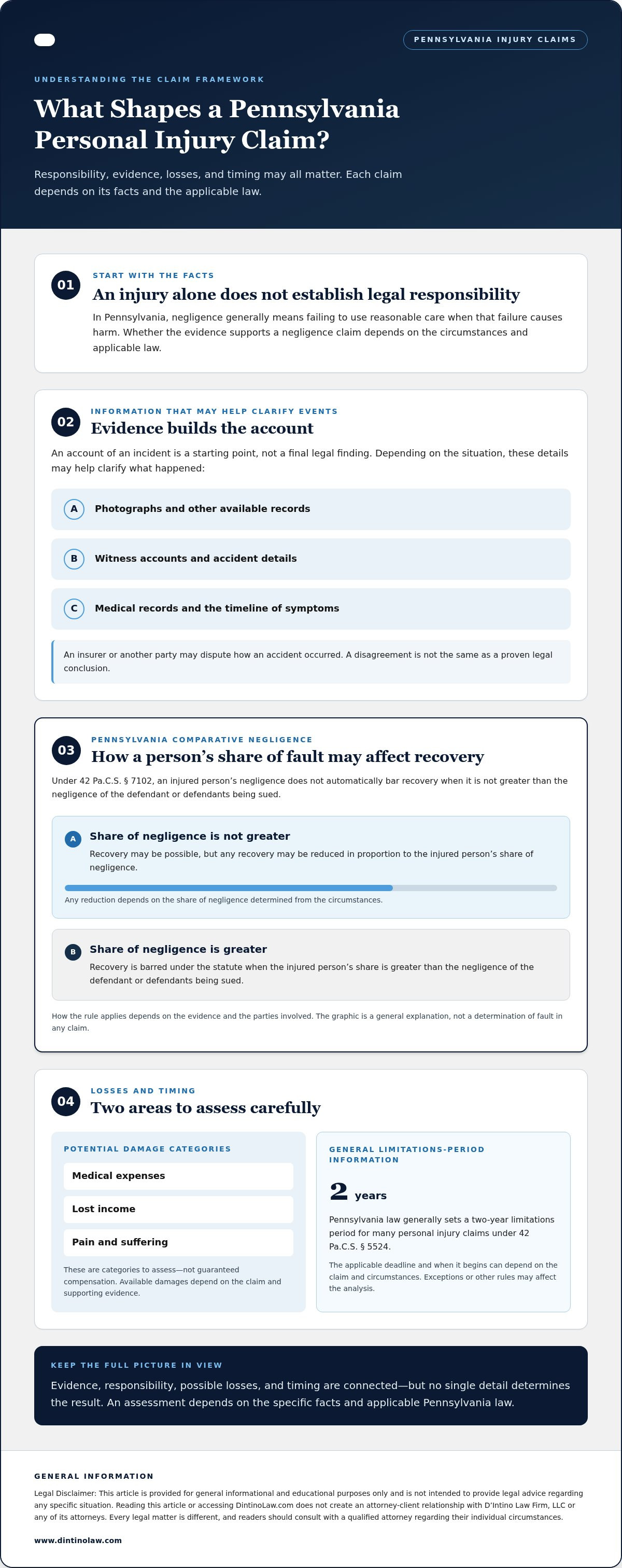
An injury alone does not establish who is legally responsible. In Pennsylvania, negligence generally means failing to use reasonable care when that failure causes harm. A person may allege that another party acted negligently, but whether the evidence supports that conclusion depends on the facts and applicable law.
An account of an incident is a starting point, not a final legal finding. Photographs, available records, witness accounts, and other details may help clarify what happened. The Pennsylvania Unified Judicial System provides information about Pennsylvania’s courts and court structure. An attorney can discuss how the law may apply to a particular set of circumstances.
How are responsibility and comparative negligence considered?
Pennsylvania’s comparative-negligence rule is set out in 42 Pa.C.S. § 7102. In general, an injured person’s negligence does not automatically bar recovery if it is not greater than the negligence of the defendant or defendants being sued. Any recovery may be reduced in proportion to the injured person’s share of negligence. If that share is greater, recovery is barred under the statute. How the rule applies depends on the evidence and the parties involved.
For example, an insurer or another party might dispute how an accident occurred or argue that the injured person contributed to it. That argument is not the same as a proven legal conclusion. A Chester County personal injury lawyer can review the available information and explain how responsibility may be evaluated without assuming the outcome.
What damages and deadlines may matter?
Depending on the claim and supporting evidence, damages may involve medical expenses, lost income, and pain and suffering. These are categories to assess, not guaranteed compensation. The nature of the injury, its effects, and the evidence supporting losses all matter. A general overview cannot determine what damages may be available in an individual case.
Deadlines also deserve attention. Pennsylvania law generally sets a two-year limitations period for many personal injury claims under 42 Pa.C.S. § 5524, but the applicable deadline and when it begins to run can depend on the type of claim and circumstances. Exceptions or other rules may affect the analysis. This general information is not a calculation of a specific deadline.
If you are unsure how responsibility, potential losses, or timing may affect an injury matter, discussing a Pennsylvania injury claim with an attorney may help clarify the questions to consider. A lawyer can review the circumstances and explain possible legal options without guaranteeing that a claim can proceed or predicting a result.
How to Evaluate a Chester County Personal Injury Lawyer Without Relying on Promises
Choosing counsel involves more than reviewing a profile or headline result. You are deciding who will explain the process, answer questions, and guide you through decisions tied to your circumstances. These practical points can help you evaluate a Chester County personal injury lawyer without treating marketing claims as a prediction of what will happen in your case.
Chester County’s official website provides information about local government and county services. When evaluating legal representation, focus on the attorney’s communication, relevant background, approach to handling your matter, and willingness to discuss uncertainty plainly.
- 1. Ask who will handle your matter. Find out whether you will communicate directly with the attorney or primarily with other members of the firm. D’Intino Law Firm, LLC clients work directly with Attorney John D’Intino Jr., from consultation through resolution.
- 2. Discuss relevant experience. Ask about the attorney’s background with personal-injury matters similar in type to yours. John D’Intino Jr. has more than two decades of experience. Experience can provide useful context, but it cannot predict the outcome of a different claim.
- 3. Clarify how communication works. Ask how the attorney shares updates, responds to questions, and explains important developments. Clear expectations help you understand how communication will work during the representation.
- 4. Listen for specific, plain-language explanations. Counsel should be able to explain what information may matter, what issues remain uncertain, and what possible next steps may involve. Make sure you have time to ask questions and understand the answers.
Why should readers be cautious about outcome promises?
Personal-injury claims turn on their own evidence, applicable Pennsylvania law, procedural issues, and individual circumstances. A past verdict, settlement, or successful result in another matter does not establish what will happen in yours. A confident prediction is not a substitute for a careful explanation of what is known and what remains unresolved.
Consider whether the attorney discusses both strengths and uncertainties rather than presenting a particular result as assured. An attorney’s stated experience is different from an unsupported claim of superiority or a guarantee. A responsible conversation should help you understand which questions need review, not pressure you with a promise.
If you are considering representation after an injury, a discussion with D’Intino Law Firm, LLC offers an opportunity to share the circumstances and ask about possible legal options. A consultation does not guarantee a claim or result, and an outcome cannot be predicted based only on general information.
What to Do After an Injury in Chester County
An injury can make routine decisions feel difficult. Focus first on immediate safety and appropriate medical attention. After urgent needs are addressed, keeping a clear record of what happened and how the injury affects you may help when explaining the situation to a healthcare provider, insurer, or attorney.
These are general steps, not a required legal checklist. The right approach depends on the incident and your circumstances.
What information may be useful to preserve?
Keep information in its original, accurate form when available. You might organize:
- Incident details: The date, approximate time, location, and a brief factual account of what you remember.
- Photos and other records: Images of the scene, injuries, or relevant conditions, along with related documents you already have.
- Contact information: Names and contact details for witnesses or others involved, if available.
- Medical and work records: Treatment-related documents, instructions, appointment details, and records of time missed from work.
- Expenses and correspondence: Receipts or other expense records, plus letters, emails, and messages related to the incident or insurance communications.
Store records where you can find them, and distinguish what you know from what you are unsure about. Do not change, hide, or discard information that may relate to the incident. If you remember something later, add a dated note rather than revising an earlier account without explanation.
How should readers approach insurance communications?
Insurance communications and documents may affect how a claim is evaluated. Read requests carefully, keep copies of what you send and receive, and make sure you understand a document before signing it. If a request or document is unclear, write down your questions and consider discussing them with counsel before responding. This general guidance does not prescribe a particular response for every situation.
A conversation with a Chester County personal injury lawyer can help you understand what records may be relevant and what questions to raise about insurance communications. An attorney can review the circumstances and explain possible legal options, but no review can guarantee that a claim will proceed or predict its outcome.
If you have questions about preserving records or handling insurance documents after an injury, discuss your Pennsylvania injury matter with D’Intino Law Firm, LLC.
Discussing a Chester County Injury Matter With D’Intino Law Firm, LLC
D’Intino Law Firm, LLC represents injured plaintiffs in Pennsylvania, including people in Chester County. The firm also serves people in communities such as West Chester, Media, Philadelphia, Conshohocken, Lower Merion, Upper Darby, Gladwyne, Drexel Hill, Ardmore, and Blue Bell, as well as surrounding counties including Montgomery, Bucks, Delaware, Berks, Lancaster, and Lehigh. If you are considering speaking with a Chester County personal injury lawyer, an initial conversation can be an opportunity to describe what happened, ask general questions, and learn what issues may need closer review.
Clients work directly with Attorney John D’Intino Jr. from the initial consultation through resolution. He has more than two decades of experience. The firm offers free consultations and flexible payment options. You can ask about the process and discuss the circumstances of your injury. A consultation does not guarantee representation, compensation, or a particular outcome.
What can readers expect from an initial conversation?
You can share information about the incident, such as when and where it occurred, the type of injury, and any questions about insurance communications or records. You do not need to have every document or answer before raising your concerns. Based on the information available, the attorney can discuss potential legal issues and options while explaining where further review may be needed.
A conversation or online form submission alone does not create an attorney-client relationship. Representation begins only if the firm and prospective client agree to work together under the applicable terms. Ask what the next steps would involve before making decisions.
How can readers take a low-pressure next step?
If you would like to discuss your circumstances, you can request a free consultation through the firm’s website. It is an opportunity to ask questions and learn about possible legal options, not a promise about what a claim may achieve. You can also explore the firm’s Philadelphia personal injury representation information for a broader view of its Pennsylvania plaintiff-side practice.
For people injured in a truck crash, the legal and factual questions may differ from those in other accident matters. Bring any questions about the incident and available records to a consultation so the attorney can discuss them in context. The conversation can help identify issues that may need further evaluation without requiring you to assume who was at fault or predict an outcome.
Take a Clear Next Step After an Injury
Pennsylvania injury claims depend on the facts, evidence, and applicable law. Accurate records and careful review of insurance communications can help you stay organized. A lawyer can explain how those details may relate to possible legal options. When evaluating a Chester County personal injury lawyer, consider whether the attorney communicates directly, explains uncertainty clearly, and avoids promising a particular result.
D’Intino Law Firm, LLC represents injured plaintiffs in Chester County and throughout Pennsylvania. Attorney John D’Intino Jr. has more than two decades of experience, and clients work directly with him from the initial consultation through resolution. A free consultation offers an opportunity to discuss your circumstances and ask questions, without guaranteeing representation or an outcome.
Request a free consultation to discuss your Pennsylvania injury concerns. A clear conversation can help you better understand the questions and options that may apply to your situation.
Legal Disclaimer: This article is provided for general informational and educational purposes only and is not intended to provide legal advice regarding any specific situation. Reading this article or accessing DintinoLaw.com does not create an attorney-client relationship with D’Intino Law Firm, LLC or any of its attorneys. Every legal matter is different, and readers should consult with a qualified attorney regarding their individual circumstances.
Frequently Asked Questions
Do I need a personal injury lawyer after an accident in Chester County?
Not every injury situation calls for the same response. A Chester County personal injury lawyer can review the circumstances, explain potential legal issues, and discuss possible options. Whether representation may be useful can depend on the injury, whether responsibility is disputed, insurance communications, and available evidence. A consultation is an opportunity to ask questions, but it does not establish that you have a valid claim or guarantee a particular result.
How long do I have to file a personal injury lawsuit in Pennsylvania?
Many Pennsylvania personal injury claims are generally subject to a two-year filing period under 42 Pa.C.S. § 5524, but the deadline can depend on the claim and circumstances. Rules about when a claim begins, along with exceptions, may affect the analysis. This general information is not a deadline calculation or advice for an individual matter. An attorney can review the facts and explain which timing issues may apply.
What should I bring to a consultation with a Chester County injury lawyer?
If available, organize incident details, photographs, witness contact information, insurance correspondence, and records about medical care or missed work. These materials can help explain what happened and how the injury has affected you. Do not delay necessary medical treatment to gather documents, and do not alter or discard potentially relevant information. After reviewing the circumstances, a lawyer can discuss which records may be useful.
Can I still bring a Pennsylvania injury claim if I may share some fault?
Possibly, but shared fault does not by itself resolve whether a Pennsylvania claim can proceed. Under the state’s comparative-negligence rule, an injured person’s negligence may reduce damages and can bar recovery if it is greater than the negligence of the defendant or defendants. The evidence and applicable law matter. An attorney can explain how the rule may relate to specific circumstances, but this answer does not determine fault or claim eligibility.
What types of cases does a Chester County personal injury lawyer handle?
Plaintiff-side personal injury matters can involve car, truck, or motorcycle collisions, premises injuries, construction incidents, medical malpractice, and wrongful-death claims. Each type of matter raises different factual and legal questions, and not every injury leads to a successful claim. D’Intino Law Firm, LLC represents injured plaintiffs in Pennsylvania, including Chester County residents. An attorney can discuss the circumstances and explain which legal considerations may be relevant.
How do personal injury lawyers typically charge in Pennsylvania?
Fee arrangements can vary by lawyer and matter, so do not assume a particular structure or set of terms. D’Intino Law Firm, LLC offers flexible payment options and free consultations. Prospective clients can use a consultation to ask about the arrangement that may apply, what the agreement covers, and how case-related expenses are addressed. Review any proposed fee agreement carefully so you understand its terms before deciding whether to proceed.
Will hiring a Chester County personal injury lawyer guarantee compensation?
No. A lawyer cannot guarantee compensation or any particular result. Outcomes depend on the evidence, applicable Pennsylvania law, insurance issues, procedure, and the specific circumstances of a matter. An attorney can review available information and discuss possible options, but past experience or results in other cases do not predict what will happen in yours. Be cautious of any statement promising a specific recovery or outcome.
Disclaimer
Legal Disclaimer: The information provided on DintinoLaw.com, including articles, blog posts, testimonials, case results, and other content, is for general informational and educational purposes only and does not constitute legal advice or create an attorney-client relationship with D’Intino Law Firm, LLC or any of its attorneys. Visiting this website, submitting a contact form, sending an email, calling, texting, or otherwise communicating with the firm does not establish an attorney-client relationship or obligate the firm to represent you. Do not submit confidential, privileged, or time-sensitive information through this website or electronic communications unless and until the firm has expressly agreed to represent you. Legal rights, procedures, statutes of limitation, filing deadlines, and other requirements vary based on the facts and jurisdiction and may change over time; nothing on this website should be relied upon to determine whether a legal deadline applies to your matter. If you have an urgent legal matter or a potential filing deadline, consult a qualified attorney promptly. Testimonials and statements regarding client experiences are individual opinions and experiences and are not a guarantee of future results. Prior results, verdicts, settlements, or case examples do not guarantee or predict the outcome of any future case, and every matter is different. This website may constitute attorney advertising under applicable Pennsylvania rules. D’Intino Law Firm, LLC makes no representation that the information on this website is complete, current, or applicable to your particular circumstances. For legal advice concerning your specific situation, consult directly with a qualified Pennsylvania attorney. D’Intino Law Firm, LLC | Philadelphia, Pennsylvania | DintinoLaw.com
