


Attorney
When choosing counsel, what matters more: a confident promise or a clear explanation of how your case may move through Pennsylvania’s legal process? If you’re comparing options for a domestic violence defense lawyer Montgomery County residents can consult, you may want to understand what an allegation means, what steps could follow, and how criminal proceedings relate to a Protection From Abuse (PFA) matter. A PFA is a civil proceeding, not a criminal charge, but both matters may arise from the same circumstances.
This article explains the general path a Pennsylvania criminal case may take and offers practical questions to help you evaluate a lawyer’s relevant experience, communication, and fees. It also explains why a PFA matter may need separate attention while criminal proceedings are underway. The details and available options depend on the circumstances, so a conversation with counsel can help clarify which issues may apply to your situation.
Key Takeaways
- “Domestic violence” may describe alleged conduct, but the criminal charges considered in Pennsylvania depend on the applicable law and circumstances.
- A criminal case and a civil Protection From Abuse proceeding are separate matters, though both may arise from the same situation.
- When evaluating a domestic violence defense lawyer Montgomery County residents may consult, ask about Pennsylvania criminal-defense experience, who will handle your case, communication, and fees.
- Before speaking with a lawyer, note important dates, gather relevant paperwork, and list your questions. Follow counsel’s guidance about case materials.
- D’Intino Law Firm handles Pennsylvania criminal-defense matters, including Montgomery County cases, with direct attorney involvement. The firm offers free consultations and flexible payment options.
What a Domestic Violence Defense Lawyer in Montgomery County Handles
An accusation involving a partner or family member can leave you uncertain about what the allegation means and what may happen next. This guide focuses on Pennsylvania criminal-defense representation in Montgomery County. It explains how to distinguish the general label “domestic violence” from the specific criminal charge and describes the role a defense lawyer may play. Not every case follows the same path.
What does “domestic violence” mean in a Pennsylvania criminal case?
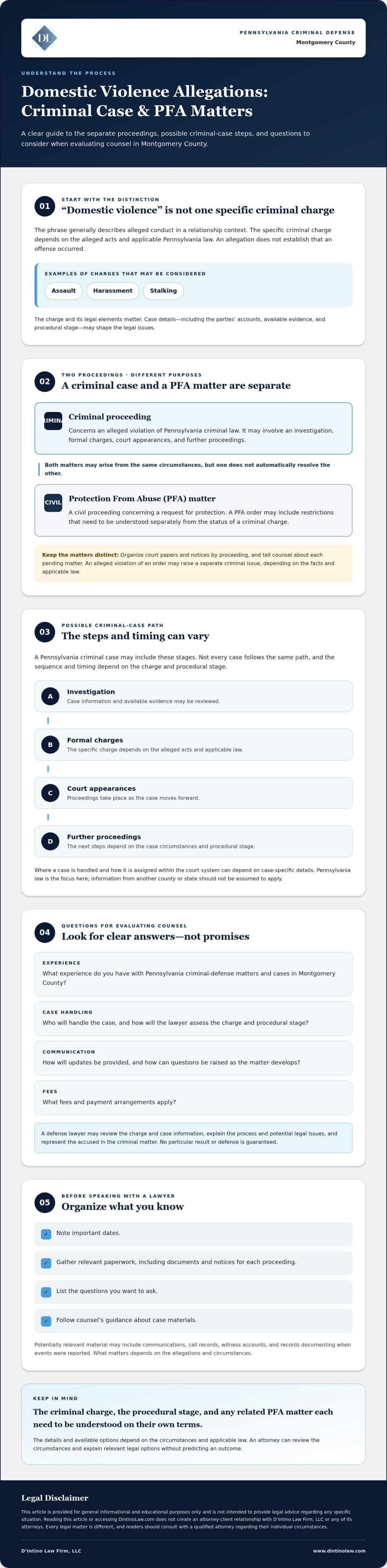
“Domestic violence” generally describes alleged conduct in a relationship context. It does not, by itself, identify one specific criminal offense. The charge depends on the alleged acts and applicable Pennsylvania law. Depending on the circumstances, allegations might involve offenses such as assault, harassment, or stalking. The precise charge and its legal elements matter, and an allegation does not establish that an offense occurred.
Case details can shape the legal issues. The parties’ accounts, available evidence, and stage of the case may all be relevant. A defense lawyer generally reviews the charge and case information, explains the process and potential legal issues, and represents the accused in the criminal matter. That review does not guarantee a particular result or establish that any specific defense applies.
A related Protection From Abuse (PFA) case is a civil proceeding, separate from a criminal prosecution, though both may arise from the same circumstances. For a broad overview of what a restraining order is, see the general reference. It is not a guide to Pennsylvania-specific rules or legal advice.
Why Montgomery County and Pennsylvania jurisdiction matter
Pennsylvania law governs the criminal case discussed here. Where a case is handled and how it is assigned within the court system can depend on case-specific details. That local context can affect where proceedings take place and which procedures apply. Information about another county or state should not be assumed to fit a Montgomery County matter.
A domestic violence defense lawyer Montgomery County residents consider should be prepared to discuss Pennsylvania criminal cases and explain how the particular charge and procedural stage may affect the issues under review. Ask how the lawyer will assess the case and keep you informed. An individualized evaluation requires attention to the specific facts and applicable law.
Pennsylvania Criminal Charges, PFA Orders, and What May Happen Next
A criminal allegation and a Protection From Abuse (PFA) matter may relate to the same events, but they are separate legal proceedings with different purposes. Identifying which matter is pending and reading what each document or court notice says can help you decide what questions to raise with a Pennsylvania criminal defense attorney. The details depend on the circumstances and applicable law.
How criminal charges differ from a Protection From Abuse matter
A criminal case concerns an alleged violation of Pennsylvania criminal law. The process may involve an investigation, formal charges, court appearances, and further proceedings. The steps and timing vary with the charge and procedural stage. A PFA case, by contrast, is a civil proceeding concerning a request for protection. The Commonwealth of Pennsylvania provides an overview of the Protection from Abuse (PFA) Order and related protective-order information.
Both proceedings may move forward in connection with the same situation, but one does not automatically resolve the other. A PFA order may include restrictions that must be understood separately from the status of a criminal charge. An alleged violation of an order may raise a separate criminal issue, depending on the facts and applicable law. A criminal defense lawyer can explain issues related to the criminal case, but that does not mean the lawyer provides family-law representation or handles every civil matter connected to the situation.
Keep court papers and notices organized by proceeding, and tell counsel about each pending matter. An attorney can review the circumstances and explain relevant options without predicting an outcome.
Which evidence and case details may matter?
Evidence can take different forms. Depending on the allegations, potentially relevant material may include:
- Messages, call records, or other communications between the people involved.
- Witness accounts and records documenting when events were reported.
- Photographs, recordings, or other materials connected to the alleged events.
- The wording and status of any court order, along with related court documents.
These are examples, not a checklist of evidence that will matter in every case. Relevance and admissibility depend on the facts and Pennsylvania law. A lawyer can assess how available information relates to the charge and the stage of the proceeding. Preserve materials in their existing form. Do not alter, delete, conceal, or withhold potential evidence.
If you’re looking for a domestic violence defense lawyer Montgomery County residents can consult about a Pennsylvania criminal matter, ask how the attorney evaluates the criminal case alongside any related order. You can also learn more about Pennsylvania criminal defense and how to discuss your circumstances with counsel.
How to Compare Domestic Violence Defense Lawyers in Montgomery County
Choosing counsel means considering fit, communication, and experience with Pennsylvania criminal cases, not who makes the boldest prediction. If you searched for “domestic violence defense lawyer Montgomery County,” use that search as a starting point. Then ask questions that help you understand how the lawyer would review the charge and keep you informed.
Questions to ask during an initial consultation
A consultation can help you understand how a lawyer communicates and what information they need to assess your situation. Ask how they would review the charges, available information, and the case’s current procedural stage. Clarify who will be your direct contact, who may appear on your behalf, and how you’ll receive updates. The answers should give you a clearer picture of the working relationship.
- Case review: What information would you need to assess the charges and current stage of the case?
- Communication: Who will answer questions and provide updates? How should you share new information or documents?
- Representation: Who is expected to handle court appearances and other work on the criminal case?
- Fees: What services does the proposed engagement include, how are fees structured, and could other costs arise?
- Consultation: What can be discussed in the consultation, and what should you understand about next steps if you decide to retain counsel?
If a PFA order is also involved, ask how the criminal matter relates to that separate proceeding and which issues fall within the lawyer’s representation. The Pennsylvania Protection from Abuse Orders resource from the Unified Judicial System of Pennsylvania offers information about protection orders. For broader information about the firm’s Pennsylvania criminal-defense practice, see its Philadelphia criminal defense lawyer guide.
Assess experience without relying on promises
Look for relevant Pennsylvania criminal-defense experience and explanations you can follow. A lawyer should be able to describe the factors they would examine without claiming to know the outcome before reviewing the circumstances. Be cautious of guaranteed results or unsupported rankings in legal advertising. Clear answers about communication, case handling, and fees are more useful comparison points than confident predictions.
After speaking with counsel, consider whether you understand who will handle your matter, how questions will be addressed, and what the engagement covers. A domestic violence defense lawyer Montgomery County residents evaluate should be willing to discuss these practical details without suggesting that any particular result is assured.
Preparing to Discuss a Montgomery County Criminal Defense Case
A little organization can make an initial conversation more focused, even if you don’t have every document or answer. You are not expected to develop a legal strategy on your own. Your goal is to help counsel understand the basic timeline, identify what remains unclear, and explain which questions may need closer review under Pennsylvania law.
Information to organize before speaking with counsel
If available, gather the papers related to the case and note key dates. Keep original materials intact, and ask the attorney how to share anything sensitive. A factual timeline can help you describe events in sequence without trying to decide which details are legally important.
- Collect case paperwork. Set aside charging documents, court notices, and any related order or paperwork you’ve received.
- Note important dates. Record dates you recall for alleged events, communications from authorities, and scheduled court appearances. Mark uncertainty rather than guessing.
- Make a factual timeline. Write down what you remember in your own words. Do not edit, delete, discard, or alter messages, records, or other materials.
- List questions. Note what you want clarified about the charge, the case’s current stage, communication, and what may happen next.
- Ask about sensitive information. Before sending private or potentially sensitive materials, ask counsel how to provide them appropriately.
Avoid discussing case details publicly, including on social media. If you’re unsure how to handle a communication or document, raise that question with counsel instead of making assumptions.
What to expect from a first legal consultation
A consultation is an opportunity to explain your concerns, ask about the lawyer’s process, and learn what general options may warrant discussion. The attorney will need case-specific details to assess the charge, available information, and relevant procedural stage. It is fine to say when you don’t know or remember something. Clear, accurate information is more useful than speculation.
A consultation alone does not create an attorney-client relationship. Before sharing sensitive details, clarify how the consultation works and what steps are needed if you want the lawyer to represent you. If charging documents identify an alleged offense as a felony, you may also find broader context in this felony defense attorney Philadelphia guide.
To discuss your questions with D’Intino Law Firm, you can contact the firm about Pennsylvania criminal defense. A conversation can help you understand what information may be relevant and which questions to consider next.
Choosing D’Intino Law Firm for Pennsylvania Criminal Defense
Choosing counsel is a personal decision. Along with experience, consider whether you understand who will handle your case, how communication works, and what the consultation and fee arrangements include. D’Intino Law Firm, LLC handles Pennsylvania criminal-defense matters, including cases in Montgomery County. The information below may help you decide what to ask as you consider your options.
What direct attorney involvement can mean for communication
Attorney John D’Intino Jr. works directly with clients from the initial consultation through resolution. Direct attorney involvement can provide continuity in conversations about the case, but it does not predict or guarantee an outcome. Ask who will be your point of contact, who will appear on your behalf, and how you can expect to receive updates.
Attorney John D’Intino Jr. has more than two decades of experience. You can ask how that Pennsylvania criminal-defense experience relates to the issues raised by your charge and what information the attorney would need to assess your circumstances.
A professional next step for Montgomery County residents
D’Intino Law Firm offers free consultations and flexible payment options. Ask what the consultation covers and how payment arrangements are explained, since individual terms may vary. A consultation can be an opportunity to raise concerns and discuss possible legal options based on your circumstances. Contacting the firm or having a consultation does not, by itself, create an attorney-client relationship.
If you’re considering a domestic violence defense lawyer Montgomery County residents can consult about a Pennsylvania criminal matter, you may request a free consultation to discuss your questions. The firm handles criminal-defense cases in Montgomery County; this does not mean it has an office located there. The firm serves clients in Philadelphia, Media, West Chester, Conshohocken, Lower Merion, Upper Darby, Gladwyne, Drexel Hill, Ardmore, and Blue Bell, as well as Montgomery, Bucks, Delaware, Lancaster, and Lehigh Counties. Any legal options depend on the particular facts and applicable law, and no specific result can be promised.
Legal Disclaimer: This article is provided for general informational and educational purposes only and is not intended to provide legal advice regarding any specific situation. Reading this article or accessing DintinoLaw.com does not create an attorney-client relationship with D’Intino Law Firm, LLC or any of its attorneys. Every legal matter is different, and readers should consult with a qualified attorney regarding their individual circumstances.
Choose Counsel With Clarity and Confidence
A Pennsylvania criminal allegation and a Protection From Abuse matter are separate proceedings, and the details of each can affect which questions need attention. As you compare counsel, focus on relevant Pennsylvania criminal-defense experience, clear communication, who will handle your case, and transparent information about fees. Preparing documents, key dates, and questions can also make an initial discussion more focused.
If you’re evaluating a domestic violence defense lawyer Montgomery County residents can consult, D’Intino Law Firm handles Pennsylvania criminal-defense matters, including cases in Montgomery County. Attorney John D’Intino Jr. has more than two decades of experience and works directly with clients. The firm offers free consultations and flexible payment options. A consultation is an opportunity to discuss your circumstances and learn about applicable legal options, not a promise of any particular result.
Request a free consultation to raise your questions with the firm. Taking time to understand the process and find counsel whose communication feels clear can help you move forward thoughtfully.
Frequently Asked Questions
Is domestic violence a specific criminal charge in Pennsylvania?
No. “Domestic violence” is a general description of alleged conduct in a relationship context, not one specific Pennsylvania criminal charge. The actual charge depends on the alleged acts and applicable law. For example, allegations may involve offenses such as assault, harassment, or stalking, but the facts and legal elements matter. A lawyer can review the charge and explain the issues that may apply to a particular case.
What happens after a domestic violence arrest in Montgomery County, Pennsylvania?
After an arrest, the next steps depend on the specific charge, circumstances, and stage of the case. Criminal proceedings may involve court appearances and other steps under Pennsylvania procedure. Review any paperwork you receive for court dates and instructions, and ask a Pennsylvania criminal defense lawyer to explain what applies in your situation. A domestic violence defense lawyer Montgomery County residents consult can assess the case details without predicting its outcome.
How is a Protection From Abuse order different from a criminal charge?
A Protection From Abuse (PFA) matter is a civil proceeding, while a criminal charge alleges a violation of Pennsylvania criminal law. Both can arise from the same circumstances, but they address separate legal issues and may proceed independently. A PFA order may set restrictions a person must understand. An alleged violation can raise a separate criminal issue, including indirect criminal contempt, depending on the circumstances and applicable law.
Can a domestic violence allegation lead to different criminal charges in Pennsylvania?
Yes. The specific charge depends on the alleged conduct and applicable Pennsylvania law, rather than the relationship label alone. Depending on the circumstances, allegations might involve assault, harassment, stalking, or another offense. The charge’s elements, available information, and procedural stage can affect the issues in the case. An attorney can review the filed charge and explain its general meaning and potential legal considerations based on the facts.
What should I ask a domestic violence defense lawyer during a consultation?
Ask how the lawyer would review the charge, available information, and current stage of the case. Clarify who will handle communications, who may appear on your behalf, and how updates are provided. You can also ask what services an engagement includes and how fees are explained. If a PFA matter is also pending, ask how the lawyer’s representation relates to the criminal case and which issues fall within its scope.
How much does a domestic violence defense lawyer in Montgomery County cost?
There isn’t one fee that applies to every criminal-defense matter. Costs and engagement terms can depend on the case and services involved, so ask the lawyer to explain the fee structure and what it covers before deciding. D’Intino Law Firm offers free consultations and flexible payment options. Ask the firm directly about the terms that apply to your circumstances. Do not assume a particular fee amount or payment arrangement.
Does contacting a lawyer or submitting a form create an attorney-client relationship?
No. Contacting a law firm, submitting a form, or attending a consultation does not by itself create an attorney-client relationship. The relationship generally requires a separate agreement to represent you. Before sharing sensitive information, ask how the consultation works and what steps are required if you want the lawyer to take your case. Readers should also understand that this article provides general information, not advice about an individual matter.
Disclaimer
Legal Disclaimer: The information provided on DintinoLaw.com, including articles, blog posts, testimonials, case results, and other content, is for general informational and educational purposes only and does not constitute legal advice or create an attorney-client relationship with D’Intino Law Firm, LLC or any of its attorneys. Visiting this website, submitting a contact form, sending an email, calling, texting, or otherwise communicating with the firm does not establish an attorney-client relationship or obligate the firm to represent you. Do not submit confidential, privileged, or time-sensitive information through this website or electronic communications unless and until the firm has expressly agreed to represent you. Legal rights, procedures, statutes of limitation, filing deadlines, and other requirements vary based on the facts and jurisdiction and may change over time; nothing on this website should be relied upon to determine whether a legal deadline applies to your matter. If you have an urgent legal matter or a potential filing deadline, consult a qualified attorney promptly. Testimonials and statements regarding client experiences are individual opinions and experiences and are not a guarantee of future results. Prior results, verdicts, settlements, or case examples do not guarantee or predict the outcome of any future case, and every matter is different. This website may constitute attorney advertising under applicable Pennsylvania rules. D’Intino Law Firm, LLC makes no representation that the information on this website is complete, current, or applicable to your particular circumstances. For legal advice concerning your specific situation, consult directly with a qualified Pennsylvania attorney. D’Intino Law Firm, LLC | Philadelphia, Pennsylvania | DintinoLaw.com
